


Right…
You’ve probably heard this 1000 times already, but.
Information is now a commodity.
You can build knowledge on nuclear physics while sipping on decaf tea, with your feet up by the Irish coastline, for free, without needing permission from anyone.
But you probably haven’t heard this idea yet.
A new scarce resource is starting to emerge. And it’s not knowledge…
Fear-mongering is the world’s best marketing tactic.
Everyone is talking about how AI is going to replace all jobs.
Writers and creators included.
How most college degrees and therefore skills are now worthless.
My goal with this essay is to remind you that nothing has changed.
The new scarce resource is wisdom.
And here is why, you absolute legend of a human.
Wisdom is not algorithmic.
It cannot be made by an algorithm.
It cannot be generated.
It cannot be prompted like Claude or ChatGPT, or downloaded to a USB stick.
Wisdom requires three things:
Action, experience, and risk.
You need to learn how to learn so you can learn how to think.
If you can think, you can formalize your thinking through writing.
If you can write persuasively and truthfully, online, you can share what you know with people 1-3 steps behind you, struggling with problems you yourself have overcome with your own proof and unique knowledge.
And if you share your unique knowledge online, you will make more mistakes than writing about it offline, and thus learn from those mistakes faster, and iterate toward whatever your definition of success may be faster too.
I am still a learner. All of my essays are me just learning in public.
Me showing my work.
I would rather be honest with you about what I have been doing, building, and learning in real time, than pretending to be some authoritative know-it-all guru. There’s enough of those bad actors out there.
Saying that, I have spent the last year engaging in constant trial and error, for hours each day.
The effects of doing so, I now see in my personal brand attracting like-minded thinkers to my writing each week, me now closing in on earning my first 10k from writing for just 1-2 hours per day, and actually having a clear vessel for my own self-development.
A vessel that makes me jump out of bed each morning, excited to create things I wish I had when I was 1-3 steps behind where I currently am right now.
Even before I go to work at my “real” job.
My personal brand within the next 3-5 years, compared to a piece of paper that says I am competent… my degree… will be like comparing diamond to dirt.
Yep, because of these four skills.
Let’s do some profound thinking about each, one by one.
Watch the video version of this essay here, friend.
Skill I - Learning
The fool is the precursor to the savior. - Carl Jung
Thank you for that profound idea, Professor Jung.
Because learning is how you go from being a fool to becoming wise.
Becoming wise is painful.
We all know what it is like to lose.
A jiu-jitsu competition… ugh.
A game of football.
A friendship of some kind.
Or a pet fish. Miss you Spongebob and Gary.
Learning is painful because a part of you has to die, before a newer, wiser part of you can forge itself into existence, and fill its place.
Think about how quickly your brain can recall a bad memory. It’s shit, I know.
Or think about how easily you remember your passions and your interests, or the things that genuinely matter to you, compared to the (obsolete) subjects you were forced to remember in school.
Your brain encodes what is necessary for your survival. Bad memories (and your interests) are survival data that your brain believes is relevant for keeping you alive.
Tombolo’s and complex numbers… not so much.
This is why wise people have failed a lot.
They’ve hit barriers. Lots of roadblocks. They have faced more upset in their lives than most would be willing to go through voluntarily.
Pain signals to the brain, your brain, that this any one thing is relevant so you don’t feel this pain again. Which means that learning, through acting, making mistakes, and taking risks, is how you become wise.
If you’re not going out and trying to fail at something, deliberately, you will always be a fool. I wish I told the younger me that profound idea, who was scared shitless to leave his house on any given day.
A fool is someone who never tries anything new, and expects new results and opportunities to come their way on a silver platter because they think they’re entitled to it.
Physics is harsh, my friend. And I’m afraid that in order for either of us to get what we want in life, we have to go out and actually try and get it.
Let’s get into the fun stuff:
The brain learns through encoding and retrieval.
Encoding is the act of thinking about information in a particular way that stores it in long-term memory - How you think about information literally determines how much or how well you learn.
Retrieval is the act of recalling information spontaneously from your memory, so you can use it in your thinking or behaviour to solve a problem, or achieve a meaningful goal.
For information to get encoded into your long-term memory, it must first enter working memory, where it gets manipulated.
(The information getting manipulated is the encoding, i.e. the thinking.)
This is what your working memory looks like:
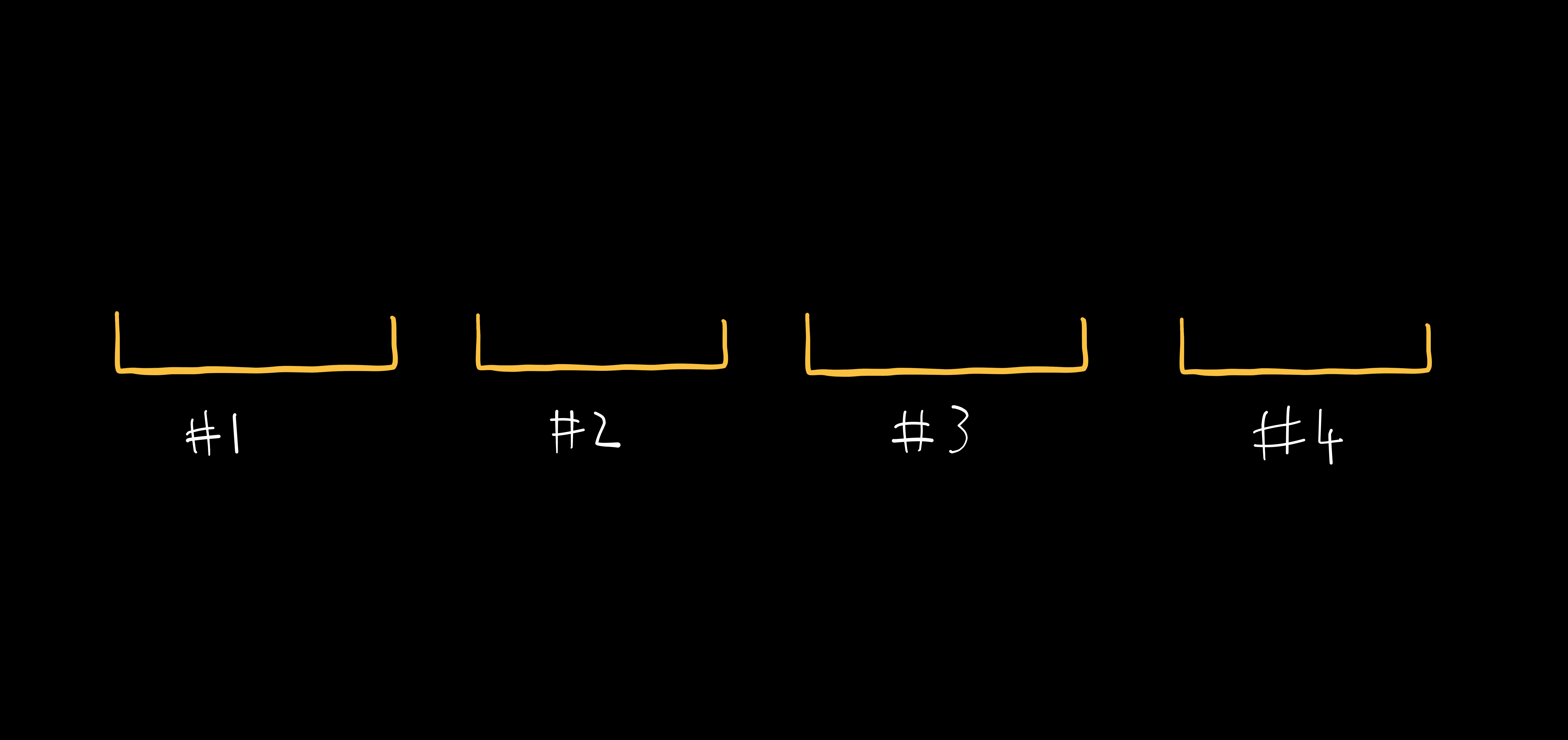
The problem with working memory is that it is limited to four units, or slots.
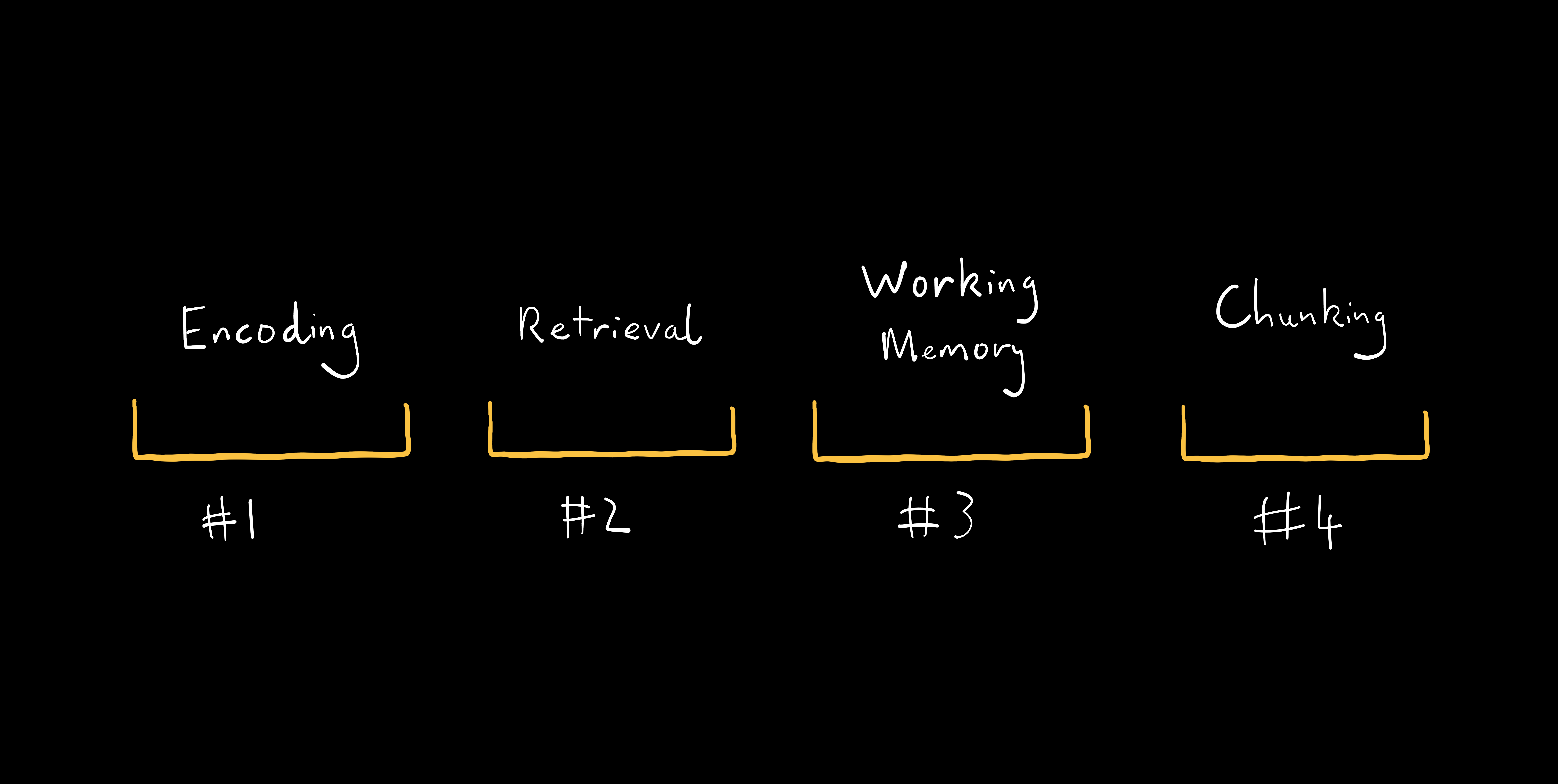
If working memory gets maxed out, you end up learning like most people, who consume for 3 hours straight, do 5 minutes of actual thinking, and retain a fraction’s worth of consumption effort, because their working memory was overloaded the entire time they spent reading.
Each slot can hold 1 unit of information, or one chunk. Which, is a group of units grouped or categorized together, which to your working memory is still one unit.
What working memory looks like when full:
What it looks like when you chunk:
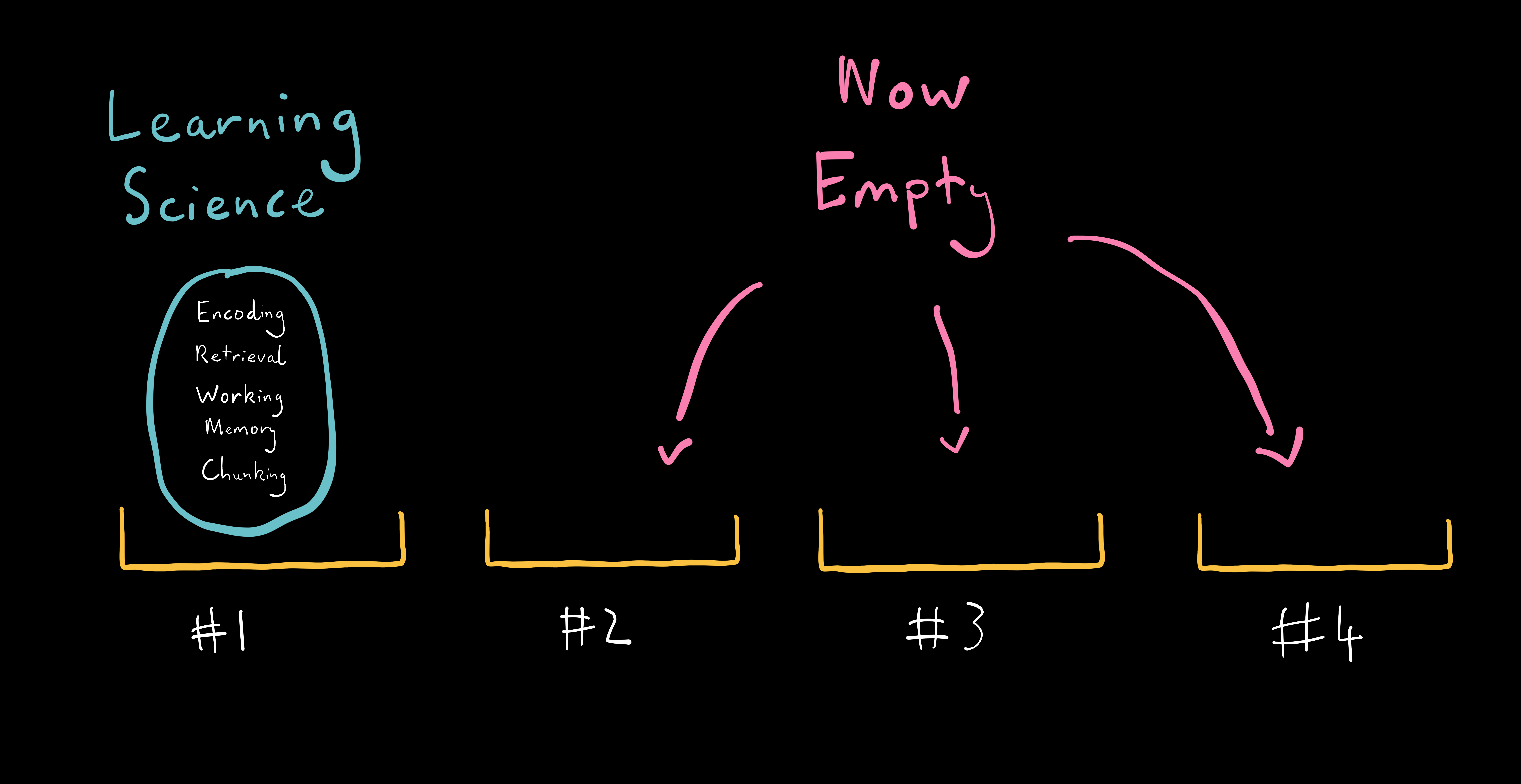
See how it frees up space so you can consume some more? Because you’ve digested what you’ve consumed?
This is the secret to learning at a scary rate, by consuming AND digesting… not just consuming for 3 hours straight, like we’ve said.
I don’t like how people call chunking a memory trick… it is literally how you digest information you have consumed. Since, when you consume information and organize it into categories, you are literally building new knowledge.
Processing raw material into something usable, kinda like the way your stomach doesn’t store food but breaks it down into fuel.
There are three questions to think of when looking to encode anything into retrievable knowledge:
How can I organize this into chunks, groups, or categories? (organizational encoding, what we went over)
How does this connect to what I already know? (elaborative encoding)
Why is this true? (semantic encoding)
Then, spend the first 5-10 minutes of any learning session trying to recall what you covered last time. Explain it, repeat it, teach it. If there’s a gap, that gap is what you need to learn next.
To get good at remembering, then practice remembering.
The gaps in your knowledge are the only learning plan you’ll ever need.
So.
If that is how we turn information into knowledge, this means wisdom is your track record of how often you have used and tested your knowledge against reality.
But we don’t want to just know things.
We want to be perspective builders.
Here’s how to think about what you’ve learned, so you don’t turn yourself into an AI chatbot reciting pure facts.
Skill II - Thinking
You cannot think about an idea you have not encoded into your brain.
It would be like trying to throw a tennis ball that doesn’t exist.
Encoding is the prerequisite of thinking.
But encoding alone does not mean you’ll have a perspective on the new knowledge you’ve built.
There’s a huge difference between someone who summarizes and someone who is a perspective-builder.
I’m not going to talk about critical thinking.
I have never been given a clear definition for that word.
I am instead going to open a doorway, for you, to the levels of abstraction.
It sounds esoteric, I know.
But a level of abstraction is simply a zoom setting on reality.
Let’s say you punched me in the face.
On a physical level, it would hurt my ugly mug, and your hand, due to kinetic energy and colliding bone/tissue.
On a psychological level, you’d probably be angry in some way if you wanted to hit me. And I would be struck with fear and adrenaline, because… you know. Why in the fuck did you just hit me.
On a social level, that is a violent act. If you strike me down and I don’t get back up, you’ve beaten me in a battle for dominance, or perhaps competence. You have physical power over me. What would other people think if they saw you doing that?
On a moral level, is it right to hit somebody? What influenced your choice to hit me, and what influences my choice to either fight back, run away, or simply lie there doing nothing.
Any one of these perspectives are true.
But they’re all true in different ways, and in terms of what they mean.
A skilled thinker holds multiple lenses in their back pocket, like a toolkit for seeing any problem from different angles.
This is how you become a perspective builder.
And this, funnily enough, is how you become a profound writer.
People don’t read your writing for the information you give them. They read your work because of your unique knowledge. Your perspective. Which is forged by consuming information through the lens of your worldview, your unique mind.
To start thinking from different levels of abstraction, right now, think about these two questions:
What principle does this example prove? (moving up a level)
What example proves this principle? (moving down a level)
If you want to go deeper, look up Hayakawa’s Abstraction Ladder, Jordan Peterson’s Maps of Meaning, and Wilber’s Integral Theory. I’ve opened the front door, I’m sticking to my word count limit here, so you have enough agency to explore the rest of the house yourself.
Here’s a prompt you can give Claude to help you study any of them:
I want to learn about [insert framework]. I’m studying the levels of abstraction, and I would like to learn more about this framework, why it matters, and how it relates to [topic you are currently interested in].
Skill III - Writing
The word essay, in French, means to attempt.
When you write a long form post, you are attempting to solve a problem.
Specifically, a problem someone else has already tried solving before.
This is why your writing is less about demonstrating what you know, and more about offering a novel perspective on a problem people care to receive help with.
Everything I write is for my past self.
Selfish, yes.
But I do this because I want my writing to help people who are 1-3 steps behind where I am right now.
1-3 mountains behind me even, if you think of Sisyphus pushing a rock uphill for eternity.
We are all pushing our own rocks.
Some of us are stronger and more experienced than others.
I’ve been told a good few times now that I’m very good at guiding people in my content, and not simply explaining or telling people what to do. Which is something I am still trying to improve.
I don’t want to be at the bottom of the mountain telling you what to do, and I don’t want to be at the summit screaming down at you, telling you to “go here then there then here then…”
I want to be climbing alongside you.
As a writer/creator, you should absolutely be doing this wherever you can.
Being in closer proximity to a problem is oftentimes more important than authority. Sometimes asking the writer making 10k per year is more useful to you than asking the writer making 1 million.
Writing is a test that you understand what you know.
When you write an essay like this one, you have to retrieve what you know and organize it into a persuasive argument.
It reveals gaps you might have missed with the previous two skills. A gap being something you need to think about, so the gap can disappear.
We are now entering the largest epidemic of fake thinking in human history.
Anyone can write a competent, bland piece of writing and sound like an authority on any topic. Because that is what lazy people want. To be seen as knowing things, without showing any proof of having done anything with what they know.
A profound thinker is different. They want to be useful.
I have written one essay per week for the last year. Sometimes two. I only ever try to make them 1% better each week.
And over this past year, my life has changed. For the first time ever, I always feel excited to create, excited to wake up each morning and have two coffees at my desk. I’m building knowledge at a compounding rate, and sharing perspectives I wish I had many moons ago, with as many absolute legends as possible.
Sorry, no way of saying that without sounding arrogant (you can’t say anything online without sounding arrogant).
My point:
Always be a learner, and write things that help, not hurt.
You only need one high-quality long form post each week to start getting attention to your body of work/mission/writing/content/personal brand etc.
Write 2000 words on a validated topic each week (high performing in the last 1-3 months, high views/engagement. I use Eden to help with this)
Offer a perspective in your long form writing that helps a specific person overcome their problem, permanently, if you can.
Repeat each week.
That’s your entire learning/content/self-development system.
An audience is a by-product of high-quality writing that helps people.
Don’t overcomplicate more than simply just helping people.
About that…
Skill IV - Sharing
Everyone I have ever spoken to in person and online wants to be rich.
Not everyone wants to help other people.
Building a personal brand, growing an audience, getting rich… they’re all the same bullshit transformations people offer you in their services or courses, but none of them address the real ‘secret.’
It’s not a secret. I’m just saying that to make my writing sound more persuasive, and therefore engaging, and thus more enjoyable for you to read.
The ‘secret’… takes a lot of effort.
It’s helping people.
Helping people creates trust.
Trust is one of the two currencies you need to become a stand-out creator in the emerging meaning economy (more on that at the end of this essay).
The two currencies:
Trust
Attention
People who chase attention alone go viral. Yes.
But there’s no through-line mission that the attention is being directed toward.
Trust is built through long, slow, dense writing that helps.
Unfortunately, not as well through the type of short-form content you can swipe through in seconds.
Social media is a two-player game.
You need to know how to grab attention, because nobody is actively searching for you in the beginning. 95% of people online scroll with zero search intent. So you need to understand how to grab attention before converting that attention into interest in what you are trying to share - with your long-form writing (or content, if you want the boring word for it).
Traffic is people.
Every view is a real person clicking on your Substack or your YouTube or your landing page.
Teach as if you are guiding a real person 1-3 steps behind you. That’s why I love including examples and walkthroughs in most of my writing now.
It’s proof that I can and have done this alongside you, which creates trust.
The process:
Grab attention on a validated topic (use Eden)
Give the reader a beneficial reason to act on your ideas
Make a promise at the start of your post and keep it
Fulfil that promise with a unique perspective and actionable steps they can follow
Think of writing/content as helping someone stuck on the mountain you were stuck at 1-3 mountains ago.
A Sisyphus who failed ten times trying to push a 100kg rock up the Himalayas before succeeding, and then helping guide other Sisyphus’ do the same on their first and second attempts.
Do this for 6-12 months and your writing will get better, which means your thinking will too, and so will your learning.
This full loop, now, of the four skills we have gone over, will teach you more than most 4-year degrees in 4 months of daily needle moving work.
A meaning economy is (finally) emerging
I’m starting to notice something, and it’s been happening for a while now.
The creators at the forefront of it won’t be called content creators, influencers, and it definitely won’t be the founder/corporate personal brands.
They’ll be just… people.
People who think about problems on a deeper level than most are willing to explore.
Who share what they think about those problems, in public.
As if philosophy and utility were fused together.
I’m calling these people who merge philosophy and utility, profound thinkers.
I think the meaning economy will reward those who turn genuine understanding into genuine value for other people, for free, consistently, online.
And I think those same people will also make the most money.
I’m not a millionaire, and I’m still labelling myself as a learner, not an expert.
I’ve only made 10k from writing online with my 2 digital products (which you can check out here) and my exclusive paid guides on my Substack (which you can also check out by clicking subscribe).
Time will tell, like it always does.
But I’ll continue to keep being a learning, and learning about all this in public, and I’ll share everything that has (and hasn’t) worked for me in this journey toward becoming what I think will matter most in the next 3-5 years down.
A profound thinker.
I appreciate your time and attention, I hope I gave you some value in exchange for both.
You’re an absolute legend.
- Craig :)
Read on from here:


How to do Research for Long Form (Essays, Newsletters, Articles etc.)

A profound thinker is someone building unique knowledge and looking for ways to share it.
I like the idea of writing as proof of thinking, not performance of authority. The “1-3 steps behind you” frame is useful too. It keeps the writer close enough to the problem to be helpful, without pretending to be standing on a mountain with a megaphone.
Another week of feeling intellectually fulfilled! Keep up the good work!