


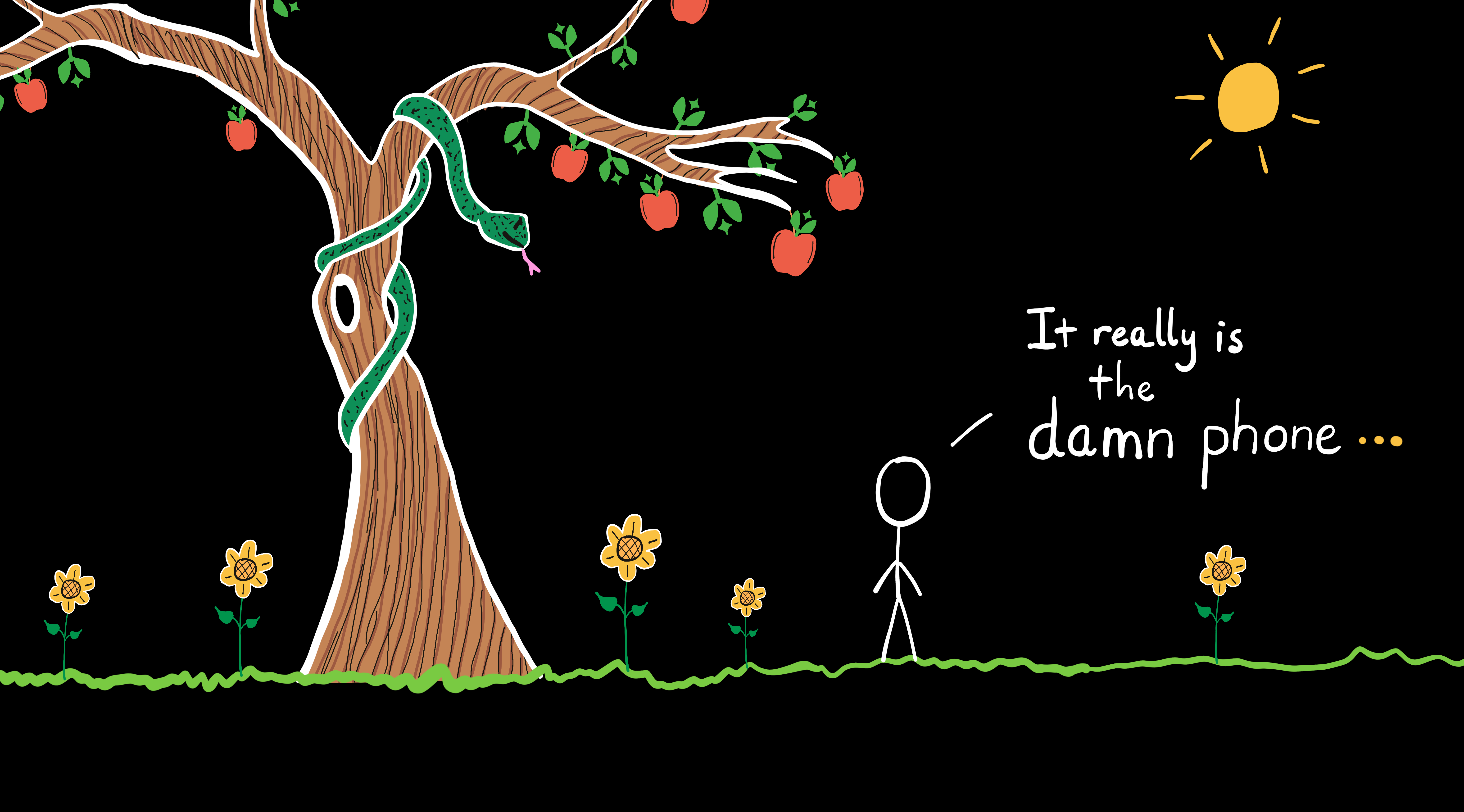
On a random day your life will end.
With half-finished books and essays.
Ideas and plans you kept delaying till next Monday.
And thank god you spent it scrolling.
Real life is lived offline.
Which means every time you decide to scroll, you decide not to live your life.
There has never been a larger generation of completely miscalibrated brains.
The root cause is what you are likely reading this on.
The smartphone.
A piece of technology carefully engineered by the world’s best scientists.
To get you addicted, so corporations can monetize that addiction.
Cheap dopamine has raised the floor of what feels stimulating.
More people genuinely feel more (fake) satisfaction from scrolling, than actually going out and living their lives.
Video games on my Xbox 360 were more interesting to me than the real games life had to offer when I was a child. I had a huge back-garden. The Irish summers were stone splitting, but I stayed inside chatting with my friends online instead of going out and adventuring with them.
I chose to escape my childhood over living my childhood.
Your own thoughts now register as boring.
Which means your own life registers to you as boring.
You can’t enjoy sitting in silence.
You don’t feel the electricity of watching a pink and yellow sunset, or hearing spring birds chirp.
I want you to carefully hear what I am about to say.
This letter is about returning to yourself.
To who you truly are.
Before an algorithm wiped it all away, and melted your mind to mush.
You knew how to live once.
You did as a child.
Your childhood interests were trying to tell you something.
They still are.
This is how to get back to living with that childlike sense of wonder you once had.
Waking up full of fire, excited to create and build something.
To let your curiosity determine your day’s plans.
To focus for hours on end, like time and attention didn’t exist. Like both were unlimited.
There is one thing you need to think about before we desensitize your brain, and then re-sensitize it with newfound sources of wonder and meaningful satisfaction.
This is a beast of an essay. I’d recommend watching the video version, or listening to it (while on multiple walks) on my Spotify, here:
How to read this letter
This is a serious piece of writing for serious people.
This is not fast content.
I try to make every one of my letters, essays, long form pieces of writing, whatever you want to call them, slow.
You need to think about them.
Profound ideas need a profound amount of thinking.
I am not here to bullshit you in exchange for your attention.
I never try to.
I have your attention right now.
I can give you my unique knowledge from my bedroom.
I am still doing the same things as the corporations. Social media can be great for this reason, there are still pros and cons to all things in life.
But I want your attention in hopes that you will think about what I have to say so you can benefit from these profound ideas.
So, to those people who comment at the bottom of my YouTube videos, and other people’s videos, too, you are hells-deep in this problem.
You want the actionable steps right away so you can get your dopamine hit for watching “valuable content,” and feeling productive, without doing anything on your part that actually makes the content itself valuable.
Which is thinking.
You have to think about the “why,” the philosophy, the unique knowledge I am giving you, before you jump straight to the “how”, the actionable steps, the frameworks.
If not, nothing is going to work for you.
Maybe in the short term, but not in the long run.
Because you don’t have the knowledge yourself to guide your actions when context comes into play. Tricky scenarios, your distinct lifestyle and responsibilities.
That is why most people who try to adopt rigid plans, fail... because the plans are rigid.
Context is everything. And deliberate thinking about the general principles that inform action and behaviour change, are what make them adaptable to your life, your brain, your needs and problems, and your context.
Thinking must come before behaviour change, which is the ultimate goal of everything I write (for you absolute legends).
I want to give you something that helps, not hurts.
Something dense. Something heavy, that requires you to mine at it to unearth the diamonds at its core.
Not something you can skip thinking about, and jump straight to the action steps or use AI to summarize.
If I can get you to spend 10 minutes of deliberate thinking about this on a walk today, I can sleep well tonight.
You have no good reason to trust me saying that, but I am asking you to.
Because if you are not willing to think about this, don’t bother reading it.
Come back when you are ready.
If not, you are doomscrolling this letter.
It might be smart to bookmark this and come back to it across multiple readings. We’ve a pretty big epidemic to start untangling with just a single letter :)
You need to empty your mind before you can rebuild it.
Remove the junk, change the oil, fast yourself to hard reset the system. So you can begin feeling what real interest, curiosity, and awe used to feel like when you were younger, and your brain was sharper.
And I’m not going to kid you.
This is going to be hard.
Prepare yourself.
Phase I: The Desensitization Phase
Your brain did not rot itself into an overstimulation-induced rut overnight.
The quickest way to get yourself out of a rut is to spend 2-4 hours, maybe more, 1-3 days even, doing nothing. No music. No phone. Zero stimulation. It sounds long, but considering most people haven’t spent 30 minutes feeling bored in over 2 years, this is the quickest way to feel that childlike sense of wonder again.
First, we desensitize before we re-sensitize.
Here are your first 4 tools.
Tool I - Do sweet nothing
The brain has something called the default mode network.
Your brain goes into this mode of thinking when you don’t have a task to be doing.
You are not doing any sort of work, pretty much.
You’re not scrolling, listening to music, writing or reading a book, even.
Nothing.
Your brain hates doing nothing.
Which shouldn’t surprise you.
Why do we scroll at every damn line we stand in?
Why do we scroll first thing in the morning and last thing at night?
The default mode network plays a vital role in cognitive processing. Emotions, information, random shower thoughts that reveal an profound idea/insight... even though you weren’t really thinking? At least it feels that way. That is why this DMN is so cool.
This is also why boredom is the condition your brain needs in order to reset itself.
You need boredom to feel interest again. You need boredom to feel curiosity once more. If not, you are jumping straight to a quick dopamine fix from scrolling because boredom is hard, but that is exactly what makes it rewarding.
No pain no gain for this tool I’m afraid.
I did this for the first time myself while in work. I work at a bowling alley, behind the bowling lanes on my own. I used to do 3x 12 hour shifts per week, and during those shifts I would walk behind the lanes for 4-6 hours straight and just stare at the walls.
After that amount of time, I would find myself becoming completely desensitized. Like completely. Then, I would find myself being capable of writing for 3-5 hours straight, and feel my mind connecting ideas faster than I could make sense of.
Your brain is always working, even when you give it space to breathe.
Yes, most people have not given their brains this space to breathe in years.
These action steps are going to signal the start of your journey into becoming human once again. They’re hard, but they’re everything:
Turn your phone onto airplane mode before you go to sleep tonight
Wake up, and do not sensitize yourself with anything for at least four hours
No music, scrolling, messages, emails, podcasts
You can read paperback books, write in a notebook by hand, go on a walk, or stare at a wall
No tasks, too. This is a morning for emptying your mind.
If you’re working tomorrow morning, great. No music while commuting, no phone for socials, and on your lunch break, eat food without entertainment. You can talk to someone, or stare at the wall. That’s it.
Tool II - Walk with zero stimulation
Last week I spent 3 hours on a Friday evening walking around my garden.
The Irish weather has decided to be nice this past week, so I used it to my advantage. You will notice with this tool, and all of the tools in this desensitization phase, that the loops in your mind will eventually close.
They will shut off.
Like you’re having 1000 mental emails coming at you every second... until eventually they just stop.
Your mind will feel less chaotic. Like you’ve been screaming at yourself for years, and your mind has finally processed everything it has needed to process.
And then this will happen.
You will start feeling curious again. Interest will start speaking to you. Your own thoughts will begin resurfacing. Carry a notebook around with you when this happens.. And please write down what comes to mind, which will be your first creation, so literally just your thoughts written down.
Do this:
Go on a walk
20 minutes minimum, each, but do longer if you can
Go to a park, on a nice sunny day if possible, and do it all in silence
Walk, walk, walk. 20 minutes in the morning, afternoon, and evening is great for circadian health, which regulates your nervous system, and therefore your emotions.
Tool III - Study physics
Real life is lived offline, and offline means the physical world.
Not a digital world you can’t even physically move around.
The problems worth solving are the ones within your general vicinity.
Messy room. No routine. No goals for the next month, not even the next week.
This profound idea really annoys me, especially when I used to think like this, but your life is in utter chaos, and yet you’ll find no issue in giving out about world’s problems when your own life is being neglected.
Make sure you yourself is in good order, before you try enforcing order in anyone, or anywhere else.
I realized this on one of my garden walks. If you threw all the screens and tech away, you wouldn’t know half of the problems going on online. And how little influence you truly have over them.
Really, I am talking about the people getting furious on Twitter/X over the most pointless shit, that has no real effect on anything in your life... other than making you feel pissed.
Those problems would still exist, yes. And the world would still be turning... and you’d be fine.
Some poor, phoneless fool is probably sitting next to a waterfall somewhere totally unaware of how angry and scared he’s supposed to be - Duncan Trussell
...you’d be better than fine, actually.
For you to do:
Organize your room, your desk, and/or your immediate environment
Build a basic routine for the week. Just a loose, non-rigid structure
Write down your goals for the next month. Or the week, and no more.
Identify one problem in your immediate life you have been ignoring. You have one hour to solve it.
Tool IV - No screens one hour before sleep
Your brain is hardwired to wake up and go to sleep with the sun.
Crazy, right?
The blue light that screens emit, it suppresses melatonin.
Melatonin is the hormone that regulates your sleep.
Blue light disrupts your circadian rhythm by up to 3 hours. And its effects last 4 hours after you put the phone down. By scrolling on Instagram immediately before you nod off to sleep, you are chemically disrupting your mood, energy, and mental clarity every single night.
I followed a strict no-screens-before-sleep routine for almost a year in 6th year at 18.
I felt more energized than I ever had. Enough to go from lifting 3 days a week to 5. I was less anxious. I wasn’t exhausted sitting in a classroom for 8 hours a day.
School is a prison, yessir.
But I was making it harder on myself than it needed to be.
Do this:
No screens one hour before sleep
In bed, lights off, between 10:30-11pm
Wake up at the same time every morning (8am latest)
Do this for 2 weeks without exception
These 4 tools are for clearing as much noise from your brain as possible.
Once the noise has been cleared, you do have to replace it with better sources of nutrients. If not, you’ll go back to doomscrolling with 4 days.
How to consume, but properly, is our Phase II.
I went on a cliff walk around the Irish coastline with my girlfriend the other week. She said something about that walk that absolutely fucking floored me:
I don’t like silence. What I like is the absence of noise.
She was talking about how quiet it was, yes.
But she was really talking about how her mind was quiet. We hadn’t touched our phones all morning. Then we went on a walk. Just the two of us. We talked about our week. Our goals together for the next 2 years.
Most people don’t like doing anything in silence because their minds aren’t silent.
And if you want the loops in your mind to close, if you want the mental emails to stop flooding in, you have to sit in silence for your mind to eventually go silent.
Phase I gives you that absence of noise.
Now let’s talk about what (actually) deserves to fill your brain.
Phase II: Consume (properly)
If I see this idea one more time I’m going to scream.
You need to create instead of consuming.
Do. Not. Get. Me. Wrong.
This idea is correct.
But it’s a paradox.
You cannot tell people to stop consuming what other people have created, and expect them to consume what you create.
Also.
Thinking is a collaborative process, in which a person provides a novel perspective with regards to something that has already been said.
Think of any philosopher you can think of.
Nietzsche, for example.
They devoured the works of every other philosopher they could find before writing about their own.
All your favorite artists have their favorite artists.
Chino Moreno from Deftones loves Prince. Ben Burnley from Breaking Benjamin says Deftones, Nirvana, and Alice Chains were massive influences for the band. Linkin Park... also Deftones, and Nirvana.
Originality is saying something that genuinely advances a conversation.
There are many ways of doing this.
And all of them require consuming other people’s creations first and foremost.
You need to create something that dense, slow, that helps. And you need to stop consuming content that is fast, hollow, and hurts.
Fast content is designed to grab attention and give you nothing life-changing in exchange for that attention. Slow content is purposefully designed to change how you think, and thus change your life.
You know you’re sick of it already.
The silly dances.
The AI voice-overs.
Fast content is numbing. It will do nothing but distract you on a Wednesday evening in the attempt to make it to the weekend.
I think you need to consume far less information every single day.
I also think you need to consume better sources of information every single day.
I present to you, Phase II.
Tool V - Do not delete social media, curate it
If it wasn’t for social media, I wouldn’t have this newsletter, I wouldn’t be closing in on having made my first €10k from writing online, and I wouldn’t have put 25+ hours into this single post.
You don’t want to be avoiding social media.
I did it when I was younger, and it was great. I had more free time, but I had no other way of contacting my friends. I fell out of touch with a lot of them, which I eventually rekindled.
Deleting social media is easy avoidance. The real mastery, however, over socials, is curation.
By curation, I mean becoming the editor of where your attention goes.
Follow 2-4 accounts of creators that post content that is slow, that helps, that requires you to think
Do not consume anything, other than from these 2-4 accounts
Unfollow creators who make fast content. Content that does not get you thinking. It only distracts you from making any change to your life, and benefits anyone but yourself.
That third step might sound harsh, but I think it’s necessary.
My girlfriend showed me a TikTok post the other day... and hell. It was a complete waste of 60 seconds of my life. Just a stupid attention grabbing post that gave me no value in terms of making any sort of change to my life.
People are starting to get fed up with this type of content.
If that’s you, curate your feed intentionally.
If not, an algorithm will do it for you.
Tool VI - Read paperback books slower than a sloth
Books are linear.
They demand that you follow a thought all the way to its end, line by line, piecing together each logical idea through contemplative thinking.
Thinking is a muscle. As is, the ability to focus.
Here’s a profound idea I can’t stop thinking about recently.
You do not read just to consume information.
You read to think.
You read to build new perspectives.
I am currently reading The Penguin Book of Existentialist Philosophy. It has completely changed how I think about perspectives. Also, how I see the world through multiple lenses simultaneously, and how I think about existential problems.
I worry about my health sometimes.
Microplastics. How I eat a lot of Chipotle sauce. How Cadbury’s chocolate is no longer legally called chocolate.
The fragility of all of it.
I love writing. I want to spend every morning for the rest of my life doing this. And sometimes I feel scared thinking about how it could all be lost on a random Tuesday while I’m sipping on a coffee... or scrolling instead of writing.
But it’s that fear.
That fear is what precedes gratitude.
I get to do this. To learn. To write. To walk and think all day instead of scrolling. And then I get to share what I create as a result of those things, to you. To people who might not have the time or ability to do those things themselves.
I wouldn’t have created this new perspective if I hadn’t have built upon what these profound thinkers said in the past.
First, a Substack note from a fellow Irishman Dylan O’Sullivan, who I admire very much:
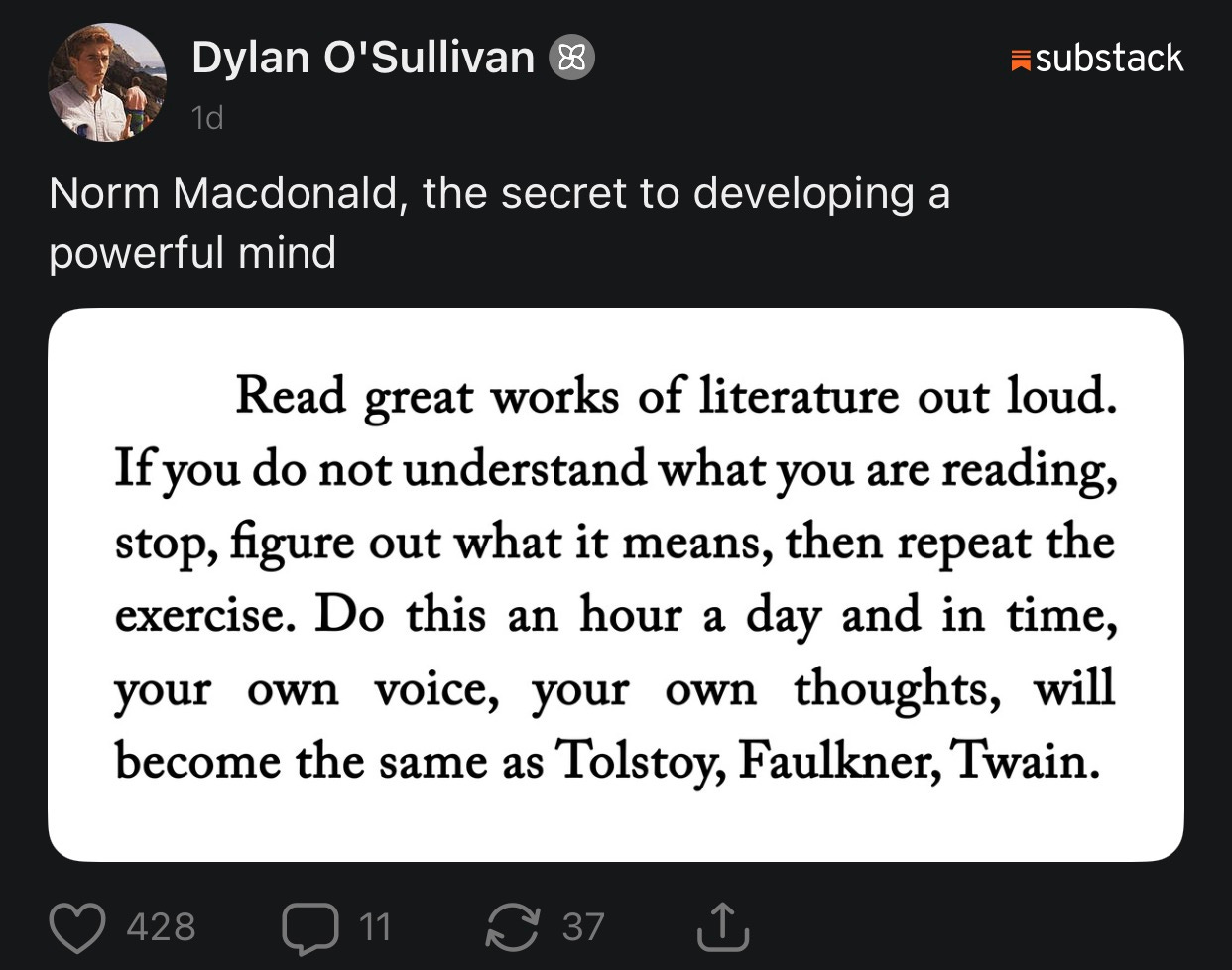
Second, your action steps:
Buy one physical book. Something you actually want to read, and not something you “think” you should
No phone in the same room while reading
Read slowly. Stop when something hits you, and sit on it.
I have a number of learning strategies you can read here, to teach you how to improve your encoding and retrieval skills for faster knowledge acquisition.
My Guide To Profound Reading gives you a complete reading framework and two bookmarks full of printed questions to think about while you read, to help you master the reading process with a simple questioning framework right away.
Tool VII - How to build a curation system
The problem I have with second brains like Obsidian and Notion is treating them as storage units. Storing tons of information you’re never going to revisit.
I prefer using them as a creative workspace.
I’m storing very little information and notes, if at all, because what is worth storing, I am building as knowledge inside my brain.
This is a creative workspace, not for storing things I might use in the future. If I need it, I’ll go find it or I’ll use my own brain. If not, I’m keeping this as minimal as I can.
I’ve been working with Dan Koe and the legends over at Eden for a good few weeks now.
I am not being paid to say this.
There’s no affiliate link or sponsorships here (I don’t agree with selling my audience’s trust away).
I am saying this because I genuinely love using Eden.
And I think you will too, if you’re a writer or creative like me looking to write slow content.
I write slow content. Dan writes slow content. Eden is the best place to start if you want to do the same.
I have been using since it was Kortex, everyday, for more than 3 years now. Which is nuts. I recommend it to everyone I know. And I have been recommending it inside my own newsletters for the last year now.
You can get 50% off your first month throughout launch (it started this week).
Download it here, and build your curation system alongside me.
So I’d like to show you what my current Eden set-up looks like, and how you can go about making something similar yourself.
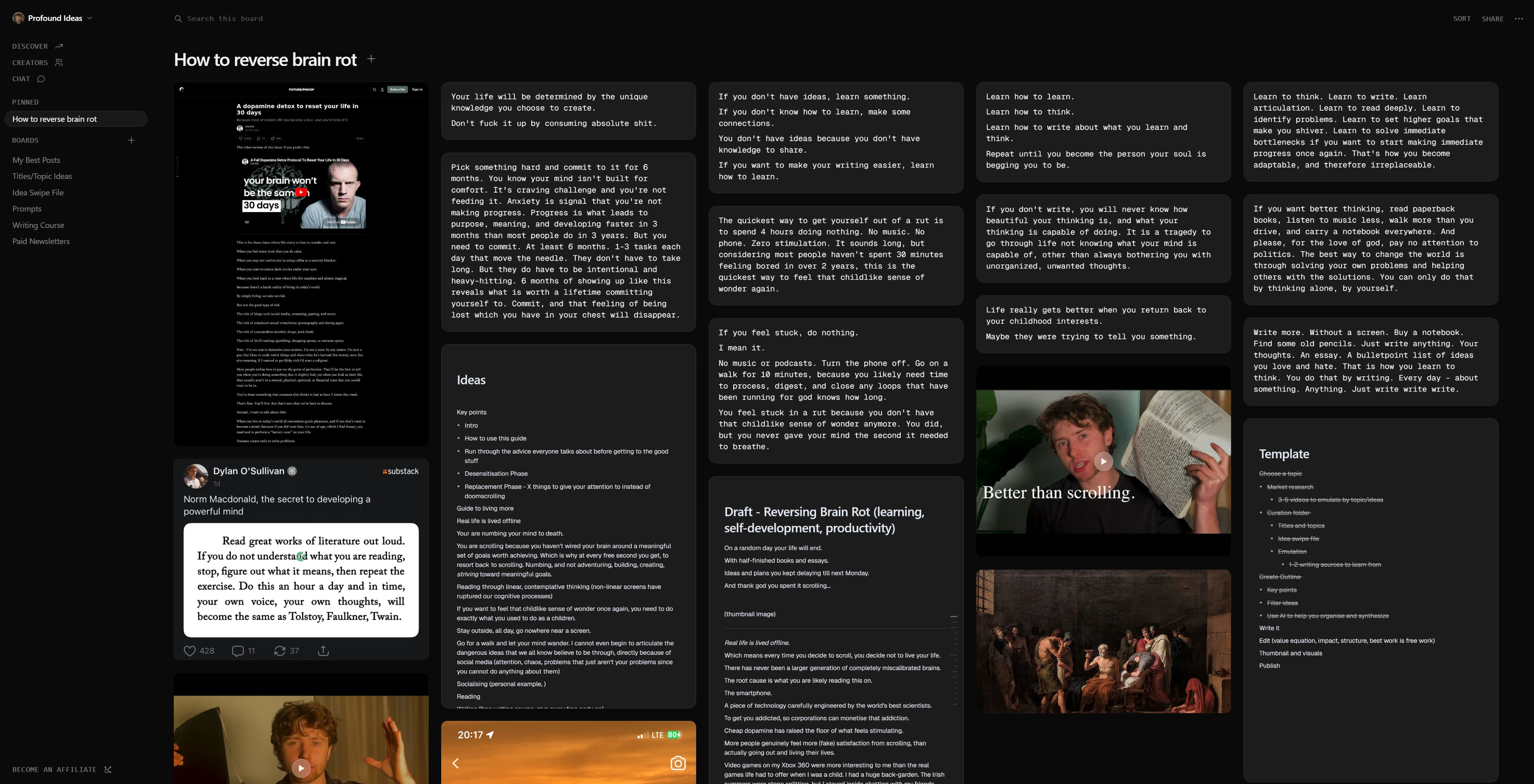
This is how my Eden setup looks currently. I’m still in the process of setting it up, but this is really all you need.
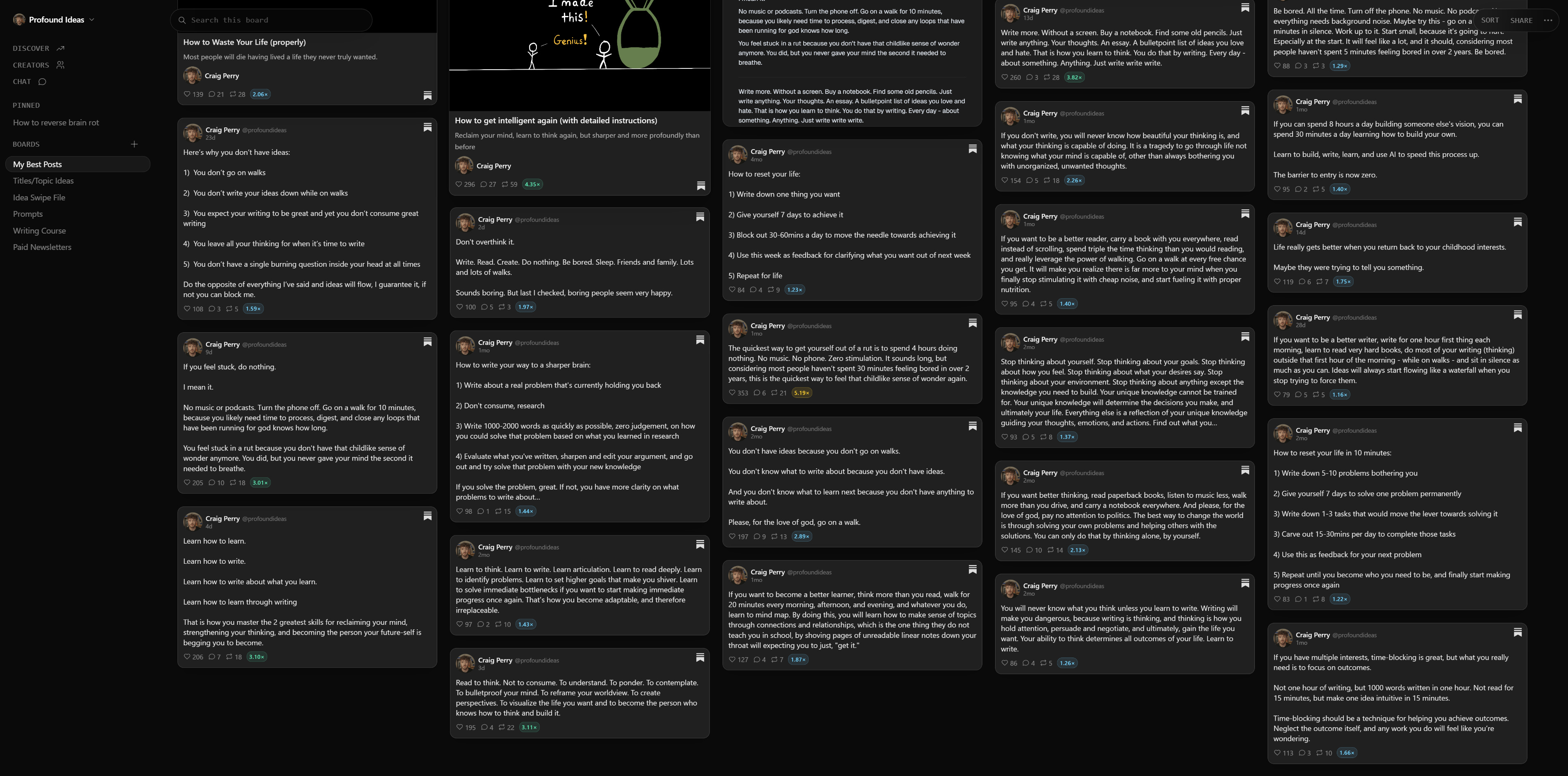
I have my best newsletters and Substack notes here so I can organize them into one place, that I can use to think about why the writing/ideas did so well, and what the highest-performing ideas are which you guys are resonating with, so I can give you more of what you want.
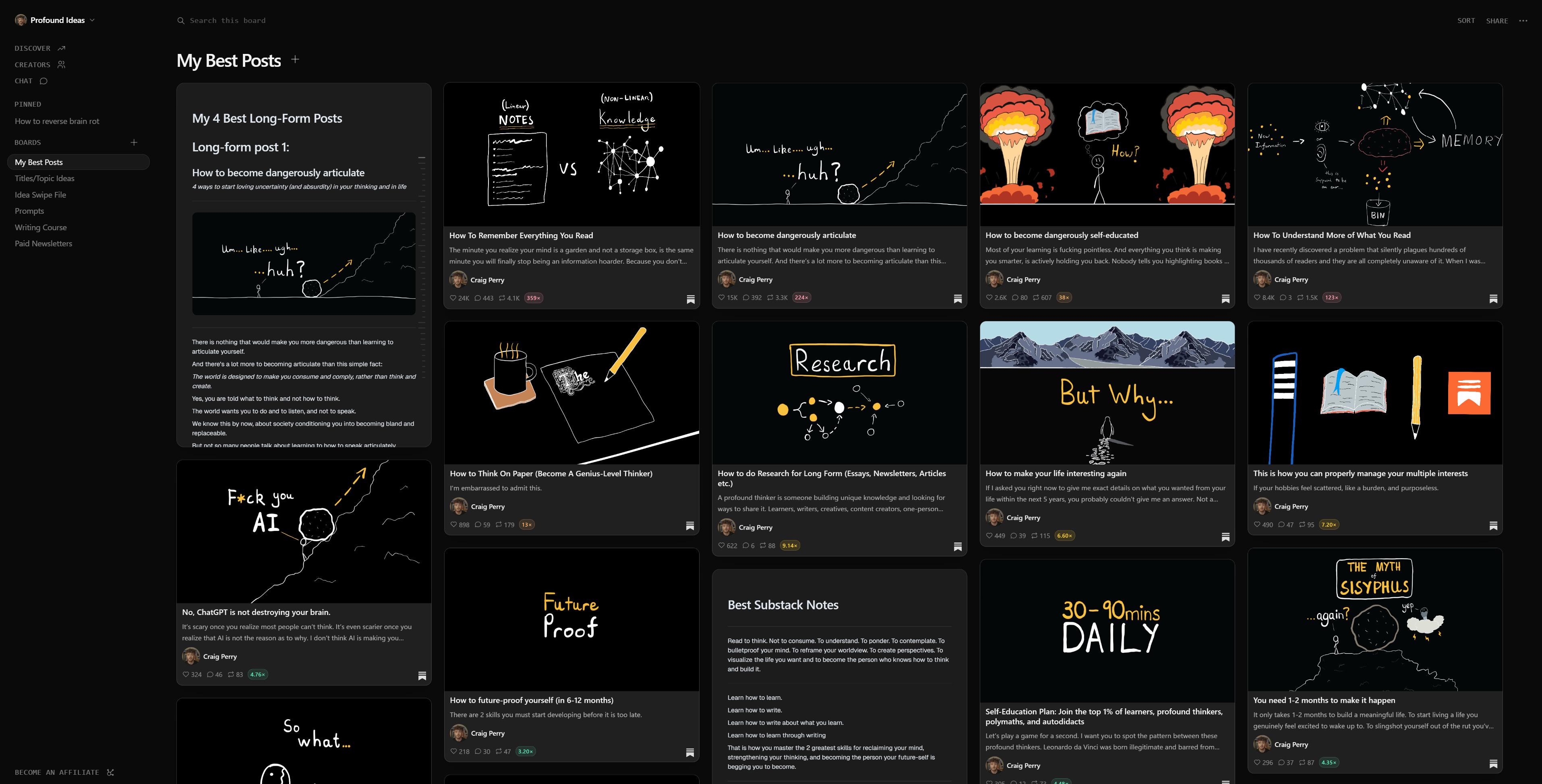
I like to screenshot validated titles and ideas while I’m scrolling. Or anything I think might be worth writing about, or including in my writing in the future.
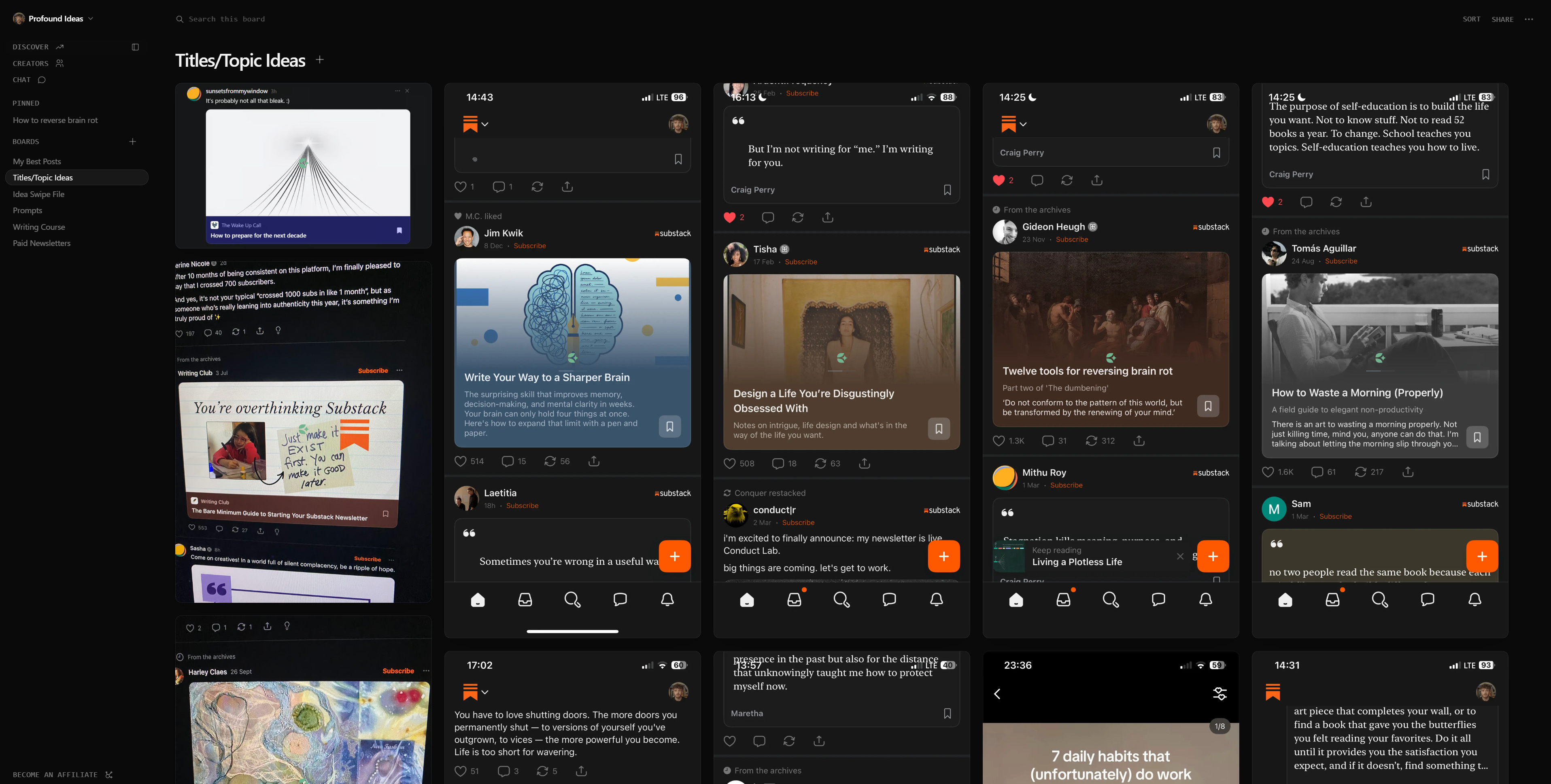
This is why I still recommend scrolling with the eyes of a creator, not a consumer.
You’re looking for ways to merge validation and interest.
Pay attention, this is important.
Topics that have the potential to get lots of attention because they are validated (high views/engagement), and then interest, in terms of me being able to talk about my own interests and provide a novel perspective beneath the validated topic.
This is the secret to writing about any of your own profound ideas you want to talk about online, and do well.
No, you do not need to talk about personal branding or audience growth in order to grow an audience... but only if you listen to what I am telling you. I am the proof that this works.
Eden also has a pretty cool discover search feature where you can look at top-performing posts, to give you some profound ideas to think about addressing in your own content.
You can filter by platform (which is vital, since content now, I believe, is very much platform specific).
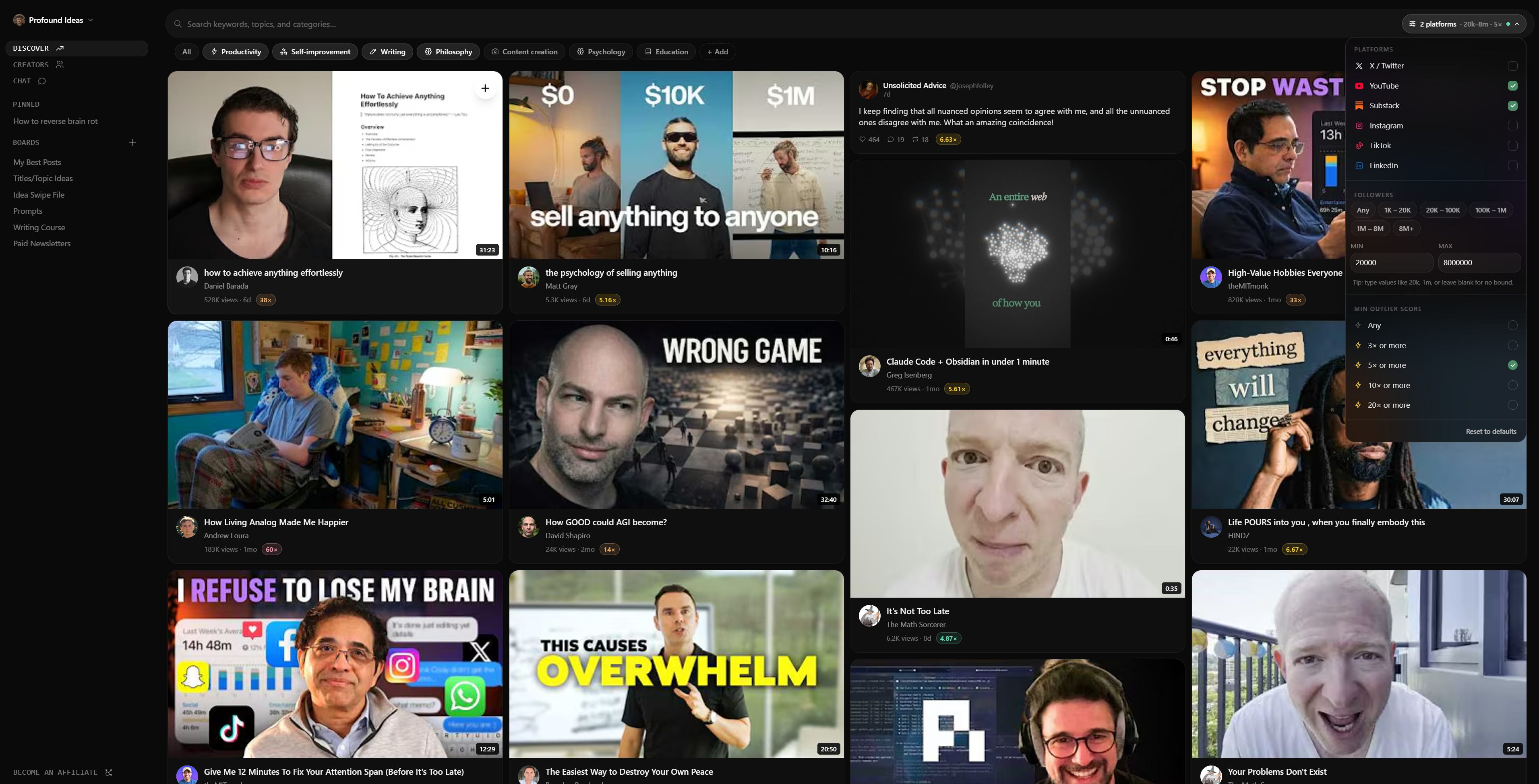
This is where the Deftones/Nietzsche idea from earlier comes in.
Find what is already working. Understand why it works. Then say something only you could say beneath that validated idea/topic/title/problem.
If you’re a creator and you disagree, I did in the beginning, it is vital to understand that the writing (content) game is a two player game.
In order for me to talk about my own interests and ideas, I need your attention first.
For you to care about what I have to say, I need to turn that attention into interest.
That’s where broad, general, validated topics come in, as does learning how to write with impact, how to write with a framework (problem → solution), how to be persuasive, and how to give readers a good “why” for being here.
No, that is not selling out. How could it be?
That’s marketing and sales.
Forget about everything you know about those two dirty words. They’re not actually dirty words.
Just think about them as this instead:
The skill of attracting attention (marketing)
The skill of persuasion (sales)
Writing and thinking is how you communicate the value in your unique mind.
You need both skills of attracting attention and persuasion to grow an audience and start getting people to care about your ideas, your writing, your body of work. Or your content, if you want the boring word for it.
Dan wrote about this exact idea in his newsletter this week. He used my own newsletter as his first example. You can check it out here if want to go deeper on the mechanics of it.
At the minute I’ve been listening to only 4 creators.
Sisyphus55
Jared Henderson
Mr. Koe
Man Carrying Thing
Creators swap out from time to time, I like Alex Hormozi and Caleb Ralston a lot, Academy of Ideas too.
Because if you’re doing any more than that you’re spreading yourself too thin. You want to think about what these creators are saying and then try act on their ideas. If not you are doomscrolling. You are not trying to integrate what they have to say into your life.
In terms of AI use, I’ve never been using it this little. I have very few prompts I use now. I like to limit my chat responses to 80 words or less, because I want to think about them. I spent one hour last week thinking about 3 Claude responses. They were 30 words each...
The centaur is always stronger than the machine alone.
How you curate will determine what you create, and whether it will be saying anything worth hearing or not.
Phase III: Create (properly)
When I started this phase myself a few weeks ago, my brain literally felt denser. I could feel the front of my brain contract while I was reading, almost like I had a pump in my prefrontal cortex.
It was absurd. Now I look cross while reading. Scrunching my eyebrows is the by-product of this brain pump, it seems.
Nature abhors a vacuum.
So does your brain.
If you clear the noise without replacing it with something meaningful, you will go back to numbing yourself with meaningless distraction within a week.
I don’t want you think of this as filling your time. It still is. Really, I want you to think of this as rehabilitation.
Creating is how you restrengthen the cognitive muscles inside the mental gym.
Tool VIII - Write without a screen
Human beings are designed to create. That is why you feel anxious and depressed when all you do is consume.
Writing is how you organize, stress-test, and structure your thinking into a single argument.
Writing is a generative process.
It is a digestive process, too, because how else do you generate proof that you have fully digested an idea, a solution to a problem, a topic, or a chapter?
This newsletter is a vessel for my own ideas. I recommend it to everyone I know to start a personal brand, learn to persuade and attract attention, and then create some solutions to problems. Some essays. Some arguments.
Become a perspective builder, and keep building perspectives to offer people based on their problems. Even your own (I write these to my past/present/future self, basically).
My friends keep telling me the difference they’ve spotted in my articulation, and my thinking too, which is hard for me to see. But it’s relevant feedback that a personal brand, writing long-form, building a meaningful body of work, you can call it content if you want to. What this will do for your thinking and learning. It’s the ultimate vessel for self-development.
You do not know what you think until you have written it down.
If you don’t write, you will never know how profound your thinking is, or what it is truly capable of doing.
I think it’s a tragedy to go through life not knowing what your mind can do, other than bother you with disorganized, unwanted thoughts.
Do this:
Buy a notebook. It’s cheaper than a Starbucks coffee.
Write anything. Your thoughts. An idea. Something that bothered you today.
Ten minutes. No filter. Don’t read it back until after you have finished writing.
If you feel stuck, write about why you feel stuck. That is enough. Just. Write. Anything.
Download my free long-form writing course that will give everything you need to start writing long-form like I do (essays, articles, newsletters etc.)
I also have the writing strategies I use personally right here on my Substack.
Tool IX - Learn to think profoundly
Having thoughts is not the same as thinking.
Everyone has thoughts.
Thinking is the deliberate reorganization of thoughts.
Most people have never been taught how to think, since school taught you how to remember and not how to reason.
Here is one of the most useful things I have ever learned.
When something upsets you, write about it. Or better, mind map it.
The key words, terms, or concepts, and organize them into groups and chunks on a page. This is a form of neurological recoding of memory.
Writing about a difficult experience reorganizes how your brain stores it, which changes how it affects you going forward. Because if you write about it, you can then see it, process it, strip away the emotion attached to that memory, and be done thinking about it.
The amygdala in your brain is what processes emotion. The hippocampus, is what facilitates (1) learning and (2) memory. And the thing about these two part of your brain, is that they are right beside each other, which means they influence one another.
There’s a reason for this.
Emotion is the primary driver of how strongly a memory gets stored. When something upsets you, the amygdala tags it as threatening and the hippocampus stores it as a quote-unquote “sensitive topic,” which is what most people call it generally.
That is why old, upsetting memories keep bothering you of their own accord, and you have no idea as to why.
Writing about it forces the prefrontal cortex, so, your reasoning brain, to engage with these memories voluntarily, of your own accord. It literally pulls the memory out of the emotional brain and into the thinking brain.
That is how you can strip away the emotion by acknowledging it, and letting the loop finally close.
In terms of how to process emotions - I learned this from Dr. K, credit where credit is due, he’s an absolute legend - ask two questions:
What is this emotion telling me (emotions are sources of information)
What is this emotion wanting me to do (emotions are sources of motivation/behaviour)
A profound idea to finish off this section:
Pay no attention to politics. The best way to change the world is to solve your own problems and help others with the solutions. You can only do that by thinking alone, by yourself, about things within your realm of control.
Do this:
When you feel reactive (angry, anxious, stuck) write it out before you post about it, talk about it, or act on it. Ask yourself: what is this emotion telling me? What is it wanting me to do?
Carry a notebook everywhere. Be ready to write, mind map, and process at any moment. I’ve found as little as 30 seconds of mind mapping each morning makes a massive difference in terms of less overthinking, anxiety, and increased mental clarity. 15 minutes is incredibly transformative, but it’s not easy either.
Read great works of literature out loud. Stop when you don’t understand something. Figure it out. Continue. And in time, your own thinking will begin to sound like the people you have spent time reading. Which means you will literally become a whole new person, and that’s not something to gloss over.
Tool X - Build something for six months
You don’t feel lost because your life is meaningless.
You feel lost because you don’t have a quest.
You don’t have a quest because you are playing someone else’s game.
You’re letting your phone determine who you are, what you think about, and what games you end up choosing to play.
Anxiety is the signal that you are not making progress.
You will never know what you want from your life in some perfect explanation. You might never. I still feel like I don’t know what I’m doing with this writing thing half the time. But I do know what I want to avoid doing, which is my version of hell. I’m not religious, I just think it’s an interesting frame to view this from.
This is what hell is to me. Not writing every day. Never writing essays like this one. Not thinking, or having nutritious food for my mind to consume, digest, and perform with.
Sometimes knowing what life you do not want, is all the clarity you will ever need. So stop waiting for the perfect plan, and start doing something, literally anything, to avoid the plans you do not wish to be following.
Pick something hard, something that makes you slightly uncomfortable to say out loud, and commit to it for six months.
Six months of showing up. Doing 1-3 intentional tasks a day reveals whether something is worth a lifetime of commitment. 15-60 minutes for each task.
Doing this will develop your skills faster in three months than most people do in three years... with a college degree, to give them one more financial problem on top of every other problem they keep ignoring, to focus on the degree.
Direction is far more powerful than how hard you work.
This is why you need to give yourself a daily project (one goal, 1-3 tasks daily to move toward it):
Your reading becomes purposeful: you read toward it
Your walks become generative: your brain works on it while you move
Your writing becomes useful: you think through it on the page
Your steps:
Write down the one thing you have been circling for the last year
Brain dump everything that comes to mind about it onto one page
Do not start building yet. Get it out of your head first.
One to three tasks a day, minimum. Show up for six months.
Tool XI - Talk to people... but actually
The algorithm has put you in an echo chamber so convincing you don’t even notice the walls.
You see more of what you like and engage with online.
I shouldn’t need to explain how dangerous this can be.
Real conversation, yes, that means in person, unrecorded, and unedited, is the last remaining space where your thinking gets genuinely challenged.
And therefore genuinely developed.
Social media is a simulation of connection so convincing that your brain accepts it as the real thing... while the real thing quietly atrophies.
Real life.
Is lived.
Offline.
This section doesn’t need much explanation. Go out and talk to real people.
You know what to do.
One real conversation a week with someone who doesn’t think like you.
No phones on the table.
No agenda. Just talk, think, go back and forth.
If you can do it on a walk, that’s a bonus.
These tools are how you go from consuming your life away to authoring it.
To becoming the writer of your own story.
Now, one final thing before you close this letter and get on with your day.
The “hinge generation”
That is what I am calling it.
We are the generation that was handed mind-numbing technology before we understood how to use it properly.
But we are still early.
We are early enough to still turn the ship elsewhere.
The next generation, will not have a chance.
It genuinely scares me.
They will be born - my kids will be born - into an epidemic of the largest amount of faking thinking in history. Anyone can post anything that sounds competent and expert-like online, with the click of a button, and no proof needed.
And a completely attention-fractured world to top it all off.
The responsibility, as it always does, rests upon the individual.
Not the government, who only cares about their own interests. Politics will always remain a politicians game.
Me and you.
Nobody is coming to save you.
Or me.
Nobody is coming to save your mind.
Or my own.
You have to do that yourself.
As do I.
And the only reason why you think that is impossible, is because technology is hardwired to sap away your agency. All we are doing is handing our agency over to technology, and that is why most people’s beliefs, values, decisions, and therefore every outcome of their lives... will be determined by an algorithm.
Sorry, but you have to do this on your own.
And then become the ideal for what comes after.
Your life will always be determined by the unique knowledge you choose to create inside your own mind. Don’t fuck it up by consuming absolute shit.
Real life is lived offline.
Go and live it.
Hopefully this helped you in some way. Feel free to save this, bookmark it, and reflect about it on a walk. It’ll be on Spotify and my YouTube channel in a few days, I’ll link those at the top of this post when that is the case.
You can check out my Profound Self-Education Guide and my free writing course if you want something to resensitise your mind with.
Thanks for thinking profoundly alongside me.
And if you’ve made it to the end of this, it means I like you. I like people who like thinking about slow content.
And profound ideas, too.
You’re an absolute legend.
- Craig :)
I love this sentence so much: You cannot tell people to stop consuming what other people have created, and expect them to consume what you create.
This has made me angry as well. Like how then are we going to interact with each other? It is like saying only you should ever speak, expecting everyone to listen to you and you will never listen to anybody else again.... loved this piece. Just came across your work and find it super helpful!
I saved this post about a month ago, and I am just now getting around to reading it. I had no idea I would be tearing up in a coffee shop while reading this.
I graduated from university two years ago, and the first book I read post-grad was Digital Minimalism by Cal Newport. This feels like an abbreviated yet more relevant version of that book. The most profound idea I extracted from the piece was to create. Periodically, I have committed to all of the other tools listed here, such as abandoning social media, consuming curated media, getting comfortable with boredom, talking to others, reading, screen-less sleep hygiene, etc. But somehow, I slowly got away from what I believe might be the most primordial tool: writing. I will need to sit with this thought longer because, as a (somewhat casual) writer, I feel irrationally biased in making this claim, but now I have something much more beautiful to think about in the shower today. Thank you for this!