


A profound thinker is someone building unique knowledge and looking for ways to share it.
Learners, writers, creatives, content creators, one-person businesses (even part-time, like me).
If you are any of these, you are a profound thinker.
Because thinking is how you use your unique knowledge to achieve what you want to achieve in life, which might include sharing your unique knowledge online to help others do that too.
How do you do that?
Creating content.
How do you create content, with or without AI?
Writing.
This is the first of a series of guides, for those who:
Are beginners who want to write about profound ideas
Are those wanting to talk about their favourite books, interests, thinkers, and topics, and actually get other people to care
Have been writing online for some time, who think they have good writing but reality says otherwise (no engagement, no audience growth, screaming into the abyss stuck in “beginner hell”)
Want to make their writing attract more attention, provide more value, and be more impactful for their readers
Note: This is for long form writing.
Essays, newsletters, YouTube and podcast scripts etc.
I’ll cover my entire content creation system - my content web - in a future paid post, along with the finer details of how I write my newsletters and YouTube scripts.
This is where it starts - research.
As of today, I’ve grown an audience of over 25k newsletter subscribers writing one long form post per week in just 10 months. Two posts, if you include my paid-tier posts. 10 months ago I was a total beginner. Now I’ve accumulated almost 1 million reads in that time. I also become a Substack bestseller in 4 months with just 10 paid newsletters.
If I can do this at 22, so can you.
This works, if you do the work and keep iterating until it does.
Yet most creators/writers just... don’t.
They hear the advice, agree with it, but don’t act on it consistently.
If at all.
They give up after a couple weeks, having spent hours staring at a blank screen before going to work, only to write long form content without any validation as proof that this could attract attention or new subscribers.
Most people get stuck in beginners hell because of the gap between knowing and doing.
Do it right, and you can escape beginners hell in 3-6 months.
If not, you’re doing something wrong, and you need to iterate and learn more about the fundamentals before you iterate again.
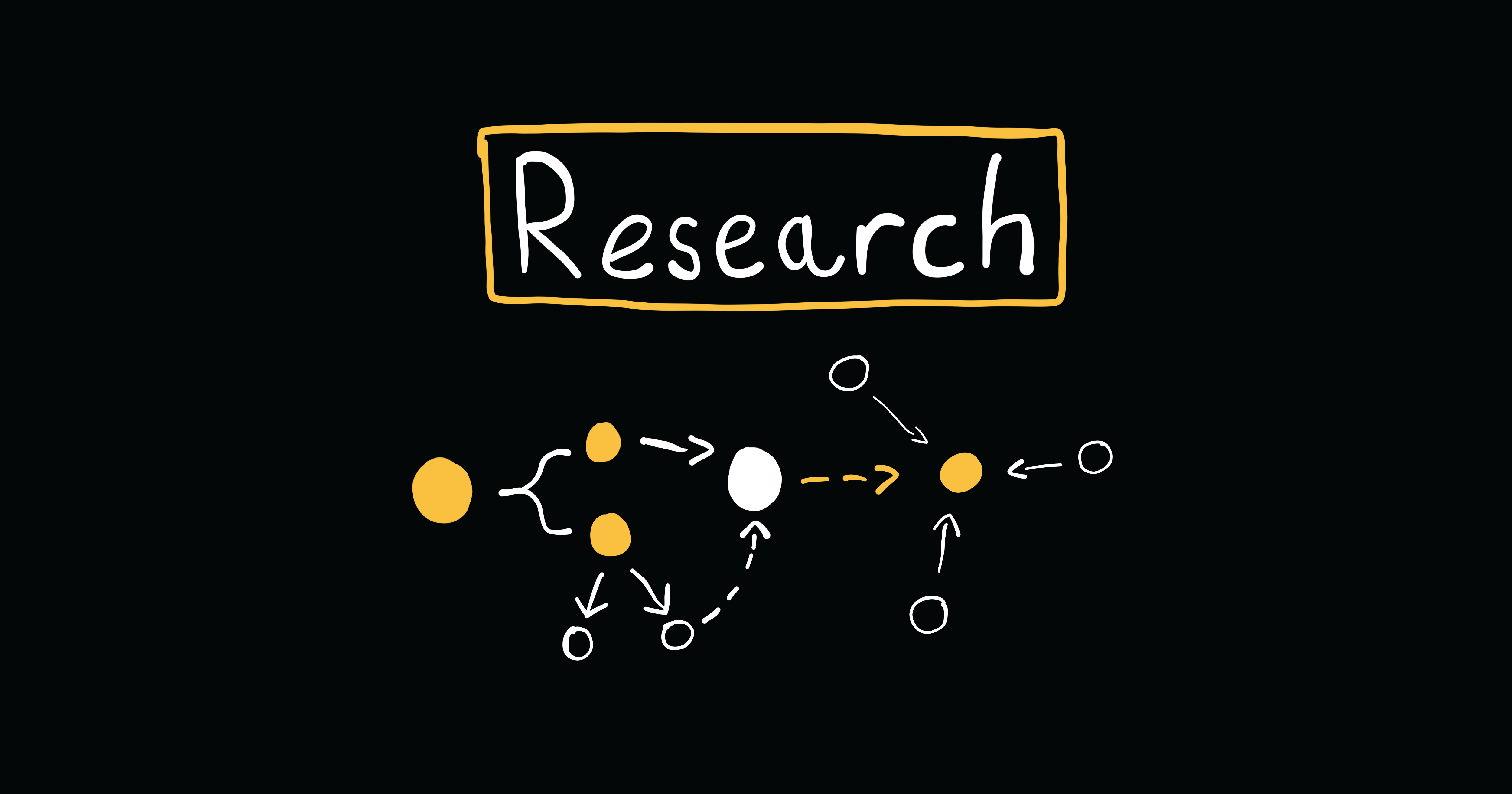
The first and most important step in the writing process is research.
And I don’t mean research in the academic sense.
Fuck that.
Research is learning. They are the same thing.
It’s the process of building a web of unique knowledge - so that when you sit down to write, you have encoded knowledge to retrieve through the act of writing. But what you want is unique knowledge. The kind that cannot be trained for. That only you can provide, from a perspective that cannot be replicated by anyone.
AI included.
That’s what these guides are about.
Why research?
Most people who want to write about ideas online either stare at a blank page because they don’t know where to start, or they write purely from personal interest and wonder why nobody clicks.
You need to find the intersection between interest and validation.
Writing from pure interest alone can be done once you’ve built an audience you can persuade to care. If you can be deeply interested in something, why couldn’t you persuade other people to be as well?
But you can’t persuade an audience you don’t yet have. That’s where validation comes in.
In the beginning, you need validated topics to write about - topics that almost ensure growth - before you can earn the freedom to write about whatever you want.
Think about Taylor Swift. I mean that.
She has had so many viral hits, which attract lots of general listeners, who, once aware of her other music, can become super fans and consume everything she creates.
To have 10 super fans you need to attract 1,000 regular fans first. To have 1,000 regular fans, you need to get ignored by 99,000.
If research sounds like a boring word, because it does, you’re not viewing it with the right mindset.
Research is learning, and learning should let your curiosity run wild.
Most people don’t understand that nobody is searching for your content. They aren’t scrolling to look for you.
Most people who scroll are:
Complete beginners in what you talk about
Scrolling for reasons other than to find your post - they’re bored, killing time, looking for something to grab their attention
Have no idea they even have a problem
Study Eugene Schwartz’s levels of customer awareness. It will change how you think about every word you write.
Just understand that everybody is scrolling past you. Think of all the tweets, reels, and YouTube videos you scrolled past yesterday.
This is the real problem that exists before you write a single word.
Research is learning
Your job as a writer is to take unaimed attention and exchange it for a life-changing perspective that could redirect someone’s life for the better.
Research helps you build toward this.
Research is encoding. Writing is retrieval.
Writing one long-form post per week is the best learning system there is.
Why?
Research is how you discover, search, gather, and encode new information into your memory. Writing is how you use that knowledge through action, the process of writing by hand itself.
Writing a newsletter every week will give your learning a purpose. Learning for learning’s sake is pointless, and it’s why most people give up reading, writing, and studying self-made curriculums. They don’t have a vessel for their learning. That’s why I recommend starting a newsletter to anyone, even if your goal is not to make money.
Your content creation plan is your self-education plan.
You should be scrolling as a creator, not a consumer.
Validation sharpens the angle that communicates the ideas you want to write about.
I’m going to give you two examples. Both of which I did back to back across a two-week period.
And every piece of knowledge I used is inside this guide.
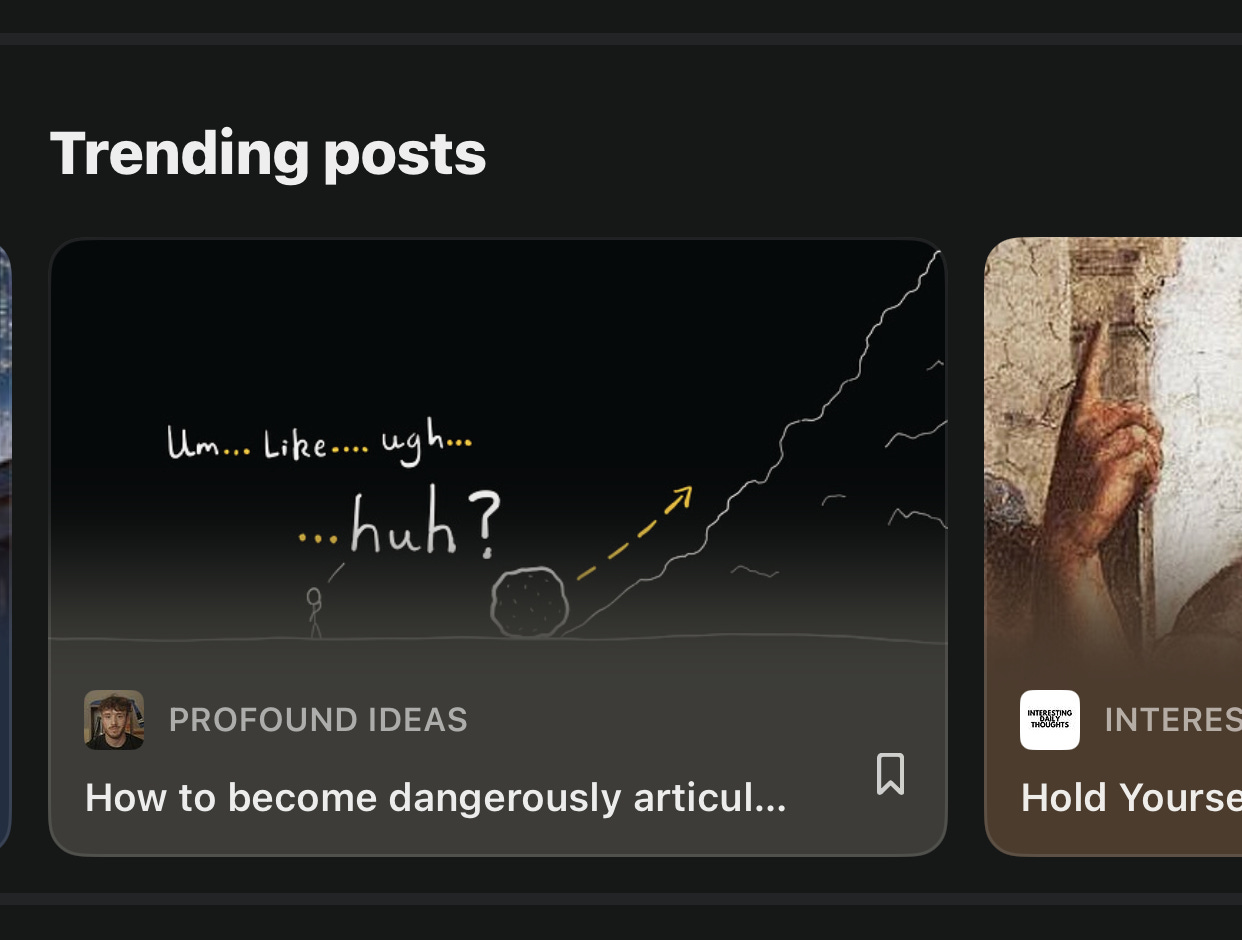
Example 1 - How to become dangerously articulate

I remember my interests at the time quite well.
I was obsessed with reading The Myth of Sisyphus by Albert Camus. I had just finished my Guide To Profound Reading, and was reading to promote. And I had seen one of Dan Koe’s newsletters go trending on the Substack page, titled “How to articulate yourself intelligently.”
Now.
Did I read it?
Not fully. I read the first half.
But I knew right away I could use that validated topic (high views, high engagement) as a way to promote my reading guide.
How?
How does reading have anything to do with articulation?
I got creative and offered a perspective, on reading as fuel for becoming dangerously articulate.
A great way to promote my product (reading guide) as a solution to a validated topic (articulation). I also included The Myth of Sisyphus as the philosophical reframe. I compared articulation with Sisyphus pushing a rock up a hill for eternity, and argued that the power of uncertainty, stemming from the concept of absurdity, is where dangerous articulation lies. The power of embracing the unknown in your speech makes you dangerous.
The newsletter went viral, got me a ton of sales, and I still get tons of likes, restacks, and comments on it to this day.
I’ll give you another example.
This was actually the newsletter I wrote the week before this one. Same principles apply.
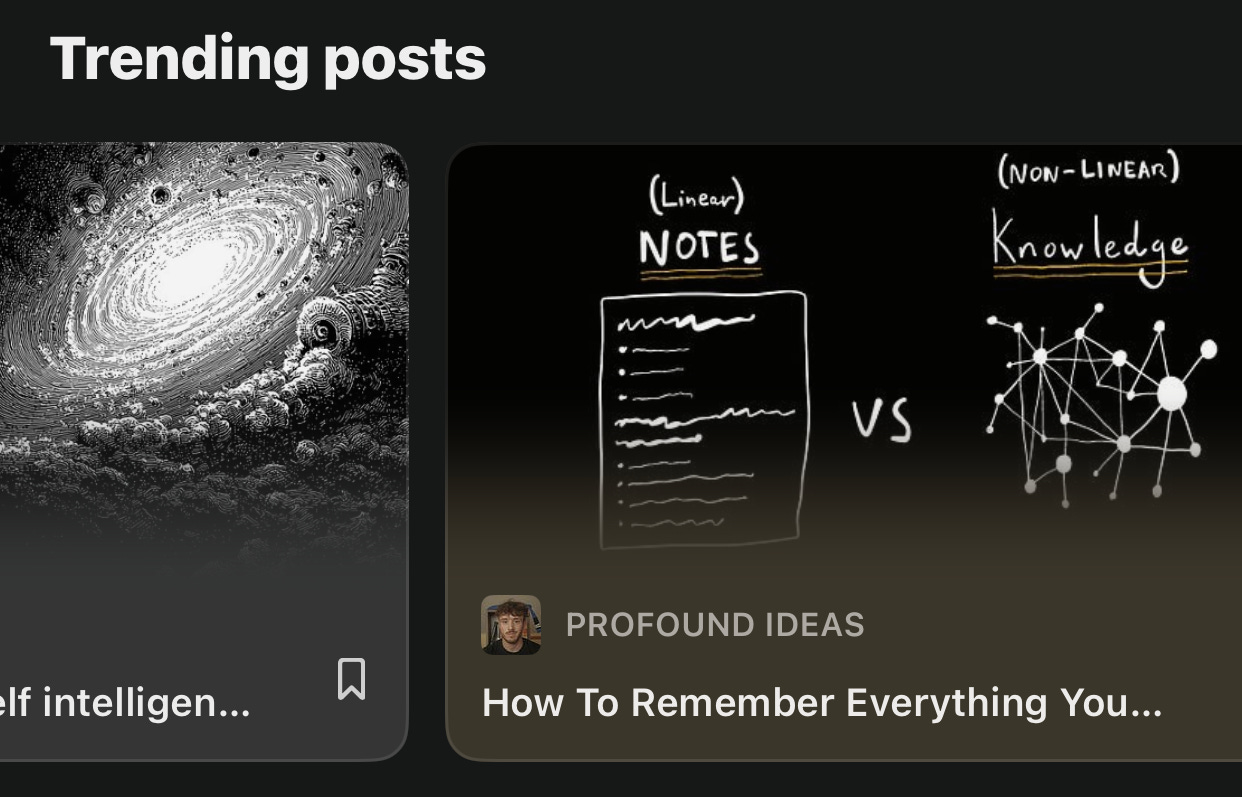
Example 2 - How To Remember Everything You Read
How To Remember Everything You Read

The minute you realize your mind is a garden and not a storage box, is the same minute you will finally stop being an information hoarder.
With my Guide To Profound Reading now completed, I knew that this was going to be my title.
Why?
First, I had written a post in the past titled “How To Remember Anything You Read,” which did extremely well.
I changed the word “anything” to “everything.”
Second, go onto YouTube and search “how to remember everything you read.” The videos that appear will show you what I mean by the term validation.
So.
I had a validated topic, I had my own profound ideas to write with, and I had my own proof to share as a learner, not an expert. Proof is vital in creating trust. No trust means nobody believes you can help them.
Too many people pretend to be experts online, talking about “how I made 3mil in 30 days” and “how I got clients x, y, and z.”
Fuck that.
I’m always learning. Even now. And I’d rather talk to you as a learner than as someone pretending to be an expert. Experts don’t exist. Humans do.
So what did I do?
I talked about everything I did while reading the first 30 or so pages of The Myth of Sisyphus, and had my mind maps to show for it. And a lot of people loved it.
Imagine this now.
Imagine if I had written about a different topic than “how to remember everything you read.” Something like “reading Camus’s introduction to absurdity.” The amount of reach, relevance, and resonance that’s going to have is slim. Most people don’t give two shits about reading that. Some do, like me. But I’m not writing for “me.” I’m writing for you.
This is a skill in itself, and once you get the hang of it you will have total freedom to write whatever you want, because you understand where the attention is and how to create in its direction.
You won’t hit bullseye every time. But following these principles will up your chances exponentially. These case studies prove they work if you trial and error with them.
Here’s another example of what understanding validation can do for you.
Mini-example - How To Understand More of What You Read
How To Understand More of What You Read

I have recently discovered a problem that silently plagues hundreds of thousands of readers and they are all completely unaware of it.
As of now, I usually make every second newsletter a paid one.
Same research process applies.
Instead of doing external research - looking at other people’s work - I did internal research.
I looked at my best free newsletters to write new new perspectives on.
Which one *cough* do you think I wrote about *cough* *cough*.
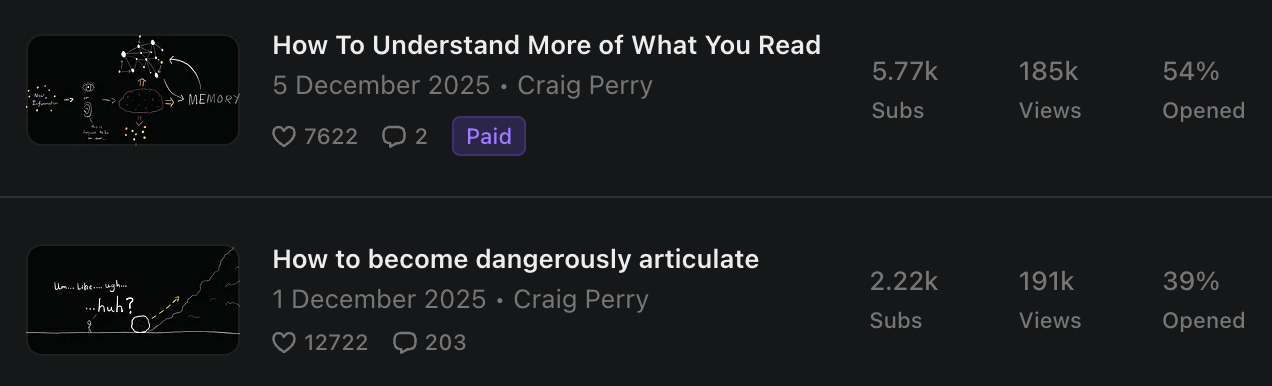
Here are the stats for all of the newsletters mentioned as of writing this:

A complete research system, with every step
I’ve given you the knowledge. This section is for helping you execute with that knowledge as best as possible.
All you need is one long-form post per week.
That’s your entire content creation and learning system.
2,000–2,500 words.
I’ve seen great success going as far as 8k words, which goes against the standard recommendation for people with short attention spans. Most of my newsletters on average are between 3-5k.
Your first step is choosing a topic.
That’s what this entire guide is really about.
But it is crucial - and I say crucial - to understand this:
There is no difference between:
The “idea”
The topic
The title
The problem
The headline
The desire
When you understand this, research becomes obvious. As does seeing what’s already working with other people’s long-form content.
