


The death of critical thinking is speeding up.
And the corporations doing everything they can to control your mind are winning.
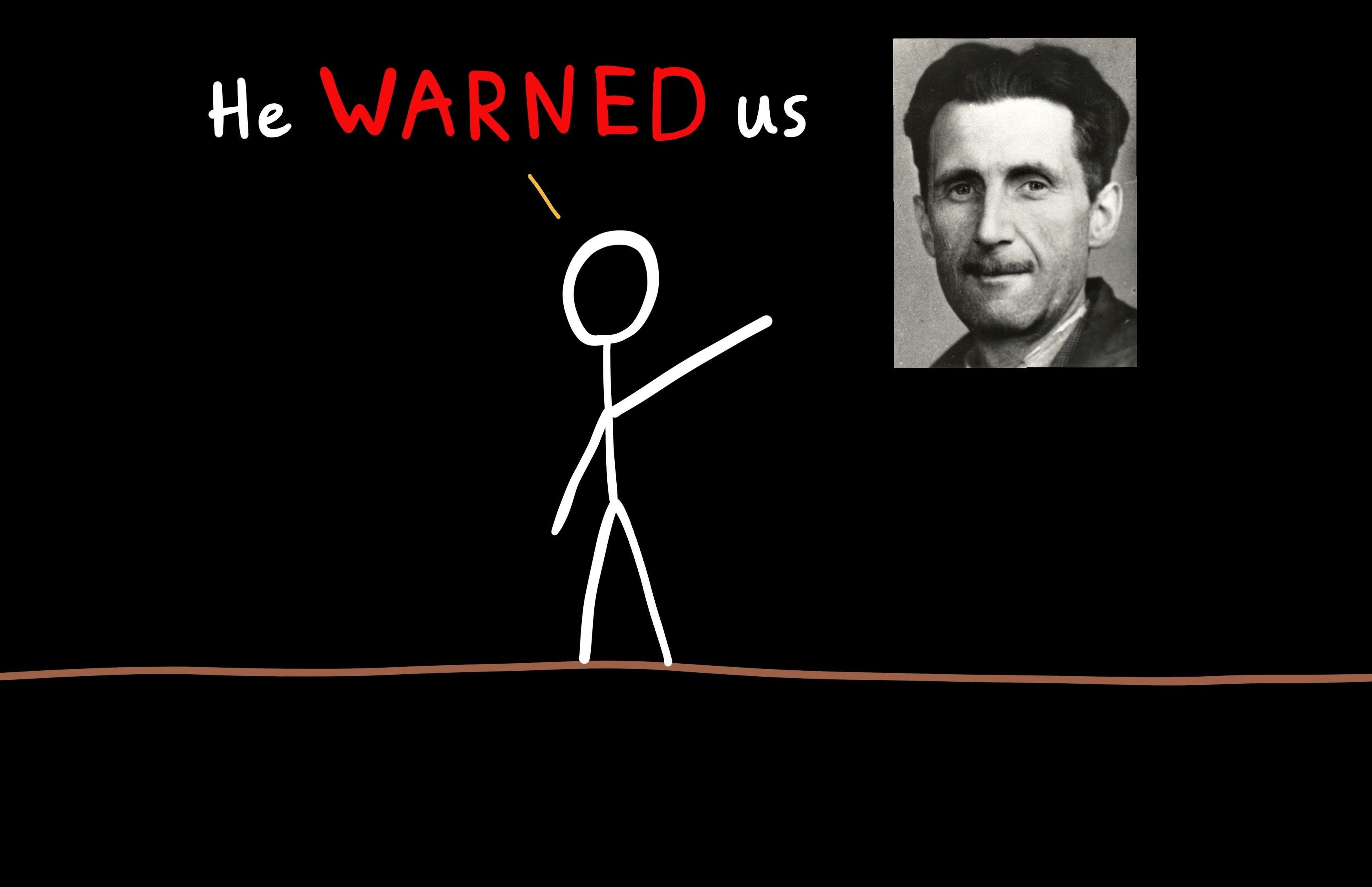
…but we all know this by now.
And deep in the back of your subconscious mind you know it’s stopping you from reaching your intellectual potential.
Yes, attention spans are not as strong as they once were.
It’s all to do with “the phones being bad.”
We get it.
I am here to show you something different.
There’s this old essay you likely haven’t heard of…
A man named George Orwell tried to warn us about this. If you don’t know who he is yet, don’t worry, you will. Because if you feel like you are wasting your best thinking hours scrolling, I’m here to tell you one thing.
Your thinking could be way more powerful than it currently is.
I am also not here to give you a lecture on your screen time analytics. But knowing that you’re a reader of my newsletters in particular, I assume you have a lot of ambition and curiosity in your life, and that you’re someone who knows their thinking could be sharper, deeper, and more structured.
Coming home from a job you hate to scroll five hours of your day away doing nothing is obviously a problem. You don’t need me to tell you that. But most people keep doing it anyway.
And that’s the thing.
Orwell wrote about this a long time ago, and he knew why your thinking feels worse than it should, and the exact habit that reverses it. So in this Profound Ideas Letter, we will think alongside each other, about why the ability to think clearly, deeply, and as a unique individual is currently declining.
Then, I’ll give you the single skill for reversing that decline, with a routine you can follow with 90 minutes of your day.
Yes, I’m not going to lie and say this will be the easiest commitment in the world.
If you wanted easy or comfort you’d be doomscrolling instead of reading this far.
But expecting to become as profound a thinker as all the greatest philosophers who ever lived with anything less than that, is exactly why we’re in this scary situation to begin with.
Idea I - This is not a new situation
Tell me if this sounds like you:
You come home from working a job you hate, and because you’re too tired to do anything else, you pick up your phone and spend hours lying in bed scrolling. And you’ve been tricked into believing that this is a form of relaxation.
I’m no saint by any means, but.
Deep down you know it’s not what you want to be doing with your life.
Let’s talk about that essay:
In 1946, a man sat down to write an essay about why the English language was dying.
That man’s name was George Orwell. And by the English language, he meant thinking.
The essay is called “Politics and The English Language.” And to prove Orwell right, it’s actually not the easiest essay to read. Go figure. But his argument is simple:
Bad writing makes bad thinking easier, and bad thinking produces bad writing… an so on.
It’s a destructive loop that feeds itself. Simply because the effect starts becoming it’s own cause.
Now what does this mean exactly?
Orwell uses the example of a person who feels like a failure. Because they feel like a failure, they drink alcohol to numb their pain. And because they drink, they feel like even more of a failure, which causes them to drink more… and so on.
The behaviour produces the condition that reinforces the behaviour.
Pay attention to this part:
Orwell had his reasons for believing that the quality of writing and thus the quality of people’s thinking was on the decline.
Those reasons being (1) political and (2) economic.
Stay with me here. This is extremely relevant to you.
Governments would use vague language to hide what they were actually doing. Terms like “pacification” meant bombing villages. The term “transfer of population” meant forcing millions of people off their land.
Language was being used as a tool for making any behaviour sound reasonable through being vague.
Newspapers also had to be made fast, which determined the quality of the writing itself. And because they were cheap, everybody would read them.
But what are the specific traits to be aware of in terms of poor writing/thinking?
Orwell outlined four major principles:
Reaching for other people’s phrasing (words) instead of your own
Making simple ideas sound, feel, or appear complicated
Using big words to make it look like you actually have a clear claim to be making
Using meaningless words to associate yourself with a group of some kind
His point:
The great enemy of clear language is insincerity.
It’s deceit.
That is what Orwell was warning us about.
And here’s how we’ve butchered that warning :)
I’ll keep this quick.
Social media ad revenue exceeded $200 billion in 2025 - Exact figures vary depending on the source. It should be common knowledge that platforms are incentivized by engagement alone and not the quality of your engagement. They want your attention first above all else.
Short form content is engineered by design - According to a meta-analysis of 71 studies with close to 100,000 participants (go on, Google the source), more short form consumption correlates with poorer cognitive performance in attention AND inhibitory control.
Literacy is collapsing - There’s too many excellent videos on this topic already.
AI is the amplifier - Producing content has zero cost, meaning volume of content produced is exploding, while the quality of thought, profound ideas, and novel insights are decreasing.
And with AI models getting trained on AI outputs (getting pumped out across the internet every day), the information source gets contaminated with more “average.”
Meaning AI trains itself on its own mediocre outputs, which means the model collapses, with AI outputs losing even more accuracy, nuance, and creativity.
Orwell’s loop is happening.
Right.
Now.
And faster than you’d think.
If you’re spending anywhere between 1-5+ hours per day consuming content that is designed to hold your attention in short bursts, and giving you zero value in return for that attention, you are training yourself to think in fragments.
What you do shapes everything else you do. The input shapes the output. That’s the loop we’ve been talking about, that cause and effect cycle.
So... what can you do about this?
Idea II - Writing is the solution
And I am not talking about the type of writing you had to do in school growing up.
Nobody is telling any of us why we should write.
But properly.
Even in university, like with all profound ideas too, there’s just so many things that we aren’t fucking told. Sorry I get passionate about this…
And that is why I’m here.
Here is why you should write, and read it twice for me:
Writing forces you to organize your thinking into an argument, and nothing makes you more dangerous than your ability to create arguments
Wow wow wow, slow down there.
“But Craig! What’s with you using the word “dangerous?” Do you mean PHYSICALLY dangerous?”
Let’s take this from a metaphorical angle.
There’s a big difference between a journal entry (writing down your unstructured stream of thoughts onto a page), as opposed to creating a structured argument (like with an essay).
An argument differs, simply because it consists of one core claim, some reasoning to support that claim, and some reasoning on why your claim should matter to the reader.
Sure why are you even reading this?
If you can’t articulate what you think within a clear structure, a structure that moves the reader from understanding the problem to understanding the solution, guess what?
You have no idea what you’re talking about, or what you actually think to begin with.
Why is that?
According to the learning science, the brain loves to chunk (group) information into parts. Writing forces you to take chunks or groups of information and to sequence them in logical order. And the wonderful thing about this, is that most of your ideas won’t survive the structuring process.
Which is the point.
Most ideas are stupid ideas.
Really. Most of your thoughts I mean. And why is this important to think about?
It means that bad ideas can die so you don’t have to.
Only the strongest, sturdiest, and most bulletproof ideas get put down onto the page. THOSE ideas are the ones worth considering.
And here’s the other thing about writing.
It slows your thinking the fuck down. It’s easier to let vagueness pass in a conversation. Because with writing, every word is a choice. Every exact word. Every sentence, paragraph, and every problem you choose to write about. How that all comes together to influence how you live your life. Reading is more like input (writing is output). Conversations give no pause for deliberation. Meditation is better at training attention than articulation, and journaling is just rambling without a structure.
Writing is the only process that forces precision at every level of analysis.
The level of the word.
The sentence.
The paragraph.
The section.
The entire piece, its topic/problem, and how that impacts your actions in the world.
Fear and laziness do not live in the specific. They live in the vague. Yes, I’m using an “it’s not X, it’s Y” sentence structure, and no, AI did not write or come up with this idea. I hand wrote it, and we’re allowed to still use that sentence structure!
You can’t fail at something that you haven’t given a criteria for success. Which is why vague plans feel safer, and vague ideas too making you feel smarter (because nobody can challenge what you’re saying if they don’t know what it is you’re saying).
Writing obliterates vagueness.
It forces you to say exactly what you mean, and then you have to look at it, evaluate and analyze it, and decide whether or not you believe it to be true.
My point:
Writing is a confrontation with what you actually think. It’s not just any high-value skill, tho it is. And most people will avoid learning that skill for the same reason they avoid having hard conversations with loved ones, enemies, or even with themselves.
It reveals things you’d rather have left unknown.
This is why AI writing is bad. Using AI to write means you’re skipping the confrontation yourself. You’re generating words that are not yours. You’re not slowing down or thinking clearly. Or choosing your words precisely, like an axe being sharpened with a stone in your hand across thousands or repetitions.
Because your words are perhaps the most powerful thing there is about you as a person.
Writing with AI removes the last chance to discover what you actually think.
And I’m not anti AI. I love talking with it, asking it questions, and asking it to prompt me with questions. I’ll think and ponder and evaluate what I think while walking through my favorite park on a Tuesday afternoon, once my work is done for the day. But that’s a different skill (using AI). It requires knowing what you’re looking for and how to ask for it.
It needs thinking first.
And you learn to think by writing.
There is nothing that would make you more dangerous than learning to write.
A person whose thinking is precise enough to build an argument, defend it with four arguments ready for every one counterargument, and change how other people act, that is what makes you extremely dangerous.
Why?
It means you can’t be dismissed, outmaneuvered, manipulated, bullied, or ignored.
So my final question to you, is.
Do you want to be vague and weak? Or do you want to be articulate, competent, and thus dangerous beyond comprehension?
So what do you write about, then? How often should you write and how much?
What happens when you do start writing one essay per week?
Idea III - Write one essay per week
Writing one essay per week is the greatest vessel there is for self-education, self-actualization, and self-improvement.
My friend:
You are an aiming mechanism.
If you don’t tell your mind what to aim at, it will aim at something itself. And it will always be the fastest, easiest, and most pleasure generating thing it can get its hands on first.
If you give yourself one essay to write every single week your brain will have something to feed on. Your subconscious I mean, and it will do so during every second of your existence. You’ll connect ideas in a way you would never have expected otherwise. And you will reach insights you wouldn’t have reached without having that weekly deadline.
Life is problems. Everybody has them. And you know for a fact that if you could solve your one biggest problem that’s causing you all your misery and suffering right this second, you would. I know I would.
Writing is how you work on your own problems.
How so?
The word essay, in French, means “to attempt.”
That is what you are doing when you write an essay or a long form piece of writing. You are attempting at solving a problem by offering a novel perspective. When you write one essay per week, you’re choosing to be a perspective generator.
What is a perspective generator?
Well, they are a profound thinker who creates and articulates original perspectives on a set schedule. Almost like it’s their full time job. I like to think of the word “perspective” as a structured argument for how to see a specific problem. Perspectives are offers, not laws. Because no perspective is 100% right or wrong. They all have some truths to them, and that’s what makes them a “perspective.”
It’s also what makes them more and more valuable than at any other point in history.
Bad thinking begins when you take perspectives as law. Good thinking begins when you learn to build them, hold them lightly, and refine them when cracks start appearing.
A perspective generator is a master at crafting better and better answers, responses, opinions, and ways of seeing the world, as opposed to the “guru” (think in business, religion, spirituality) who has the one and only answer.
Which is why you need to post your writing online.
Now before you cringe and leave over the idea of becoming a content creator (because you’re not… not really).
You’re not posting for the sake of clout, not even subscribers or money (not yet).
You posting because you need feedback.
Where is the value in having an essay stored inside Obsidian or Notion? To let it gather dust? If you’re doing that, you’re talking to a brick wall. There’s no value in doing that for yourself. Let alone others.
An essay that gets posted online, however, is a conjecture thrown into the world to see if it survives.
A conjecture being an opinion, conclusion, or perspective.
See?
Another reason to post online is to test if you can capture attention. I’m being serious. Can you hook people in successfully? Can you persuade someone to keep reading? To actually consider your perspective? If you can’t do it online then why think you could do it in a room full of strangers, or in front of your friends and family (who will lie and tell you it’s good because they care for you).
You.
Need.
Data.
Feedback from reality.
Because you need to know if the ideas survive or if they die.
Information is available to everyone. AI is a thing now. Before that, it was Google. A perspective, however, is information organized through experience and structured into an argument. That’s what wisdom is. Moving from data, to information, to knowledge, to understanding how and when and why to apply what knowledge due to your own lived experience.
Yes. That’s wisdom.
AI can’t give you a perspective. It can only give you information, and they will never be the same thing.
I’ve written about this before, about writing being high leverage if you can build an audience.
Putting all else aside (the opportunities that having attention can give you), a larger following online means you have more reach, and can receive more feedback. More feedback means better thinking. Better thinking means better writing. And at some point the distribution does compound, because you’ll be doing the same amount of writing every day even if you have 10 newsletter subscribers or if you have 10,000.
I’ve written about 100 newsletters since May 2025 and I have close to 100,000 people across two long form platforms. And it was by writing one essay each week that I’ve now become able to survive off of my digital products and paid newsletters now. I’ve declined every opportunity to do client work (for now) and I still get more sponsorship and affiliate opportunities than I know what to do with.
All from writing one essay per week.
I don’t like talking about business to be dead honest. I still feel like a fish in a smaller pond when it comes to it. The money is nice, but it’s really just a by-product.
Writing one essay a week will change how you think, what you believe, how you relate to people, and how you feel.
The primary effect of writing is that you become a clearer, more precise, and more dangerous thinker.
You just also happen to build a vehicle for building your life’s work in the process.
Here’s exactly what you need to do to write one essay every single week.
Idea IV - How to write your first essay
Step (1) Choosing what to write about each week
Choose one topic to write about. You’ll do this at the start of each week.
I define a topic, as being the one core problem you’re actively trying to solve in your own life.
I wanted to write about Orwell’s essay because I myself had been reading it for fun. And this is just one perspective on that essay (as imperfect as it is).
You see, a lot of people never get past this first step, and think writing is pointless, or whatever, simply because they don’t choose to write about a problem that’s killing them.
Cause why bother?
Interest is by far the best leverage you have in your life. If a problem really grips you, and it feels like you can’t let it go, you can bet that you’re going to feel exhilarated learning and researching about it while you outline.
AND, if the problem is real to you (because you can’t argue your pain away with logic, for example) then you won’t ever run out of (1) motivation and (2) topics to write about.
Your reader’s will feel this in your writing too. Which helps with keeping them engaged.
Pick one problem to solve. Make sure you can say it aloud in a single sentence that a 12 year old could understand.
Make one claim about that problem.
Then, have a think about what your solution to that problem might be. This is where your perspective really starts to emerge from your thinking.
Step (2) Spend 30 minutes thinking before you write
I like going to the park for this.
Go on a walk and think. You can open AI on your phone, no need to type, and simply start talking back and forth with it. Talk through your topic/problem you’ve chosen to write about. State your claim, along with any other ideas or angles you have, and tell AI to push back while helping you create a 2000 word outline.
If not you’ll write a 6000 word piece you can’t publish within your 7 day deadline.
I almost forgot.
Read the AI responses out loud and respond to every single one.
Why?
Well dictation forces articulation.
You cannot hide in vagueness when you are speaking. You have to be specific and clear. With AI, you’re thinking back and forth with an intellectual sparring partner. You’re still the one doing the thinking, too, because you are talking.
I love AI in the sense that it can hold context (what I have previously said) and surface things I might have missed.
But mainly because it can compress feedback loops.
What does this mean?
You have a conjecture. You get criticism about it, and thus revise it, and you repeat that loop in seconds, and not days.
This step is about organizing your input. Your raw material, if you will. Your ideas.
Ask AI (I recommend using Claude for all this) to help you build a 2000 word outline using a problem → solution framework.
And don’t go over 2000 words!
Step (3) Write for 30-60 minutes straight
NOW sit at your desk.
Write directly from the outline you have made. Vomit out a first draft. You will likely be 20-50% over your word count. Again, that’s fine, as long as you cut once you’ve finished your first draft.
If you get stuck staring at a blank page it means your outline wasn’t fleshed out enough. It could have been more solid. Because the outline is 80% of the writing process, and if you nail that, you’ve done all the hard word.
If you need to, go back and clarify or stress test any sections of your essay and continue on with writing.
DO NOT use AI while writing.
You need the slowing down, and the precision that comes from making every single word choice with your own damn brain.
Which is the purpose of thinking.
This step, now, is for crafting your raw material into a structured argument.
Which means you have 30 minutes of thinking and 60 minutes of writing per day. Which also means you’ll be creating a higher quality finished product by not switching back and forth between the two modes of thinking (context switching ain’t good for the brain).
All you need open beside you is your outline. Even if it’s inside an AI chat, you’re not using AI at all. You. Are. Writing. And with no tabs open. No email either. Keep your phone downstairs or in a separate room.
Just get the first draft written as quickly as possible.
You will probably feel the urge to edit while you write, please don’t. It’s a pain in the ass. And that’s an understatement (take my word for it).
You can edit once the first draft it out.
Step (4) Send it out!
Now it’s time to feel the relief.
And publish your essay online!
Do it on Substack and/or X.
Simply because that is where people are, all over the globe, to go and read long stuff like this very newsletter.
Your essay is complete once it meets reality.
What do I mean here?
Well… are people reading it? Are they clicking onto it? Do people like, share, or repost it? Do they agree or disagree?
You’ll get more and more data from week to week as your audience grows.
Which is great. You can’t get that from inside of Obsidian or Notion.
Pick one day of the week to post it, I like a Saturday because I have jiu-jitsu at 12pm on Sunday mornings, so I can’t really do much writing on Sundays.
Review your data after 2-3 days, even as far as a week after posting. Open rates, read rates, responses… it’s all inside of Substack. Note what worked, what didn’t, and do more of what worked.
I would urge against putting this off.
Posting online, I mean.
Writing for 6 months without posting because you don’t feel ready is totally missing the point completely. You won’t ever feel ready, you just have to do it until you stop not feeling ready.
Post the damn thing. Believe in yourself, and have some faith in your own thinking. There’s enough slop going around now that people already have full faith in, so why doubt yourself?
I teach my full writing process inside The Profound Writer.
2 new modules have just been released for those already inside the course. I’ll be moving it over to Eden, which is why I’ve been writing content so little. I’m basically rebuilding the course for the 5th time now (ughhh) but it will be worth it.
I’ll leave it there for today, you’re an absolute legend.
- Craig :)
I have these writing guides on my Substack:
How To Write Long Form (Essays, Newsletters, Articles, YouTube Scripts etc.)

The term “content creator” has lost the weight it once had.
How to do Research for Long Form (Essays, Newsletters, Articles etc.)

A profound thinker is someone building unique knowledge and looking for ways to share it.
Full Guide: Write Impactful Hooks For Long Form (Cheat Sheet Included)

If your long-form content isn’t getting clicks or growing your following each week, it usually means one thing:
Hi @Craig Perry - IMHO this is actually good news - yes we are in some literal sense losing our minds - AND you and others have switched on the light and now the critters are scrambling for cover.
So I’m optimistic we’ll get through this in a way that folks in the 40’s struggled due to ravages of war.
I’m obsessed with all things Dante and his world was another same-but-different layer on this ever repeating cycle. Much less spiking on wooden poles, Oooof.
You got this, WE got this. Keep up the great work! (loved your talk with @DAN KOE BTW)
🫡 As always amazing.