


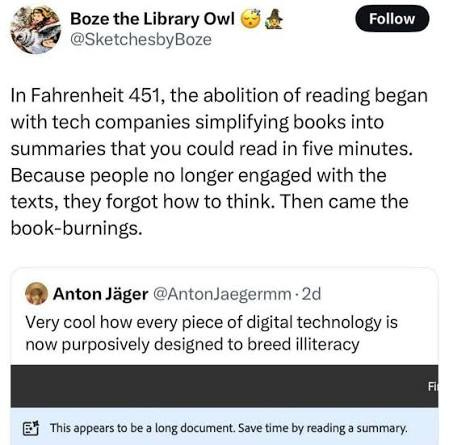
Safe to say things are getting serious.
I don’t mean to scaremonger saying this, but.
We are losing the ability to stretch our minds on a collective level.
This absolutely should frighten you.
Most people don’t read books anymore.
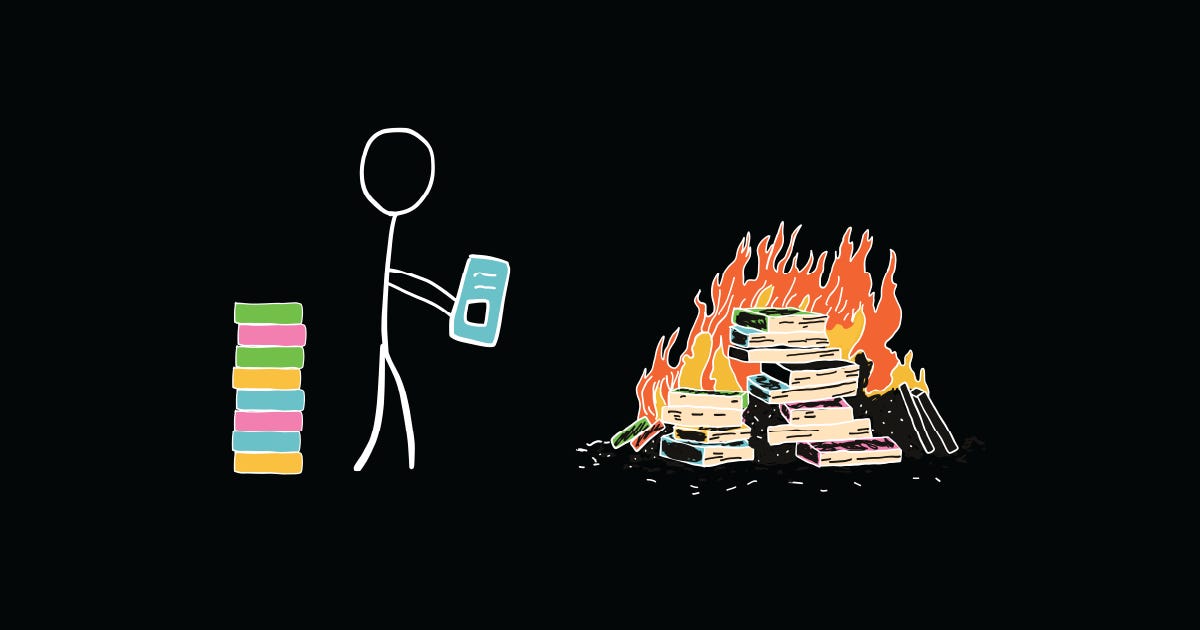
Most people would rather have a Wikipedia article summarized for them.
Most people would rather let a phone tear their focus in 100 different directions within five minutes of waking up… than to enjoy the bliss of that first golden hour of being awake.
And most people think they’re still thinking.
Just know I say… most people… as a signal of hope.
I never wanted to be a writer.
Which I’m happy is no longer the case. I just turned 23, and I’m sitting here at 11:24am, sipping my first americano of the day, with documents full of profound ideas, and bullet point outlines, scattered across tabs on the monitor to my left.
Since I was a teenager, I’ve always had a thirst for profound ideas across old books and YouTube video essays. I would spend every spare second of thinking time building my second brain, anytime I wasn’t doing maths homework or finishing my undergrad thesis.
I’ve always had a strong desire to be a deeply intellectual person. More importantly, I’ve always wanted to live like one.
To spend my days reading.
To spend my days thinking.
Writing, and creating solutions to problems that might help me suffer less on a day to day basis.
I used to view writing as a torture method that was tedious and draining to my brain. And school has a big effect on why most people still think this.
Those same people have never used writing to stretch their mind beyond what they believe, simply to test if they should still be believing in it.
This essay is about regaining what our generation is starting to lose.
I have 2 profound ideas to share with you, and a plan you can start today, for living a life for maximizing your intellectual capabilities.
A deeply intellectual way of life.
It’s our responsibility as the hinge generation to not lose our intellectual faculties.
Who knows what “geniuses” will be running the world that our kids will live in.
You’ll have to think with this one.
But don’t worry, we’ll think through it together.
Oh yeah. This is in video form you beautiful human!
Listen while on a walk. You know the drill ;)
Idea I - How surface-level thinking became the new normal
Profound Idea: Stupid thinking begins when questions stop being asked.
It has never been easier to feel informed while understanding nothing.
There are a number of forces at play here:
The dominant emergence of short form content, engineered phone addiction, and AI outputs you can skim in seconds.
But do you know what every one of those forces do?
They make the appearance of understanding feel effortless.
I am here to remind you, and myself, in writing this…
…that the actual cognitive work needed to understand something has not changed whatsoever.
Not.
One.
Bit.
You can get a Wikipedia article summarized for you in seconds. You can watch a 60-second reel that “explains” how to learn anything fast like a Grade-A student. Heck, you can ask AI to breakdown the structure and mechanisms beneath this exact piece of content if you want. And when you’ve done those things, you feel like you understand it.
Nah.
Being informed is not the same as being enlightened.
Knowing what claim is being made in an information source, is not the same as knowing what the claim is and understanding why it’s true, and how it’s relevant to other claims.
Profound Idea: Surface-level thinking lives and dances around like a jolly ol’ clown within that gap between knowing and understanding.
There are some general traits to beware of here:
Surface-level thinking is black and white - You’re either pro or anti AI, right or left, or believe any one thing is wrong or right with absolute certainty.
Surface-level thinking is quick, tribal, and a means to an end - There isn’t a more a dangerous, self-limiting idea than thinking of education as something to be ticked off or completed. Let alone in just one 4 year period, or when a governing body says you are “competent” now, in the form of a piece of paper.
Surface-level thinking is when you have no direct control over your water supply of information - How much is flowing, and where from.
These traits are symptoms that you are skipping the deep and important contemplative work.
How so?
Profound Idea: Overstimulation increases the threshold for what gets perceived as stimulating and thus interesting to your brain.
Who needs to feel bored when you can whip open Instagram reels or YouTube shorts while waiting in line for a coffee?
Long walks. Reading hard shit. Mind mapping for an evening or two each week. Training your focus by narrowing in your field of vision at a singular dot on a wall for 20-60 seconds (try it).
This would sound and feel like death to an overstimulated mind.
An overstimulated mind will always reach for surface-level thinking because it’s the easier and faster kind of thinking.
I actually wrote the outline for this by hand just for the thrill of testing myself, and seeing where I could improve my thinking. It’s only when you step away from all forms of digital technology (AI especially) and let your mind think (alone, uninterrupted, with no tools but your own brain) that you realize how hard thinking is, and how little of it you actually do.
“Ok Craig. So why give two shits?”
Our water supply of information has been poisoned by surface-level thinking and therefore surface-level ideas.
AND it’s overflowing.
Which is not something to let slide (please resist the urge to skim past this here) because human beings are tool builders at a fundamental level.
We build homes to keep us warm and protect us from nature. We create systems to help us achieve positive outcomes that would help us in our day to day lives. We create solutions based on the materials… the information… we have available to us.
Clear, simple, basic thinking has never been more valuable.
And you need to be deliberate about every single thing in your life if you expect to combat this.
You need contemplation.
It is the one thing every force of modern life is actively fighting to take away from you.
Idea II - The three levers of profound thinking
What you let into your brain, and how you think about it, determines what goes out.
This determines your life.
Everything you consume today will downstream the thoughts you have later today, tomorrow, and in the future. If you consume creative, productive, and profound ideas, your work will be creative, productive, and profound.
But if you input is shit?
Profound Idea: Focus is the removal of options, and surface-level thinking begins when curiosity disappears.
The purpose of living an intellectual (deliberate) life is to take as much control over your intellectual faculties as possible.
My writing has suffered recently because I’m not learning as much. I thought it was because I was doing too much writing (output). Nope, my input had decreased without me being aware of it. Now that I’m aware of it, I can give my attention to it, think about the problem and solve it.
Why is this relevant?
Ideas need to be diverse and abundant.
That is what leads to original, new, and novel ideas.
Profound Idea: I personally see originality as a progression or furthering of an idea.
Nietzsche read the works of Plato. I learned jiu-jitsu first from my coach who has his black belt. We go to school and learn of these complex explanations of how certain things happen to be true (from books, lectures, PowerPoints) so we can understand them, before creating our own explanations of those same truths.
I encourage you to try do 10 hard rounds of jiu-jitsu on no fuel. Or to read a chapter of a book after being awake for 36 hours.
You need a high-quality input source (information) in order to process information to a high-quality (thinking), to go out and do something high-quality (create).
Which leads me onto what I’m calling the three levers of profound thinking.
Because a contemplative life consists of three parts: what goes in, how you process it, and what you do with it.
Each part has a lever.
(1) Curation - the input lever
Curation is the filter for what enters your mind.
If you don’t curate your feed, algorithms will do it for you, which will thus determine what you expose yourself to, and therefore focus on and think about.
Pretty spooky.
Curation is like putting a dam before the overflowing content pipeline of sludge and slop.
Without it, you are handing the first stage of your thinking to an algorithm that has one purpose, and that is to keep you scrolling (attention > understanding).
(2) Curiosity - the processing lever
Be curious, not judgmental. - Ted Lasso
Yes, I know that idea is originally from Walt Whitman, and no, I will not quote him, because quoting Sir Lasso literally proves my point on originality.
Curiosity is the antidote to ignorant thinking.
People who judge simply aren’t curious. And we judge people based on what we lack in ourselves (or what we consciously or unconsciously perceive to be lacking in ourselves).
Curation controls what goes in to your mind. But curiosity determines what you do with it once it’s there. Think receiving information vs actually thinking about it, or “consumption” vs “digestion” in the learning/self-education niche online (my roots).
(3) Creativity - the output lever
Create something.
A routine, a relationship, a body of work people can spend weeks and months exploring. If you don’t create a life for yourself, you will be handed one. You have to go out and build it.
You need to create a routine. Create some systems. Create a plan to go to the shops and buy a notebook and make a template for planning out your days.
Of course I’m going to mention writing.
Profound Idea: Writing is a voyage of discovery into the unknown and murky waters of your own mind, to shine a flashlight on what you believe to be true.
I actually wrote a 2000 word draft of this newsletter and realized I wasn’t happy with it.
I discovered what I thought by writing, and then writing again, which is why I was late getting this out.
Depth matters more now than volume, anyways, since everyone insists on posting cadences and “the right method” for content. The secret lies in doing less but better.
That’s a lot we just went over.
In sum:
Curate your input.
Process it with curiosity.
Create something from it.
Repeat the cycle for as long as you are breathing and you will live a deeply intellectual life.
The deeply intellectual life: control your input, sharpen your processing, and raise the quality of your output
So we need to improve two things: focus and thinking.
I am not going to think here for you. In fact, I’m only giving you a line or two at most for each action step. Because I want you to practice what we have been preaching inside our minds here, me as I write this, and you as you’ve been reading this.
You need to curate sources. Do your own research. Explore different perspectives and compare/contrast them.
You need to think and figure this out for yourself.
Curation - control what enters your mind
Step 1: Subscribe to 5-10 creators at most
If not, your feed will do it for you, so be deliberate about whose ideas you want entering your mind (what you consume will determine the opportunities and problems you see).
Step 2: Ignore all social media for 3 days straight
I don’t care. Just do it. Use an app blocker if you have to.
You’ll have your curated subscription feed ready for you once you’ve desensitized yourself completely.
Step 3: Once your 3 days is up, keep social media deleted off your phone (laptop only)
Keep WhatsApp or any communication platforms only. Just no scrolling. If you need a social platform, only use it at a computer.
Step 4: Download an app blocker you can’t turn off
I swear by Opal, although the recent updates have made the app feel clunky to use. I use this for blocking Spotify mostly, and email access.
Curiosity - process what you consume
Step 5: Read paperback books
15-30 minutes a day is huge. Reading is a meditative practice that literally improves focus by forcing you to narrow your gaze to one word at a time while you read.
Step 6: Be bored a lot
If you can do 3-4 hours on a weekend or day off, great. An hour is optimal each day, even once a day split into two 30 minute chunks.
Step 7: Music for just an hour each day.
I don’t care. Block it when your limit is up.
Step 8: 15-30 mins a day of using your cognitive faculties
Reading paperback books. Mind mapping on paper. Journaling or writing by hand. Lecturing on a topic to an invisible audience while walking around your local park.
Step 9: Meditate
I like the Waking Up app.
Creativity - do something real with your thinking
Step 10: Give yourself a meaningful problem to solve each week
45-60 mins first thing each day (if you can) working on one project (build a newsletter, learn to write long form, learn to draw or read, understand learning science, build an intuitive comprehension of Existentialist philosophy or the art of cooking steaks).
Anything.
Step 11: Buy a notebook to plan your days
I plan my day simply:
2-4 high ROI tasks first thing, 45-90mins per task (I’ve been testing this the last while), which gets me to about 3-4 hours of deep work per day
I’ll leave you with that.
Go on a walk. Think about what we thought through together.
That is how I suggest we start reclaiming our minds by actually using our minds.
Curate.
Question.
Create.
I value your time and attention a lot more than you realize.
Thank you for having an interest in profound ideas like I do.
You’re an absolute legend.
- Craig :)
If you’d like a complete system for writing long-form about your interests and ideas online - and build an audience doing so - check out The Profound Writer.
You can read on from here:
How to become dangerously intelligent

Society has made you think that increasing your intelligence is impossible.
Prompt: How To Do Deep Research As A Writer

I’ve learned that if I don’t have ideas to write about, I lack one thing:

Where your focus flows, your life goes.
We can do so many amazing things in life only if we can focus on the right things and create not just consume.
Loved this one!
True you become what you pay attention to.
Great article craig🙌.