


Tell me if you are any one of these three people:
You’re busy for 16 hours of every day and you’re not getting anywhere.
You’ve got a million tasks and projects on your plate and you can’t start any of it.
Or you know exactly what you need to be doing to reach your big life goals… you’re just not doing any of it.
I’m going to burst a few bubbles saying this. A quick apology in advance for anyone who clicked expecting a “don’t worry my friend, you are not the problem!” message (because you are never the problem…obviously).
Because to be honest, you’re probably going to spend another year being busy with nothing to show for it.
Your to do list will continue to grow. So will the chaos in your mind. And the advice you already know about productivity, focus, and whatever else related to helping you become successful, well, it will continue to sound like a parrot whispering into your ears.
It’s all trite.
Because deep down you know it.
You know the one thing you could be great at.
And its going to keep staying half done unless you listen carefully to what I’m about to tell you.
You’re spreading yourself so thin because you’re trying to achieve everything, and trying to achieve everything is the best way to achieve nothing.
We have three things to think through together.
What obsession actually is.
How to find your one true bottleneck (I’ll explain what this is and how to find it)
How to cut everything else that isn’t that bottleneck.
So you can finally become successful in your life (no matter your definition of “success”), and remove all the guilt and clutter from your mind that has come from beating yourself up until you started reading this very sentence.
Let’s start by defining obsession in our own terms.
And no.
This type of obsession will be in no way related to running yourself into the ground, or even the idea of compulsion.
In case you missed it:
The Profound Writer V2 is launching, and it’s 50% off right now.
If you want to build an audience writing about your genuine interests and deep ideas (like I’m doing in this letter), consider joining.
It’s a course with a built-in Custom AI that knows every module, principle, and checklist I teach (yes, this is a course you can literally talk to in Claude or ChatGPT). And it teaches my full writing/content system that helped me build an 83k+ audience in 18 months.
No more newsletters that take forever to write, or constantly buying static writing courses that don’t help you with implementing what you learn.
You have a little over a week until the price increases.
Click here if you’re interested in joining.
P.S.
If you have any questions regarding the course, send me a DM or an email. I’m here to help in any way I can!
Idea I - Obsession
It is not that we have a short time to live, but that we waste a lot of it.
- Seneca
We will be defining obsession as where you put the limited human resources you have.
Because the fact of the matter is… I don’t know how much time I have left on this Earth.
Neither do you.
I want you to think of your life as a book being written one page at a time. One page being one day. An 80 year life is about 29,220 pages (if you include leap years). At 23, I’m a little farther on than page 8,400.
Nobody knows which page will be their last.
Obsession means you must narrow your very limited resources. Because they are not infinite.
Have you ever pulled an all nighter the day before an assignment is due and blitzed out a full essay, (like you were superhuman almost) because you wouldn’t let yourself sleep until you got it done?
That’s a super relevant example.
Or imagine yourself taking a magnifying glass and narrowing the Sun’s light. Really think about this. Think about taking all that light, with it being so far spread out and evenly distributed across a massive surface (the Earth), but directing it to a singular, tiny point on a page.
Flames!
You can either be great at one thing or half decent at many.
Because you do have a finite amount of time and attention. And so many of us waste our lives acting like this isn’t true. Especially young people my age (I have noticed).
So obsession means putting everything you have onto that one thing.
Building the business, building the physique, the relationship, or even tidying your bedroom.
And I don’t mean you should burn yourself out in the process. Willpower is finite. So know your limits and back off from them, so that you can sustain them across your entire life. However long that will be.
The fight for focus is a never-ending battle.
So if you can only be obsessed with one thing, which one thing do you choose?
Idea II - The Theory Of Constraints
There are no solutions. There are only trade-offs.
- Thomas Sowell
There’s only ever one bottleneck holding back your progress.
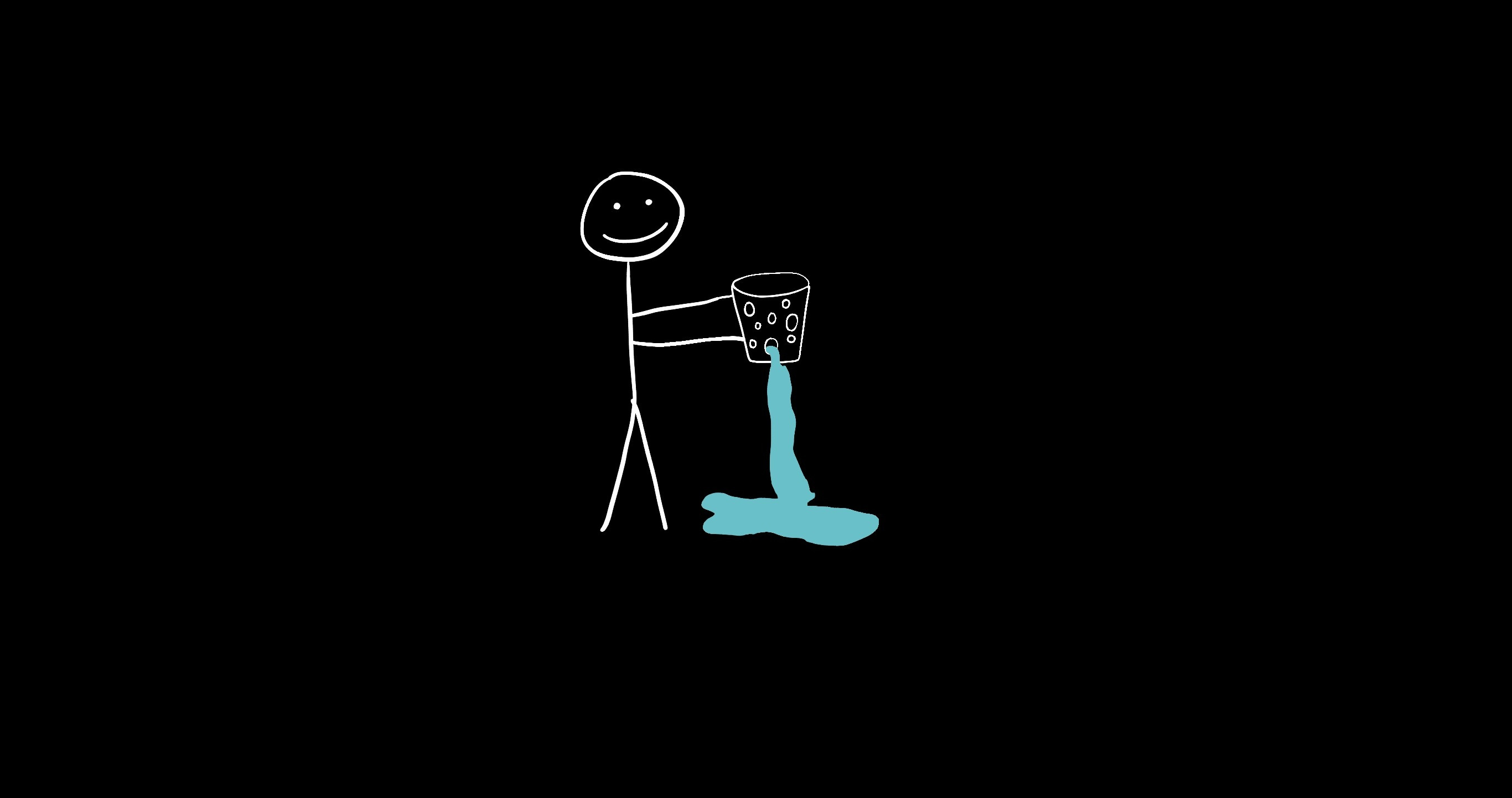
I want you to think of a bucket.
But it’s no ordinary bucket! It’s a holy bucket… well, it has a ton of holes. Maybe 3, maybe 10. Either way.
The water only rises as far as the lowest hole. Which means if you can patch that hole, the water can continue to rise, until the next hole shows.
This is the theory of constraints in a nutshell.
Why bother trying to make the perfect lifting program that’s optimized around 4 days of lifting per week… when you haven’t gone to the gym once in the last 3 years?
It would be foolish to do. Because it ain’t the damn constraint.
Every time you make a choice in life you cut something. That includes good things, too. In my own life, I’m eating the same 3 meals Monday-Thursday. I’ve cut my lifting down to 6 barbell exercises, with minimum correctives for some nerve issues I have in my neck. I haven’t touched X in god knows how long. And I still haven’t gotten around to building that reading list I’ve always wanted to build.
Having priorities and trade offs means that good and bad things both go into trade offs.
Which means:
Anything that isn’t the bottleneck is a distraction (even when it’s a good thing).
I know that going to sleep between 12 and 2am is far from being optimal according to the healthmaxxing bros. But I still get at least 8 hours of sleep every night. I have no intentions on optimizing that right now. My focus is on launching The Profound Writer V2 and getting back to writing these newsletters more consistently.
So how do you find your one bottleneck and cut everything else?
Idea III - How to embody obsession correctly
This is how you can make visible progress on one thing, and dump the overloaded plate you’ve been carrying with that hectic mind of yours.
All guilt and clutter removed.
Let’s rewire the expectations you have of yourself here. This will be your new “done” definition:
If you can name your one thing, and everything else is cut or parked.
Here is how you can do that.
1) NAME THE ONE GOAL
Write down one sentence on a piece of paper (or a yellow sticky note) naming the single result you want, and with a date on it.
Usually within the next 30-90 days.
Because without a destination, you can’t tell the difference between a bottleneck and an opportunity to distract yourself. You’ll want to bench 225, learn how to pole dance, and complete Ark: Survival Evolved on your Xbox One within 2 weeks… and achieve none of them.
You only need 15 minutes for this step.
And why start here?
It’s simple, really. You don’t know where you’re going without a direction. Your ideal is like a judge. It’s the thing you measure yourself against.
And notice who you’re not measuring against.
You’re not measuring yourself against people on your feed, nor what other people appear to be in your eyes (the reality is always a lot less exciting or more dishonest than you’d think).
The only thing you’re comparing yourself with is your ideal.
It’s YOUR ideal.
Back to the book idea: every day you write one page. And the only question that is of any real value to you, is “was today’s page 1% closer to my ideal than yesterday’s page?”
Write down your sentence.
So that everything that isn’t the ideal becomes visible to you.
2) FIND THE BOTTLENECK
List everything you can think of standing between you and your ideal.
Be as specific as possible.
Then pick the one thing limiting all the other things on that list. This is you finding your lowest hole in the bucket.
Why only one?
As you’ve now learned, patching any hole above the lowest one doesn’t raise the water. You can fix five things about that bucket, like the exterior, the handle, or even the shape of the bucket itself. But if you have holes in that bucket… you won’t get to fill it as high as you’d like.
Especially not past the lowest hole.
To find your bottleneck, run through your list and think about the following question:
If this were solved, would everything else get easier?
It’s a hard question to think about. I am not gonna lie to you here. Seriously, it is a profound idea to think about across every domain of your life.
Only one item on your list gets a yes.
Recently, for me, the lowest hole in my bucket was my deep work routine (about 3 weeks ago). Until I could sit down for 2-3 focused blocks every day for a week straight, nothing else I fixed raised the water.
Give yourself 30 minutes for this step. By tomorrow, your to do list should shrink so much that the only thing left to do is work regarding the bottleneck itself.
3) CUT EVERYTHING THAT ISN’T THE BOTTLENECK (GOOD THINGS INCLUDED)
This is a hard one.
For everything that doesn’t touch the bottleneck, sorry, but you have two options:
1) Cut it… and it’s gone
2) Park it for later
With the second option it can stay in your life, but you’re not trying to optimize or develop it.
I parked jiu-jitsu and reading for the last few weeks in order to launch The Profound Writer V2. Neither of those was my constraint in relation to making money (so that I can survive and continue to write these newsletters for you legends).
Good things take the same hours as bad ones.
How long should this step take?
The answer is as long as it takes for the bottleneck to move.
Once my deep work issues got patched up, the water rose and the next hole showed up. That’s when you assess, see where the constraint has moved to, and you start again.
I recommend you cut or park one good thing today.
Then, find your lowest hole in your bucket. Patch it up, then look for the next one.
I also recommend that you read about The Theory of Constraints itself. I’ve been trying to use it across all domains of my life (health, mind, soul, and not just business). And to be honest, the change in perspective has been staggering.
Go on a walk and have a think about the ideas we discussed.
You’re an absolute legend.
- Craig :)
P.S.
If you want to build an audience writing long form like this very newsletter, consider joining The Profound Writer V2. It teaches my complete writing/content system, and it’s 50% off right now.
The price will be increasing next week, so check it out here.