


It only takes 1-2 months to build a meaningful life.
To start living a life you genuinely feel excited to wake up to.
To slingshot yourself out of the rut you’ve been stuck in.
To launch yourself into a completely new way of life.
Today, we will be discussing The Myth of Sisyphus by Albert Camus…
…but not in the way you would expect.
I will not be doing a summary of the book. ChatGPT can do that for free in less than a second.
I want to give you something far more practical and rare. Something you can’t find anywhere else, something not even AI could give you.
I’ll be connecting The Myth of Sisyphus with philosophy, psychology, cool topics and profound thinkers, personal stories - lots of profound ideas, basically! - to give you a complete plan to start living a life you truly enjoy, namely, in response to absurdity.
If you don’t know what absurdity is, don’t worry. You’ve likely felt it, but you’ve just never named it before.
You can think of this as a life-reset course, so you don’t have to spend years figuring this all out like I did.
My goal is to make this the most practical, applicable, and valuable post you have ever read.
Feel free to save this post and return to it. It’s very idea dense.
Because this might just change your life.
And here’s the deeper issue behind why you might not agree with me yet.
Sorry if this doesn’t interest you, ignore it.
I didn’t plan on putting this here - this has been a passion project for me to write for a while now - but I don’t want you missing out if you haven’t heard.
If you want to teach yourself anything but don't know where to start - I created The Profound Self-Education Guide. It's a complete system for becoming an autodidact: vision, anti-vision, and project-based learning. No passive consumption. No tutorial hell. Just directed learning that compounds into real knowledge. It’s 50% off until February 21st.
(If you struggle with reading books but retaining nothing - I created A Guide To Profound Reading. It's a 3-step system for turning what you read into deep, connected knowledge that actually sticks. No highlighting. No note-taking graveyard. Just comprehension and retention.)
Note: A Guide To Profound Reading is included with the The Profound Self-Education Guide via lifetime access to my paid Substack tier.
I - Absurdity
A burden-free life is not possible, no matter how much you want one.
You’ve probably confronted absurdity at some point in your life, but you just didn’t have a name for it.
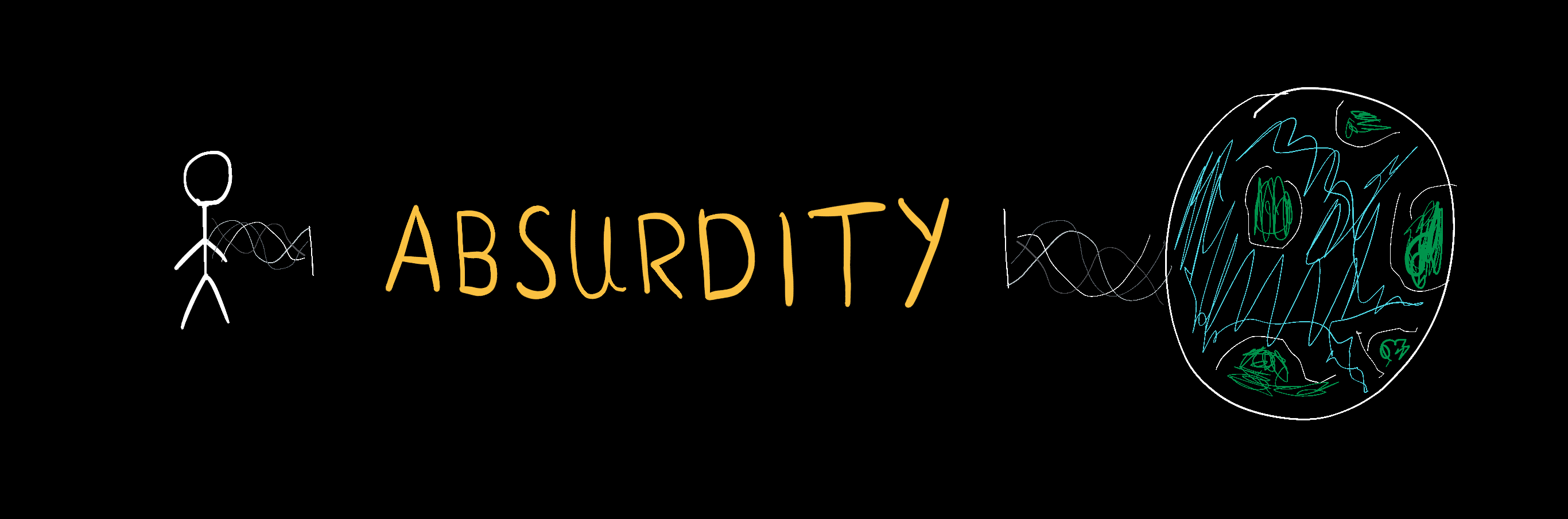
We can define absurdity as the conflict between the human heart’s need for certainty and meaning, in a universe that doesn’t seem to offer us either.
You know the age old story.
Walking to work one day, on the bus to college, or suddenly you’ve hit 30.
And it hits you.
This all seems a bit… repetitive.
Monday, wake up, coffee, one hour commute, work (procrastinate) for 4 hours, lunch, work (procrastinate) for 4 hours, one hour commute, home, dinner, too tired to do anything, couch, Netflix, brain-rot doomscrolling, junk food, feel like shit, sleep at 1am.
Tuesday, wake up, coffee, one hour commute... This is the loop of suffering. Because life is suffering. It’s probably the most fundamental truth there is.
But you don’t have to live your life like this.
You can wake up knowing what you're pushing toward. Commuting can be a time for profound thinking and learning, not scrolling to fill the “dead time” with poison. Work can fund your future work or build your skills. You can see a 9-5 (or some other variant) as a stepping stone into doing meaningful work. Your evenings can be for pushing your own rock - writing, lifting, learning, creating. And you can sleep at 11pm being tired from real effort; not exhausted from nothing.
The trajectory of most people’s lives is determined by what needles - or rocks - they move in their evenings.
If any at all…
There will always be hard days, but they’re hard in a direction you’ve chosen, and not one you haven’t.
I remember watching a Jordan Peterson clip (regardless of your opinion of him) when I was on my lunch break at work when I was 18, and it blew my fucking mind so hard that I had to screen record it. Here’s the profound idea:
You are going to develop a chronic illness at some point in your life, at least one, maybe two. And if it’s not you it’s going to be someone you love. So, what type of person do you want to be when that flood comes?
He ended by saying this:
When the flood comes, and it will, you want to be the person who built an ark.
My mam passed away from cancer when I was 12, after a 2 year battle with stomach cancer.
She was a fucking fighter, and that’s an understatement to say the least! She was, and always will be the strongest person I know. She always kept pushing a rock up the hill, even when the days were hardest, and the rock felt heavier than usual. And she never gave up.
Not once.
Losing a parent at that age definitely gives you a perspective. It was strange being told that I was the “oldest 14 year old” people had ever met. And in all honesty I don’t like talking about all this. I don’t want any sympathy in saying it either. But maybe you can relate to this in some way, because absurdity is a natural response to loss. Especially at a young age. At any age, really.
It crushed me like an avalanche, waking up the morning after the day she had passed.
I’ll never forget that feeling in my chest. I had just woken up, and that first 5 seconds after waking where you’re not fully conscious of anything - and everything feels blissful - it got me in a good mood. The summer sunlight was beaming through my bedroom door which was wide open, lighting up my red and blue Spider-Man themed bedroom that needed to be done up. My first thought upon waking was to run into my mam’s room and say good morning.
That was my first confrontation with absurdity.
It was also the same second that reality crushed me with a whole new rock to push.
My mam didn’t choose her rock.
It was dropped on her, but she pushed it anyway.
I’m telling that story because I’m trying to solve a problem that hits close to home.
It’s also why I’m not giving you a summary that AI can give you with a single sentence request.
Again, regardless of your opinion, I’ve always appreciated how Jordan Peterson lectures. He starts with a question - or a problem - he’s genuinely interested in solving, and he goes on adventure through the abstract world of profound ideas.
Synthesising.
Making connections to looks of theories, concepts, and explanations along the way.
So, we can define the goal of this newsletter as follows:
How can somebody build a meaningful life despite how hard life can be, no matter the circumstance?
We all have different problems. But I want to offer a solution anyone can apply.
Regardless of whether you’re having a bad day, because you failed your 3rd grade math test, or you’ve just come home from your parent’s funeral and you’re facing the void, not knowing what the coming weeks will fire at you. Nobody asks for any of this shit.
But I will say this.
If you don’t voluntarily choose a rock to push, life will give you a rock of its own choosing.
Your first profound action: If you’re serious about this more than most, take out a pen and paper and write down one thing you know you should be doing that you’re not.
Don’t think too deeply about it yet, just write it down for now.
It will be important later on. All you need is one sentence.
II - Illusion
O my soul, do not aspire to immortal life, but exhaust the limits of the possible. - Pindar
The human heart will always seek comfort trying to live a painless life. But that’s impossible, so we reach for illusion instead.
The illusions are devouring us in our 21st century.
I don’t think this is a problem with willpower, because that’s finite. But what isn’t finite is desire.
Unfulfilled desire creates an infinite void.
The void inside us all demands to be filled, and if we don’t fill it deliberately then something else will.
The founder of logotherapy, Viktor Frankl, influenced by his experiences in Nazi concentration camps, believed that when the human spirit gets blocked or repressed, one experiences what he called existential vacuum.
An emptiness that gnaws at you from the inside like a wild dog trying to escape a cage.
Jung saw the same (profound) idea from his perspective:
Until you make the unconscious conscious, it will direct your life and you will call it fate. - Carl G. Jung
When your life force has no outlet, it can turn against you.
Nature abhors a vacuum.
If there’s an empty space, nature will fill it with something.
And if you don’t fill it with purpose, it gets filled with poison.
Scrolling, porn, resentment, bitterness, cynicism; whatever is closest and easiest.
Jung called it “the neurosis of our time.”
Camus called it “an absurd sensitivity that can be found widespread in the age.”
In The Idiot, Dostoevsky says it’s “better to be unhappy and know the worst, than to be happy in a fool’s paradise.”
“Mental illness” is to illness as what “social science” is to science. - Naval
We are experiencing widespread meaninglessness disguised as mental illness.
Instead of confronting this void, we seek relief with illusions. And when you don’t choose your own rock, your energy gets attached to rocks you never dreamed of pushing. Let me show you what this actually looks like.
Brace yourself.
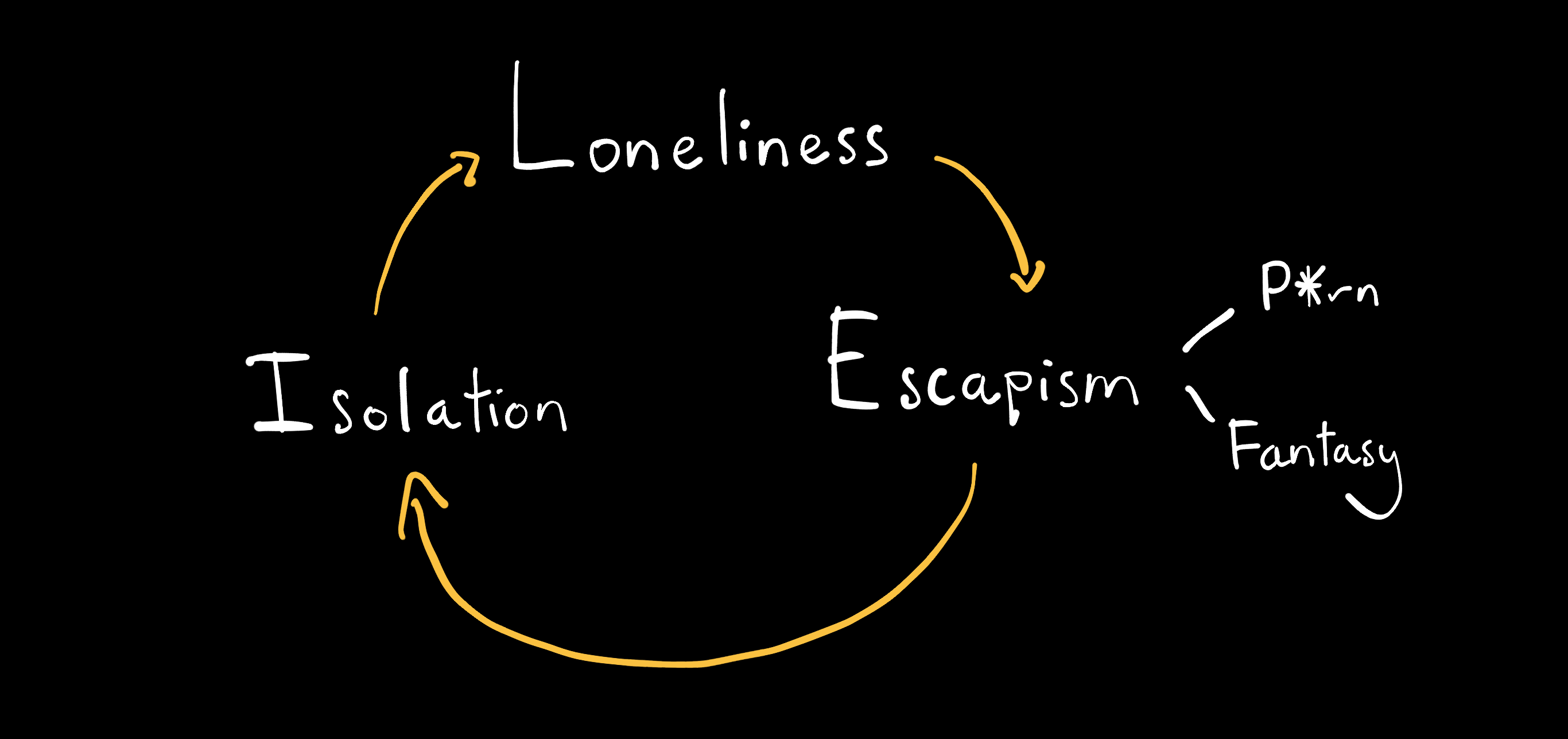
It starts with loneliness.
When you’re lonely you reach for pornography. Not because your mind is broken, but because your brain is desperate for connection and will settle for a simulation when the real thing feels out of reach.
The lonelier you feel, the more you reach.
The more you reach, the more isolated you become.
Loneliness → escapism → deepened isolation → intensified loneliness → escapism…
It’s a recursive loop.
That’s only the first loop.
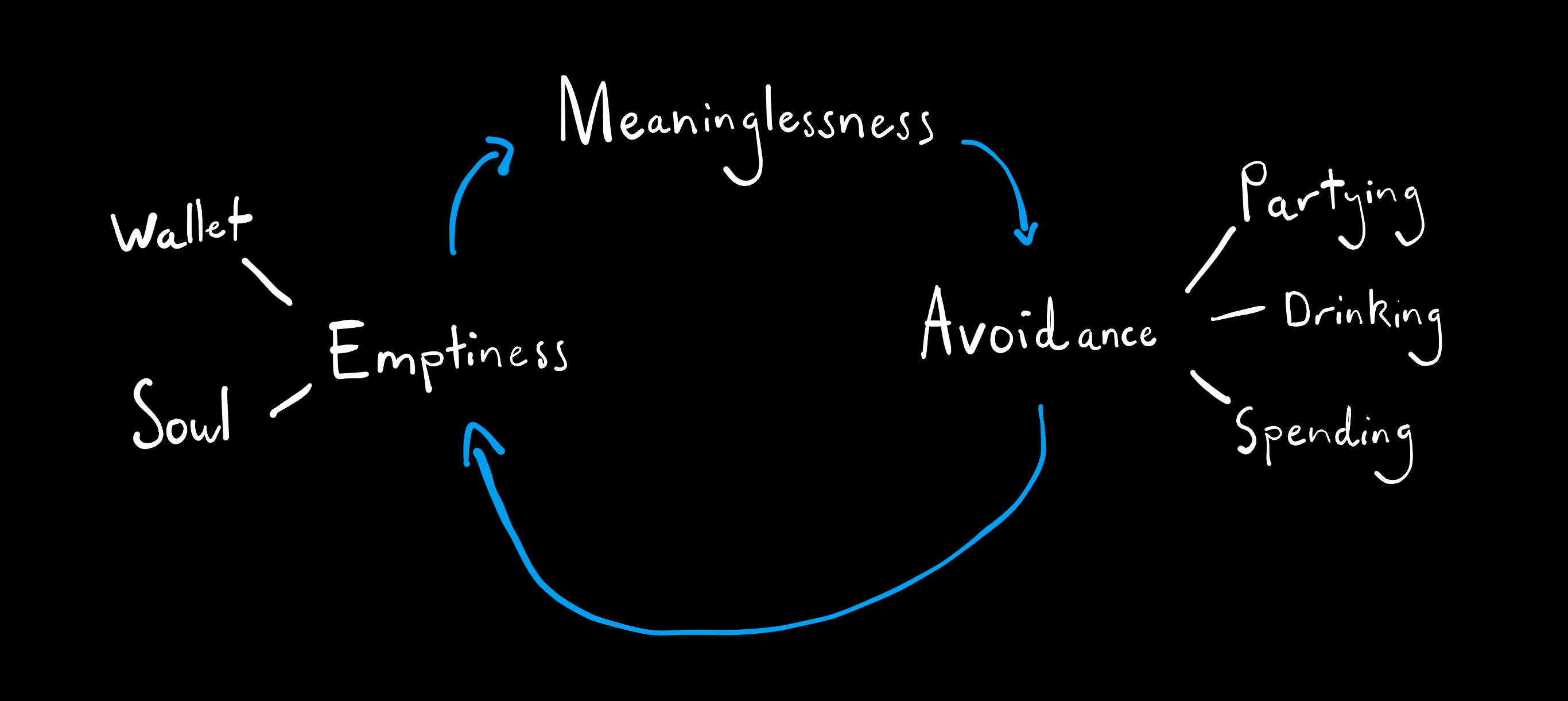
Next comes meaninglessness.
When your weeks feel pointless, you blow half your week’s wage in a nightclub just to have “fun.” To say fuck you to the six other days of the week that made you miserable.
You call it fun, but it only feels like fun because it’s energy looking for an outlet.
This is avoidance coping - a short-term strategy for changing your behaviour to avoid thinking about, feeling, or doing hard things.
Here’s a profound idea that Nietzsche said in Beyond Good and Evil:
The strength of a person’s spirit would then be measured by how much ‘truth’ he could tolerate, or more precisely, to what extent he needs to have it diluted, disguised, sweetened, muted, falsified.
You might think you’re revolting against the absurd by doing meaningless work on your weekdays and partying in response on your weekends. But you’re numbing yourself on a Saturday night instead of confronting the problems plaguing your life from Monday-Sunday.
Reality hurts, but it makes you capable of seeing what’s hurting you and how to overcome it.
Now it gets worse.
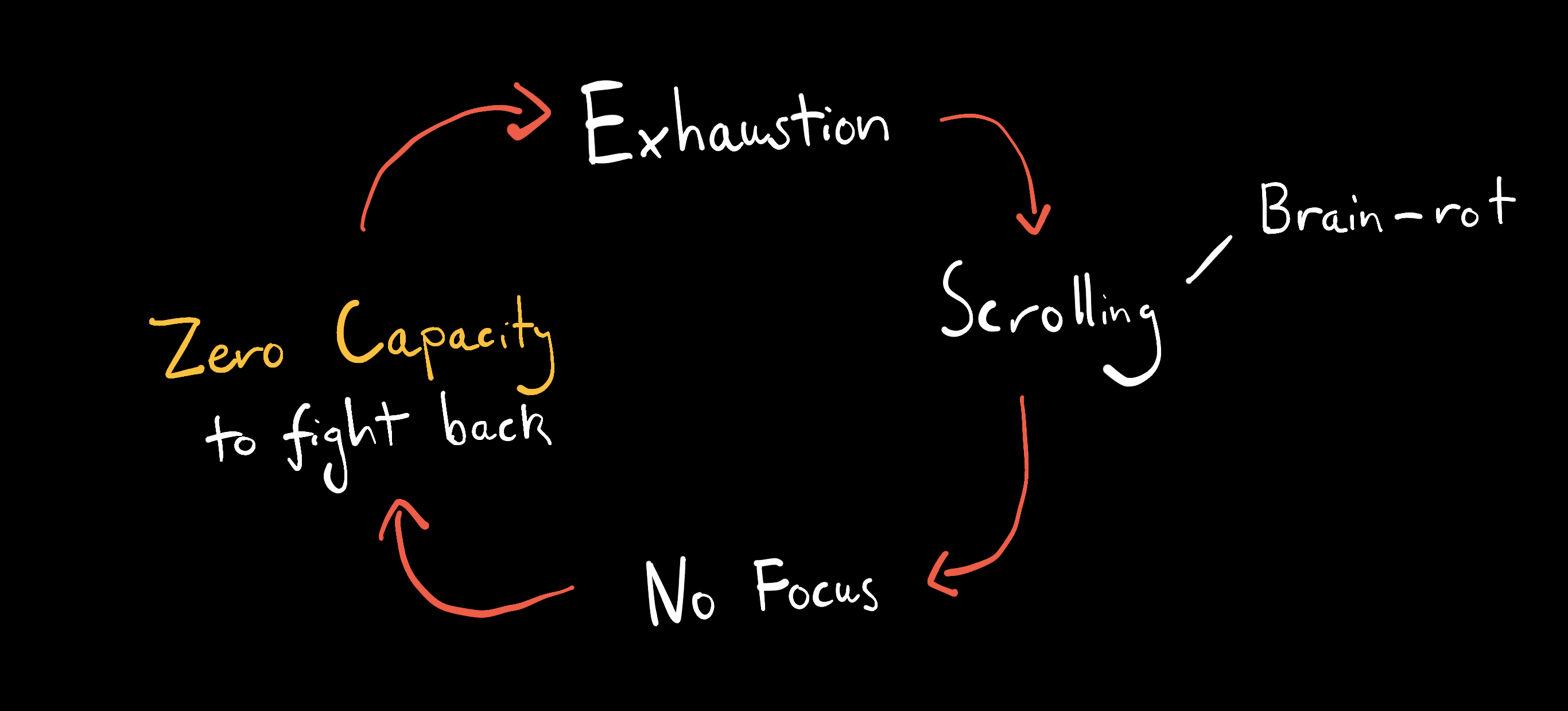
When you’re exhausted, you SCROLL.
You tell yourself you’re taking a break.
But scrolling isn’t rest.
It is cognitive exhaustion pretending as rest.
I know what you’re thinking. Reading this, you are technically scrolling right now. But I want you to gain something greater than the efforts you’ve put into reading this. Not to sound like a guru, because I’m not one. I’m 22. What the fuck do I know. But if all it took was 30 minutes to change the entire trajectory of your life, would you take it?
Here’s a profound idea:
People who scroll for more than two hours a day show a 35% drop in prefrontal cortex activity.
The prefrontal cortex is the part of the brain that controls impulse and focus. Meaning, the one resource you need to fight the doomscrolling epidemic is the exact resource doomscrolling destroys. Your mind is the only weapon that doesn’t need a holster, and brain-rot limits your rounds of ammunition against brain-rot itself.
But here’s where shits gets insidious.
Social media is hardwired to hijack your dopaminergic pathways. You know, the same reward circuits activated by cocaine. Platforms like Snapchat use mechanisms like streaks to keep your brain hooked, like a slot machine you carry in your pocket.
Here’s the hairy part.
Your brain doesn’t feel pleasure from getting a like or a follow, it feels pleasure from the anticipation of getting one within the realm of uncertainty.
So if you want to desensitise your reward system, reduce your baseline motivation, and feel constant apathy, stimulate the fuck out of your mind with socials.
That’s why you no longer feel excited about the small things anymore.
That’s why you’ve lost that child-like interest and curiosity towards your life that made everything feel electric to experience.
And we let social media shape everything about who we are because all we want is validation. We’d rather get our validation from an algorithm than from real fucking humans that live in the real world - real life is lived offline.
We outsource our judgments to algorithms (and machines…) because we’ve forgotten how to judge for ourselves.
Of course, it doesn’t stop at the digital realm.
When we think of luxuries we think of McLarens and Rolexes. But there’s a difference between being rich and being wealthy.
This comes from a famous study on the hedonic treadmill, which I think will completely rewire how you think about success:
People who win the lottery and people who become paraplegic both return to baseline happiness within two years.
We adapt to the things we buy, and return back to baseline happiness shortly after purchasing them. It’s how our dopamine systems are designed to work. I read this in Dopamine Nation by Dr. Anna Lembke in my first year of college (I tried memorising the whole book line by line haha)
Here’s a profound idea that stuck with me, and it will likely stick with you too:
For every bit of pleasure you feel, you will feel the same amount in pain before returning to baseline levels of dopamine.
To sum:
The void doesn’t care what you fill it with.
Porn.
Parties.
Scrolling.
Validation.
Possessions.
It swallows them all and asks for more because none of them were ever meant to fill it.
It’s easy to revolt against your own life when you don’t have a life to begin with, and that’s why most people seek illusion instead of actually embracing life and its limits.
As a result we become weak.
Resentful.
Bitter.
Cynical.
If there are three emotional states to avoid in life at all costs, it’s those three. That’s my opinion, anyways.
Listen.
I love going out drinking with the lads once or twice a month and getting buckled. I love looking at seal memes, and sending Instagram carousels of otters to my girlfriend. And I love getting a Dominos on a Friday with the lads, one of them more or less owning the pizza cutter in my house at this point - it’s basically his (love you Eric).
I’m talking about this.
The point is recognising the difference between choosing pleasure as part of a meaningful life and escaping into pleasure to avoid confronting meaninglessness.
Here’s our second profound action for today:
Define one escape you use when stressed, bored, or sad.
Write it down, and write down what you could do for 1-5 minutes instead that would actually push your rock forward.
I say so little time because time doesn't matter. It's the way you act and move a needle in that time that does.
And this is the craziest part about all this that nobody fucking cares about...
Everything is amazing now and nobody is happy.
You have infinite leverage with AI. Access to all known information. You’re not like Nietzsche or Dostoevsky who were limited by the books they could afford and find. You don’t need to work day and night in factories like how it was in the Industrial Revolution. You can start a newsletter, share your creations, learn marketing, and earn a side-hustle/passive income writing essays like this fucking one.
More tools.
More access.
More abundance than any generation in human history - and meaninglessness is sky-high.
Why?
Because we abuse the abundance. Our minds are hardwired to seek the treat.
We use infinite leverage to scroll infinitely. We use access to all known information to watch strangers dance for fifteen seconds at a time. We use freedom from factory labor to sit in fluorescent offices doing work that makes us feel nothing, messing up our circadian rhythms in the process too.
Most people choose illusion because it’s easier than revolt. But reality can only be tolerated by a select few. And those select few are the ones who reap the rewards most.
You can’t expect to live a meaningful life when all you’re doing is deluding yourself from living the one you have, and you can’t live a meaningful life when you’re trying to avoid the only life you do have.
Illusion is corrosive.
It slowly erodes the chances you have at this one life. It doesn’t sculpt you into the statue you want to become - it breaks the marble down into the dirt beneath you.
Every moment spent in illusion is a moment not spent building an Ark.
Every escape is a choice against meaning.
Every distraction is a vote for fragility.
The point isn’t to make it through. The point is to live.
The question isn’t really whether life is absurd, but what rock are you currently pushing, and which rock do you really want to spend your one life pushing? Because there’s a difference between pushing in circles and pushing upward. And that difference changes it all.
III - Progressive overload of the soul
Having stuff isn’t fun. Getting stuff is fun. - Jimmy Carr
We now turn to the final chapter of Camus’ The Myth of Sisyphus.
To the menial thinker, the story of Sisyphus looks like a tragedy.
But you shouldn’t be quick to call Sisyphus a victim of his circumstances.
Camus calls him the absurd hero.
Why?
He’s doing the same thing over and over for eternity with no apparent benefit? Like running around in a circle.
I think this is why hell is conceived as a circle, or as a series of circles in Dante’s The Inferno.
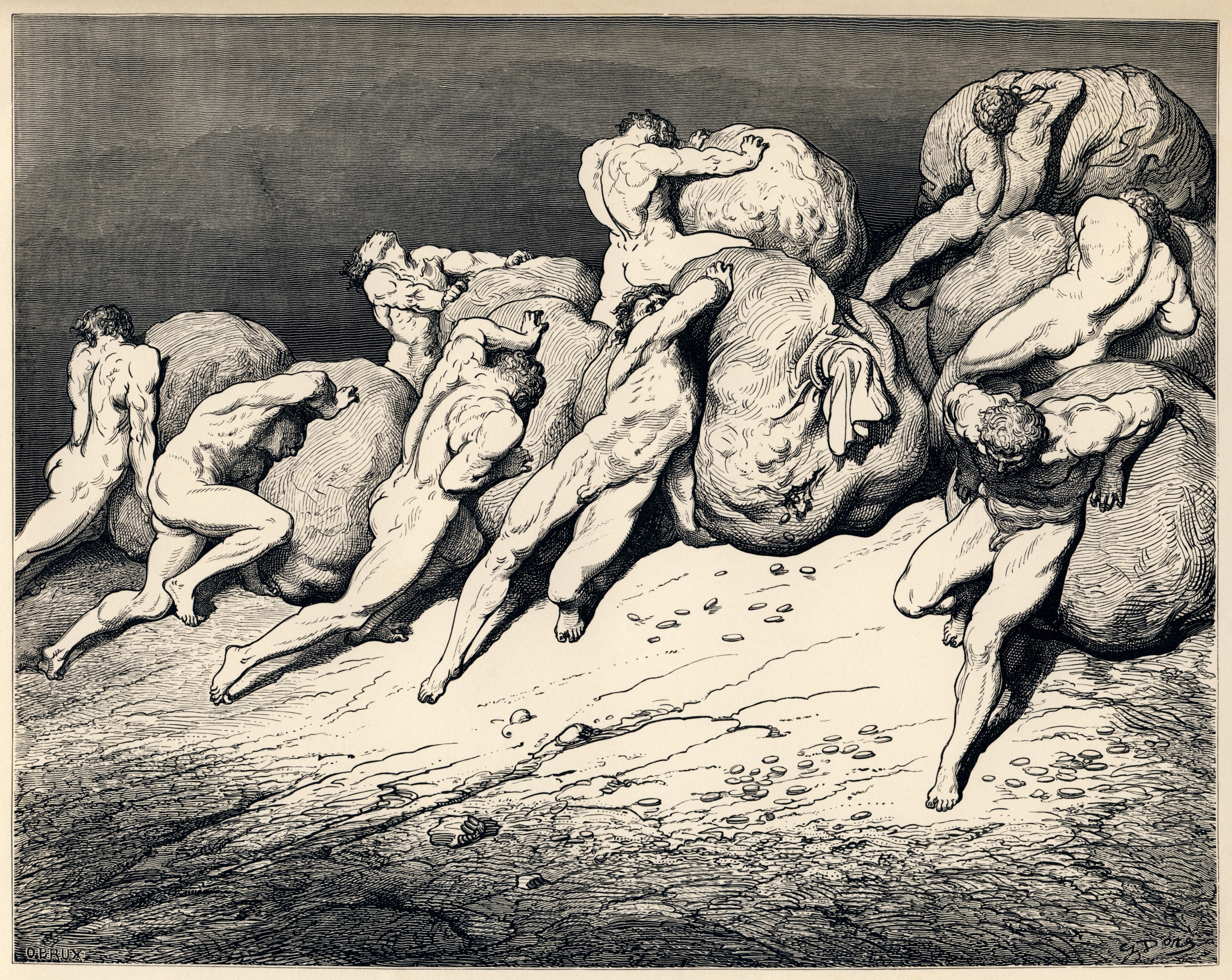
Albert Einstein defined insanity as doing the same thing repeatedly while always expecting a different result upon every attempt. Naval defines iteration - a profound idea I never shut up talking about - as a learning loop. You try to achieve something, you see what physics, free markets, and mother nature have to say, and you reflect on that feedback and try achieve it with more clarity and knowledge this time around.
You hunt like a lion, you rest, and reflect before you hunt again tomorrow at dawn.
Me myself? I firmly believe that happiness is found in progress. That most people don’t lack meaning, they simply lack movement towards something worth their efforts. They have no rock to push, or a rock that’s theirs to push.
I’m going to offer a question, then:
What if meaning is to be found in a progress loop?
If all you’re doing is pushing the same rock day-in and day-out, always expecting your life to change... simple logic will tell you that this is hell. You’re moving around in a circle.
I have a pretty good analogy to make here, and it’s one you might be familiar with.
Lifting weights in the gym looks like torture.
Lifting a barbell off the floor only to repeat it 11 more times, only to come back and do it all again on Thursday coming.
Here’s one thing that never gets discussed about Sisyphus:
Progressive overload gives the push a purpose.
That’s what distinguishes exercise from training. Simply moving around a gym randomly from exercise to exercise, vs adding weight to the bar with intention and a vision to achieve.
It’s torture vs training.
This turns the circle of hell into an upward spiral of progress:
Week 1 - You do random exercises because you’re clueless
Week 2 - You bought a beginner’s program to follow
Week 3 - You add 2.5kg to all your exercises
Week 4 - You add 2.5kg to all your exercises
...
Week 12 - You’ve added 8kg of muscle and lost 10kg of fat, and never want to lift less than two session per week ever again
The rock is the same, but the pusher gets transformed on every repetition, giving the endless pushing a purpose. You keep going to the gym twice per week, the exercises remain the same, but the load gets heavier because your back has gotten stronger, and you reap the rewards of bearing a heavier load than most - an epic physique.
But here’s where it gets interesting.
The human psyche actually does develop in a spiral, not a circle.
Human development is non-linear and dynamic. Everyone across the global population is at a different stage of development in terms of their levels of awareness. And since we are all at different stages of development in terms of our thinking - this is really a model of awareness about your own thinking - it means we all encounter problems differently depending on our level of development.
This is why progress moves in a spiral, not a circle.
You can encounter the same problem across years, months - even every Sunday for example - and be at a different stage of development upon encountering it.
Let me give you an example.
A baby can’t open a chocolate bar because it doesn’t know what a chocolate bar is, or that it can be opened and/or consumed
A child cries when they can’t open a chocolate bar and thinks to go to their parents
A teenager can’t open a chocolate bar so they use a scissors
An adult doesn’t want to eat the chocolate bar because they know it will make their stomach feel sick
Same problem, but four different responses based on four different levels of awareness.
This is why the problem of meaninglessness is so hard to solve practically.
We are all at different stages of development, meaning we all see and approach the world differently with our own individual thinking. My mind is going to approach this problem very differently than your unique mind. Same with the mind’s of my friends, and of your family. No two souls will read this newsletter the same way, and take the same two ideas from it, and create the same understanding of what to do once they’ve finished reading it. This is one thing that makes your mind incredibly unique.
Yes, I am talking to you.
Here’s the profound idea as to why.
You see what you aim at.
Aim at nothing and you’ll see nothing worth pursuing.
Aim at comfort and you’ll see threats everywhere.
Aim at growth and you’ll see opportunities all around you.
This is why two people can face the same problem and respond completely differently.
Now.
Let me give you the two loops that determine everything.
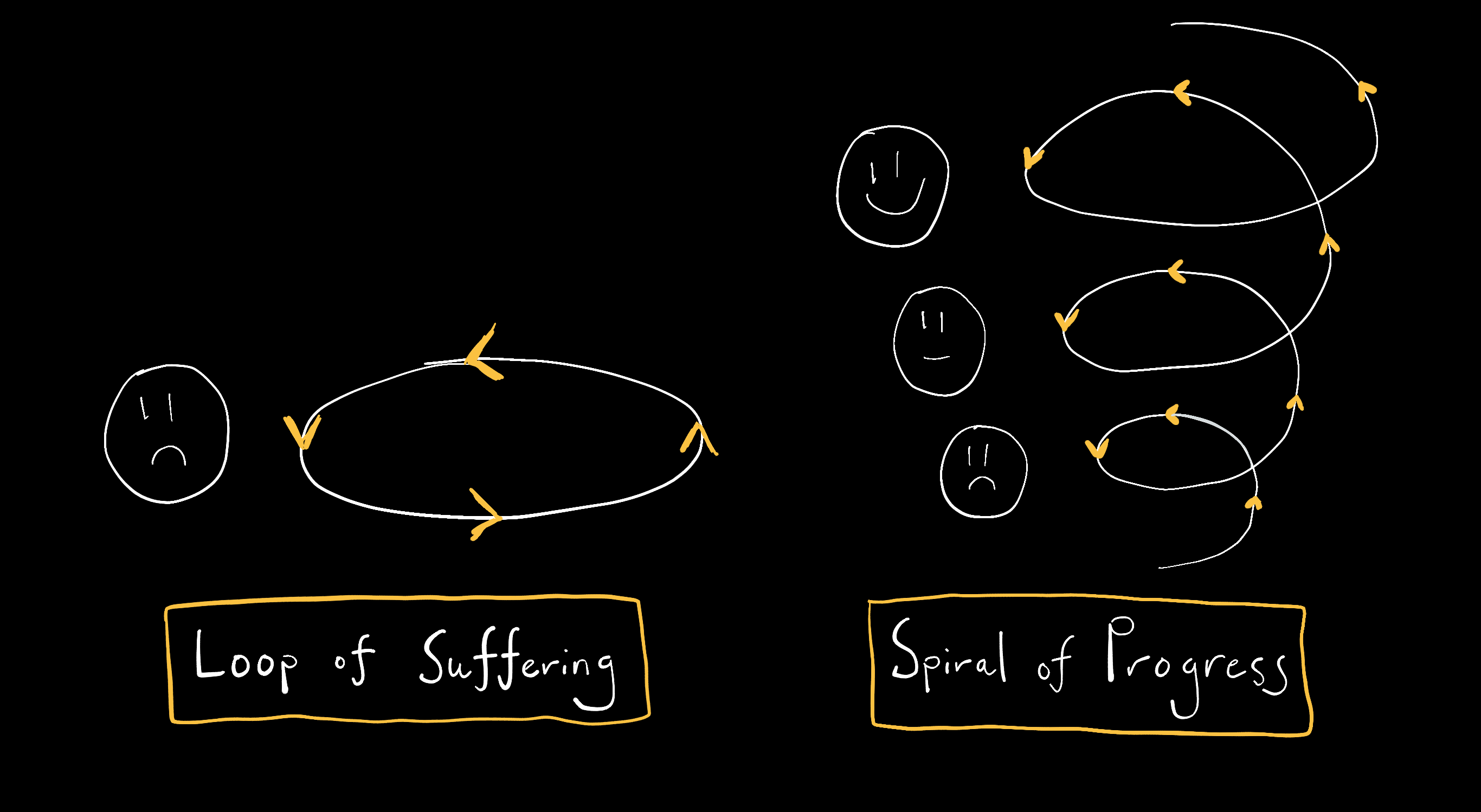
Spiral of progress
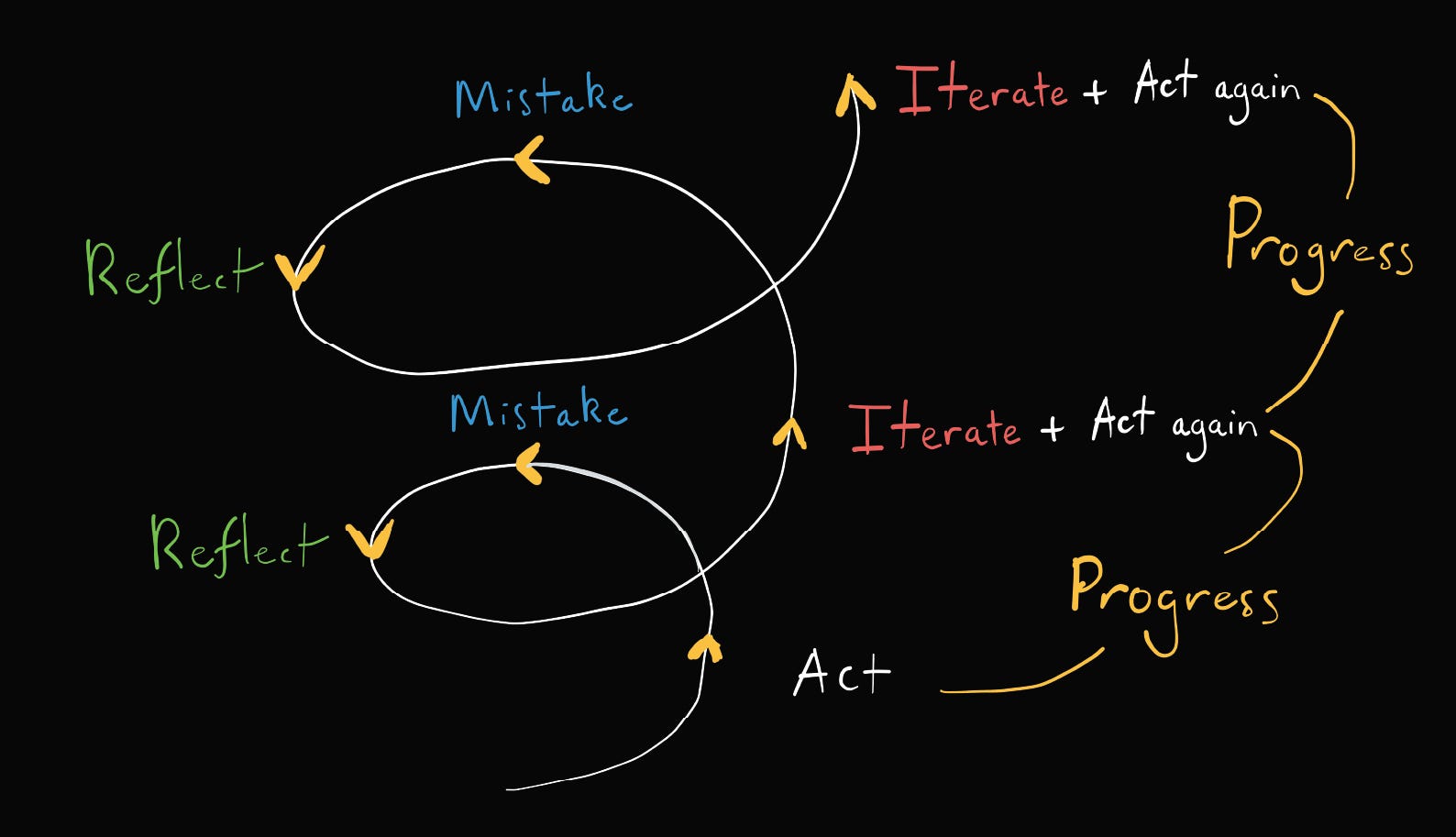
You act → make a mistake → reflect on data → iterate and act again
Loop of suffering
Safety → predictable → stagnation → death of meaning → moving in a circle → hell
Here’s another visual to explain the spiral of progress:
Life is going to throw rocks at your feet and force you to push them. Death, sickness, cancer; you understand this by now. The weight of the rocks will never get any lighter. Ever. If anything they’ll get heavier the longer you are alive. And when that comes, you want to be the person who built an Ark, who has the muscles ready to push big rocks when they come crashing down.
The rocks will never get lighter, but your back can get stronger.
Now, I know what some of you are asking.
“Craig, if progress is the answer, then why does starting feel so impossible?”
This is a BIG problem for most people, and we finally have an answer as to why.
Starting feels hopeless when you can't see where you are going. When you’re at an early stage of development, the path forward looks like a fog. You don’t have enough clarity to see what your next step should be, and that’s because you feel safe and accustomed to moving in a circle. Your mind almost wants you to keep moving in a circle because that’s all it’s ever known - safety.
Clarity doesn’t come before action, it comes from action. You don’t think your way into a new way of acting. You act your way into a new way of thinking.
It takes about 1-2 months of chaos, confusion, and feeling like you’re on the verge of throwing it all away for the right amount of vision to form where you have absolute clarity and launch into a new way of life.
The first step doesn’t need to be the right step, it just needs to be a step, because that’s what generates the data you need to take the next one.
Think of the following examples:
Writing 500-1000 words about your interests every morning, even if you don’t know how to write persuasively yet
Doing one set of squats in the gym and then leaving after that one set
Sending one message to someone you’ve been meaning to talk to for months
Reading one page of a book - even one paragraph - and thinking about it as deeply as possible
This is the part that sounds like bullshit until you’ve lived it.
You have to fake movement until you become someone who wants to move.
You have to fake bravery until you feel it.
You have to fake discipline until you build it.
You have to fake curiosity until you fucking find it.
This is an identity shift.
Not waiting until you feel like the person who can do hard things, but acting like that person until the feeling catches up. The high-quality actions must come first if you expect a high-quality identity to forge.
Let me give you a personal example.
3 months after I started lifting weights, the results shocked the life out of me.
I was 16, and I was no longer tired walking up the two flights of stairs in my house. I live in my attic, so yes, two flights - I know that scares some people. I stopped feeling like the skinny kid anymore because I had packed on some mass, and I was getting tons of compliments from the lads at school. And I stopped playing video game instantly. Life seemed like a better video game to play instead.
What about you profound thinkers? I haven’t forgotten about you:
The reader who reads one page a day and thinks about it deeply - in a year, that’s 365 pages of real understanding
The writer who writes 500 words per day - a 5,000-word essay done in 10 days, submitted a month early (like what I did in college!)
The person who does 20 minutes of focused work on their side project daily- in 60 days, they’ve put in 20 hours of real progress
All of this creates tolerance.
By engaging in this progress loop you build tolerance for the weight. Not because the weight gets lighter, it never fucking will. But your capacity to bear it increases.
You don’t try to make an anxious person less anxious, you make them braver. Tolerance, learning, and personal development compound through these loops. You develop a coat of armour against absurdity by doing this. By becoming the kind of person who can push the rocks voluntarily while trying to be happy.
Camus said that one must imagine Sisyphus happy.
I say, we should imagine Sisyphus trying to be happy, because he’s all in no matter what. He’d might as well make that choice.
If you lack meaning, you lack movement. Happiness isn’t a place. It’s the feeling of your feet moving towards somewhere new. So, how can we start to develop our backs muscles, then? To do this, it’s important to understand how meaning is built through taking voluntary responsibility. This is what I call the trinity of meaning.
IV - The trinity of meaning
Here’s how to build a meaningful life.
If meaning, purpose, and happiness are to be found in progress, and using the Sisyphus myth as our unique mechanism, let’s outline the framework as follows.
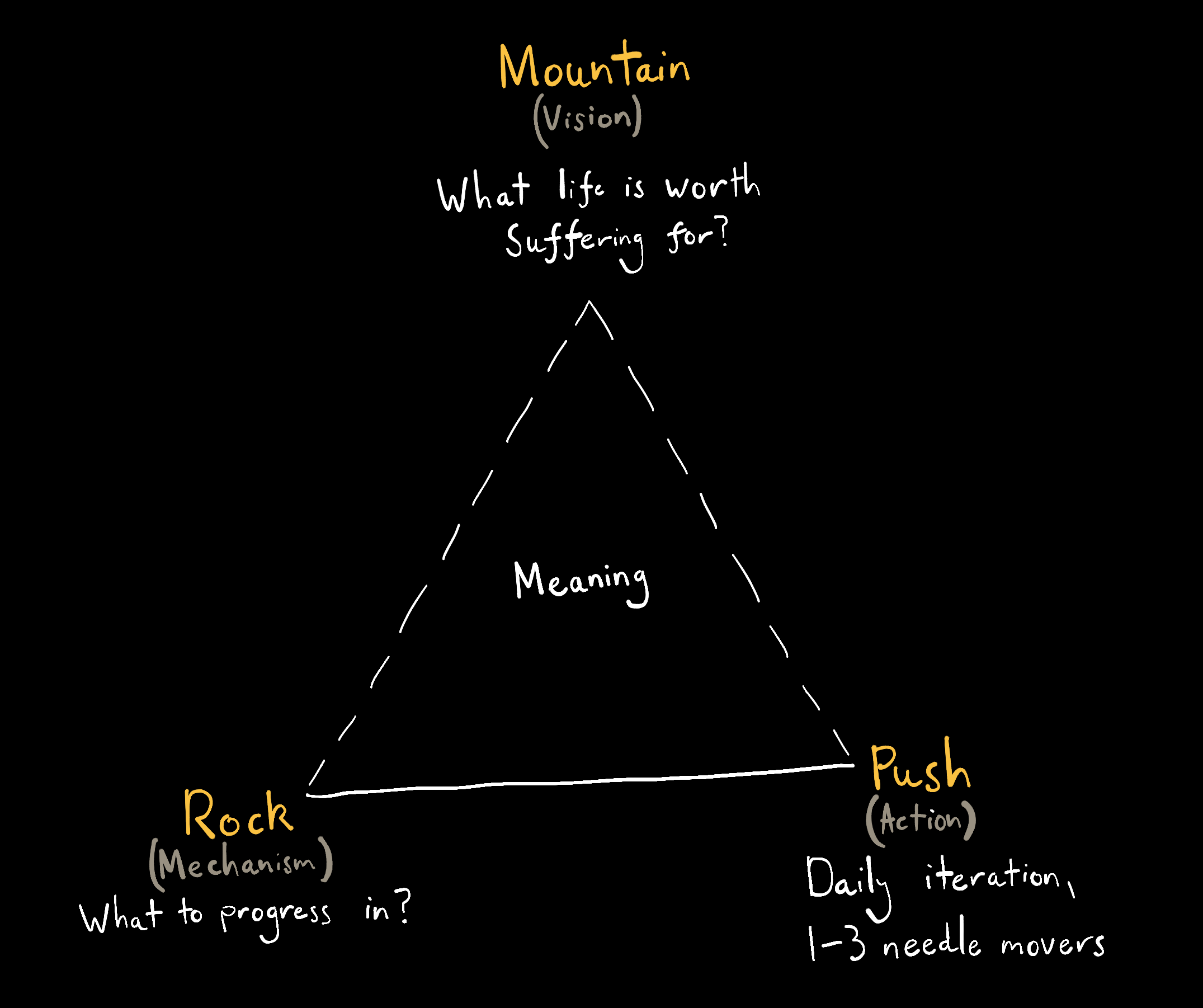
The rock is objective responsibility.
The push is subjective effort.
The offer to help other people 1-3 mountains behind you push their rocks is collective value.
First, choose your mountain
Before you pick a rock, you need a mountain.
This is your vision to work towards.
Ask yourself this:
What life would make your existence worth suffering for?
What would you be proud to have built when the flood does come?
A meaningful life, we can say, has at least three pillars:
Work that challenges and fulfils you - a career, freelance creative work, a job that has you excited to slingshot out of bed each morning
Financial control - not being ruled by desire; 3-4 days of meal prep is cheaper than one meal at McDonalds; every time you don’t spend money you save it
Relationships you’ve deliberately built - starting with yourself; instead of asking “how can I find the one,” ask “how can I make myself into the best possible partner?”
The reason I say these three pillars is because they are the 3 big markets of health, wealth, and relationships. That’s where value exchange happens most in free markets because that’s what everybody desires and pays money for improving.
Nobody is perfect, so you shouldn’t expect the way you should live your life to be either. But these are better rocks to be pushing than none. These are good things, because they are better than the alternatives of being broke, having vices control your bank account, being isolated and alone, and being covered in Cheeto dust working a job you hate for 30 years while living in your parent’s spare room.
Second, pick your rock
Your rock should have three qualities in being the right one to push, for you, right now:
It scares you slightly - you’re not sure you can do it, but you’re curious
You can push it for 20-30 minutes without dying - it’s challenging but not crushing
Pushing it makes you stronger - it builds a skill or capacity you want
Here are some examples across a few domains that most people deem as being meaningful:
Health - 20 minutes of lifting, a 10-minute walk, meal prepping for 3 days
Creative work - Writing 500 words, reading 1 page deeply, 20 minutes on your side project
Career - Sending one important email, applying for 3 new positions, 20 minutes learning a new skill
Relationships - Sending one message to someone you’ve been avoiding, 10 minutes of genuine listening, writing down what you actually want in a partner, or better, how you can be a better partner that other people would want to be with in the first place
Do 1-3 of these needle-moving tasks per day. Look at the examples above to see what I mean. See how they are measurable and lever moving? Not “write for an hour",” but “write 500 words in 30 minutes.” See the difference?
Your next profound action: Pick your rock using the three qualities above.
Write it down. Set a timer for 20 minutes and push it.
That’s it, that’s the whole system put as simply as I can.
Thirdly, at last, we have the push
You’ve given yourself something to aim at with choosing a rock. But this is where the difficulty is, and paradoxically, where all the joy comes from.
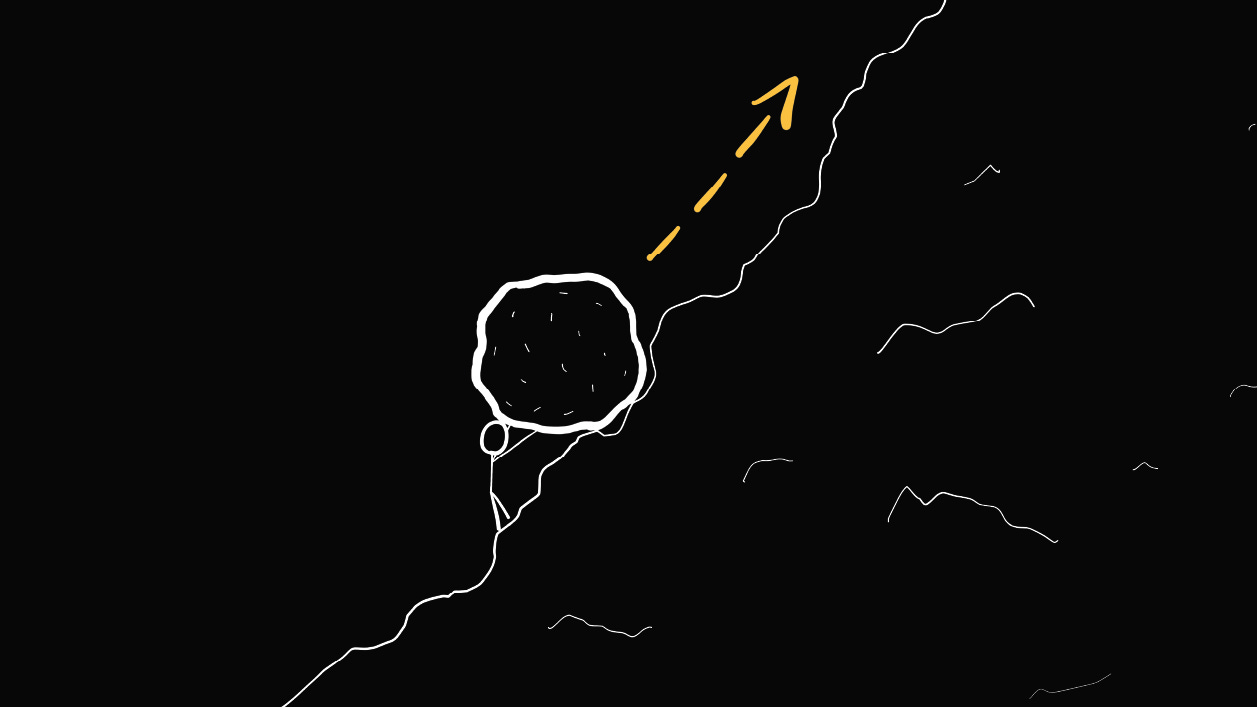
Meaning is found in friction. It’s found in the push to keep on fighting even if you’re losing the round no matter what.
If that’s in a jiu-jitsu competition, it might be giving up towards the end, but making it as hard as possible for your opponent to win in those final seconds. Or a 6am start before a 10-10 shift at a job that swallows your days, preventing you from being in places and doing work that makes you happy; but you know you need the money, and your newsletter won’t write itself beyond 10am.
Once you start pushing towards something you want to achieve, likely a vision of some kind, you need iteration. I don’t believe in the whole “it takes 10,000 hours to become a genius” thing. I think it takes 10,000 iterations. It takes 10,000 cycles of the learning loop, that is, iteration
You delay taking action because you think you need to learn more first. But the real learning only begins once you start doing. - Jude Fredman
Failure is feedback for iteration.
You try, physics has something to say, you adjust. The only true failure is not starting or not reflecting at all.
Pick your aim, your rock, and a mountain to climb.
You don’t need to spend hours and hours every single day fixing your life. You need 1% improvements which are permanent, but done daily. For example, if I understand intuitively how to write hooks at the start of my newsletters, that’s done. Any other improvement is a micro-detail. Understanding the big picture of a problem or topic is HUGE. Once you know how to write at least not a terrible hook, if it’s intuitive, that problem stays solved forever. Same with outlining, editing, persuasion, flow.
In all honesty, I think once you start this journey you won’t be able to unsee what you’ve seen.
You’ll feel different from people who are still trapped in illusion. You might feel isolated for a while, and that’s the cost of awareness, or “being a smart person” as everyone loves to say about themselves online.
Yes, you might miss some nights out. Yes, some people won’t understand why you’re being so locked in. But you’ll find new people climbing their own mountains. They’re often quieter, harder to find, but worth the search. And the people who matter will respect your pursuit, even if they don’t understand it… yet.
This is the price you pay to live a life like nobody else.
I really like the profound idea that you should never listen to somebody telling you how to live your life, if they’re not living the type of life you want to live yourself.
I’m not saying you should become a monk, or go “monk mode.” I still go out with the lads once or twice a month and get buckled. I love looking at seal memes and sending Instagram carousels of otters to my girlfriend. And I love getting a Domino’s on Fridays with the lads. The point is recognising the difference between choosing pleasure as part of a meaningful life and escaping into pleasure to avoid confronting meaninglessness - like we have said.
Like how the gym doesn’t just give you muscles; it gives you 45 minutes of being fully alive, fucking shit up with the weights, and knowing you’re becoming someone who can push bigger rocks quite literally. And it gives you a chance to listen to Three Days Grace, Breaking Benjamin, and Linkin Park, and who doesn’t want that?
Your life will become a better video game to play if you pick a rock to push yourself.
We’ve covered a lot of ground, so I want to help you out with understanding whether this is working for you or not at any given time.
You’ll know this is working when:
You catch yourself looking forward to your rock-pushing time. Not dreading it, not forcing it, but actually wanting it. Interest is the ultimate form of leverage you have in life. If it feels like fun, and not work, it’s working!
You start saying no to things without guilt. The party you don’t want to go to, the scroll session you don’t need, the “opportunity” that’s actually a distraction. If it doesn’t move you closer to your vision, it’s a distraction
You notice you’re handling stress better. The same shit still happens but it doesn’t crush you like it used to. You’ve built tolerance
You feel a quiet confidence you can’t quite explain...
You don’t need a radical transformation, you need subtle wins that compound and connect to one another, that integrate to form a way of life you truly want to experience daily.
Your first week will feel like shit. Total chaos and confusion. You’ll feel like you’re doing it wrong, but you’re not. Everything is data for iteration next week
After your first month things will feel better. You’ll have some small wins and the fog will start to lift. And you’ll finally have days where you actually want to push your rock
After two months, your vision will have mostly formed. You can see where you’re going now. The 1-2 month mark is when you know this is working. Your improved strength will show for it too
From months 3-6, there’s been a measurable transformation. People start noticing, you start noticing, and the identity shift has taken hold. Your vision is always iterating as you are, but you have a direction, which is the main thing
Month 12 and beyond, you’re unrecognisable compared to who you once were. You’re not a different person, you’re just who you were always meant to be
The 1-2 month mark is when the fog lifts. That’s when you know it’s working.
I thought I would include a little timeline like this because this is what I’ve experienced in my own life. I think I’m currently going through another identity shift, and have been for about a month or two now, maybe three.
But to conclude my waffling, and to return to Camus’ words, you want an indifferent smile to life. By accepting the weight of the rock you become free of it. It will no longer crushes you but gives you ample opportunity to push. And I think there is no greater thing to strive towards than that.
To stand at the bottom of a mountain of your own choosing, preparing to push your 978th rock, and cracking a damn smile knowing this will be just beyond your zone of current proximal development.
It’s not an easy pursuit, but it is yours. So make sure it’s your own.
I appreciate your time and attention, I know it’s very valuable.
Hopefully you gained something greater than the time you put into reading this.
You’re an absolute legend.
- Craig :)
If you have any requests for a newsletter you’d like me to write (free or paid), tell me with this button. If not, no hard feelings:
As Aristotle writes in Ethics, “For, as we said, happiness requires not only perfect excellence or virtue, but also a full term of years for its exercise.”
Happiness, then, is less a state we arrive at and more a choice we repeatedly make, sustained over time through how we live, act, and practice virtue.
I, without a doubt , loved reading every word in this piece. Thank you