


Having multiple interests will feel like a burden if you don’t create a vision that integrates them.
First objection:
What authority do I have in saying this?
Well, I am a 22 year old Irish dude who started writing a weekly newsletter when I finished college as a vehicle for my own self-education.
Writing my newsletter is my personal vessel for managing many of my own multiple interests.
But even if you’re not looking to write online, I think I have a unique perspective to offer on this topic.
This newsletter is for a special type of person.
To those who love reading, writing, fitness, personal development, their friends and family and career, but can’t seem to give enough attention to any of them.
To those who feel like every interest is stealing time from pursuing other ones.
To those who feel guilty reading a book when a college deadline is near.
To those who train extra sessions in the gym when they know they should really be learning skills that will actually serve their future.
Have you ever felt so alienated by super-productive people who think they’ve solved the focus problem and you haven’t?
What about the drain that comes from not knowing what decisions to make, or what interests to follow first thing in the morning?
There is nothing more debilitating than quietly letting curiosity feel like a source of shame.
For the longest time, it always felt like I had far less focus than I thought I was capable of.
I used to go on walks and listen to productivity gurus talk about how they could do 4x what I was doing, so naturally, I thought I was definitely the problem, like I had a focus issue.
And because I wasn’t moving any needles, I would feel guilty going to jiu-jitsu or seeing my friends.
I gave up reading for some time too, because I didn’t want to waste my limited focus per day on anything but my writing.
Letting yourself frame your own curiosity as a liability is not a fun way to live.
The real problem here is serving one interest at a time instead of a vision.
Most advice on managing multiple interests says to pick one interest, niche down your focus, and don’t do anything other than that one interest.
And if that advice has ever felt wrong to you, almost like it was designed for a different kind of person... you’d be right.
I’m going to show you why most productivity advice is biased (and how you can build something better).
The person who loves fitness and reading Greek philosophy and studying Jungian psychology and writing... they are the person most likely to lack a mission that makes every interest feel like they serve one another.
That’s what this newsletter is about, helping you make every interest feel purposeful and relevant.
Not a single ounce of your time wasted.
Every interest amplifying each and every other one you have.
We’ll cover the philosophy behind why this works, with three profound ideas that will change how you think about your own development, and a practical framework you can start using immediately.
By the end of reading this, you’ll have a clear structure for managing every interest you have, without feeling the guilt that comes from being unable to manage any of them :)
You can watch the video-version of this newsletter, where I use mind-maps the explain the heavy concepts.
You can listen to this while on a walk, on Spotify, here:
Most interest-managing advice is destined to not help you
Most people who are deep generalists or polymathic by nature, do the following.
Time block each interest.
Pick the one main interest that takes total priority (and secretly shelve the rest).
Feel guilty about spreading yourself too thin.
Eventually burn out or drop every interest entirely.
This usually happens because most productivity advice is quadrant biased.
Meaning, the advice favours or optimises one domain of life, while letting the other domains atrophy.
Specialising on a single interest in this manner can be a lot more dangerous than you might think.
Think of the well-educated readers who have read hundreds of books but are socially isolated and don’t have anything concrete to show for their knowledge.
Think about the full-time business owner earning tons of money, but who has deteriorating relationships and terrible physical health.
Or the bodybuilding meathead with a brilliant physique who can’t think for himself or hold a conversation for more than 5 minutes.
Or the person - or people we all know - who has spent 50 years obsessing about their career, but has no interests, hobbies, or even an identity outside of their “life’s work.”
Specialisation can make you fragile if you aren’t careful.
You can probably feel this in your own life, as if something is off, because you’re doing well in one or even a few areas of your life, while letting other ones quietly decay.
If you’ve ever had a great week of productivity but felt physically drained, or a great week of training but felt like your mind was turning to mush, that’s what quadrant bias feels and looks like.
Here is a profound concept you aren’t taught in school, and it will change how you see this problem entirely.
The AQAL model, from Ken Wilber’s Integral Theory, is a way of looking at life through four dimensions simultaneously. Think of it like this: most life advice you receive only looks at your life through one perspective. The AQAL model says there are four perspectives, and you need all of them to see the full picture.
Here is what the model looks like (in the top right), and what each quadrant means:
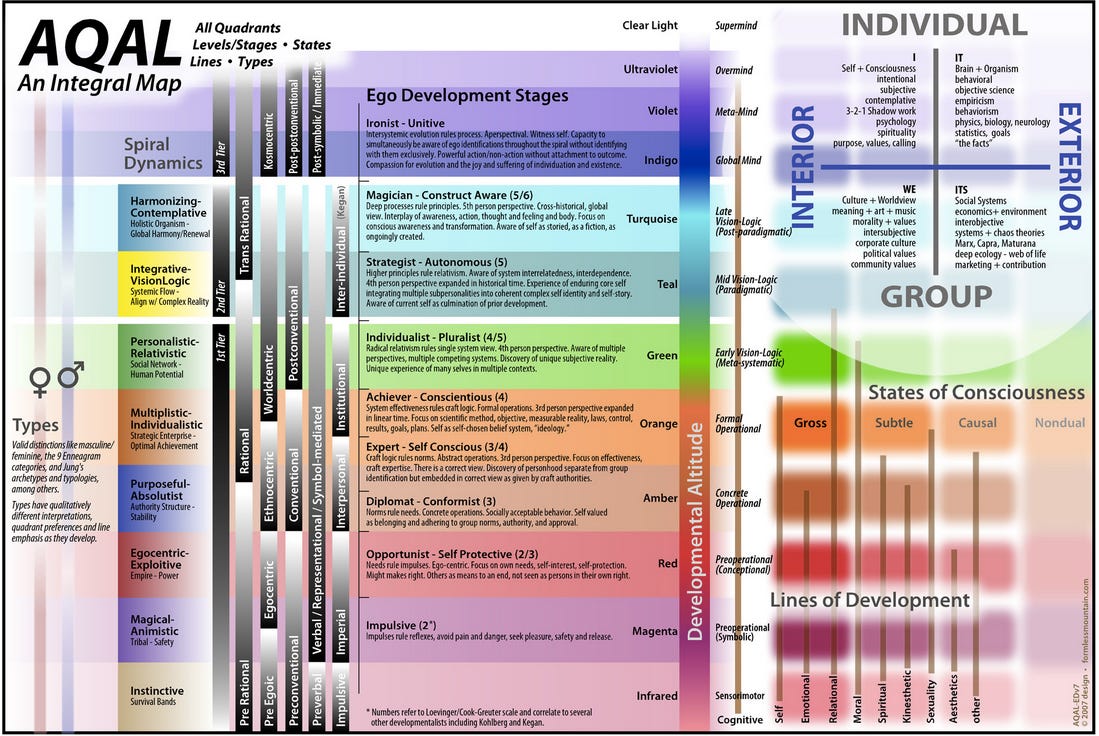
The four quadrants are:
Your inner world (Interior-Subjective) - your thoughts, emotions, desires, motivations. The mind.
Your biology (Interior-Objective) - the mechanisms working within the brain (not to be confused with the mind) and body. Your nervous system, your hormones, your physical health.
Your culture (Exterior-Subjective) - the shared beliefs, expectations, and norms of the people around you. What society tells you success looks like, and how you “should” be managing multiple interests...
Your environment (Exterior-Objective) - the physical world you interact with. Your tools, your routines, your living situation.
So, why is this relevant for you to understand?
Each quadrant shapes all other quadrants simultaneously.
When a productivity guru tells you to focus on one thing, they’re giving you advice from only one quadrant.
For that specific case, it’s USUALLY only from the exterior, systems-based quadrant (on the bottom right)
They’re ignoring your inner drive to explore (quadrant one), the way your brain actually learns best across multiple domains (quadrant two), and the cultural pressure that made you feel guilty in the first place (quadrant three).
That’s why the advice feels wrong.
It’s just incomplete.
And once you see this, you just... can’t unsee it.
Ever, or anywhere.
I’d recommend exploring the AQAL model if you’re interested in this type of stuff. Let me know if you’d like a newsletter giving you my personal perspective on it.
3 Profound Ideas to change your life
Now that you can see the problem clearly, here are three profound ideas that will reshape how you think about your interests.
I - Your Interests Are A Network
This is why I think it’s so important to understand schema theory in learning science.
Your brain stores information as spider’s webs. They’re called schemas, or mental models or frameworks, even.
Not isolated facts or sentences, not like a storage vault.
This is why isolated information, or information that doesn’t feel integrated with tons of connections to prior knowledge, gets dumped by the brain and forgotten.
This is why you want your multiple interests to connect to each other in at least some way.
Think about how this actually works in practice.
Reading is not just about completing a book. Reading fuels idea generation. Reading improves your ability to think, create new knowledge schemas, and formulate objections and counter-arguments. Reading is what teaches you to think, as does writing.
Writing and reading are synergistic, going hand in hand. Writing is how you express your thinking. Writing IS formalised thinking. And the only way you can have ideas to write about - ideas being the same thing as knowledge - is by consuming information... which is reading.
Lifting is not only for improving the physical body. It is what gives your mind a break from the mental gym. When you are reading or writing, you are training your mind to mental failure. The best way to enhance mental recovery is by lifting weights or exercising. Training is a method for cognitive recovery. And also idea generation, because the best way to come up with ideas is actually not to force them, but rather let ideas flow without restriction.
Training a martial art is a great form of socialisation and mental relaxation. It requires and thus trains physical and mental toughness, discipline, and creative thinking. Yes, jiu-jitsu is a highly creative sport and form of creative expression.
Seeing your friends is another form of socialisation, but also relaxation and emotional regulation. It improves your storytelling abilities which helps improve your writing, and develops taste for the books you choose to read, and the people you choose to talk to in the first place.
Notice how, when done right, your interests can all become nodes in the same integrated network?
All connected, and thus amplifying one another?
If your interests connect, they make the web stronger, and increase the chances of you being able to manage them all, since they all feel relevant and purposeful.
Read that previous paragraph one more time.
Which leads me onto another point.
Your interests will feel easier to commit to since you know they all serve each other and some overarching big picture mission you are trying to achieve for yourself.
Coherence is what makes something feel purposeful.
Here’s the deeper science behind why this works:
The brain organises information most effectively in the form of chunks. It groups information based on meaning and relationships to other chunks, eventually forming schemas. Every node you add to your web of knowledge strengthens the retrieval cues you have to remember or recall that knowledge. Your brain best learns information through encoding by connecting new information to information you already know. This is literally the definition of encoding.
This applies to any interest you might have. Reading fiction or non-fiction. Writing articles, content, college essays. Lifting weights, marathon training, BJJ, Muay Thai. Literally any human relationship you have.
If your interests don’t feel connected, and they all feel scattered and loose, it means you haven’t finished mapping out your vision yet. This is a bottleneck, which is great, since bottlenecks can be fixed.
But there’s something else to consider here too: knowing that your interests can connect doesn’t tell you how to develop them. For that, you need to understand something about where you are right now... and where you are currently heading.
II - If you feel behind, you’re likely at a different stage of development
The Spiral Dynamics model views human development in a series of stages.
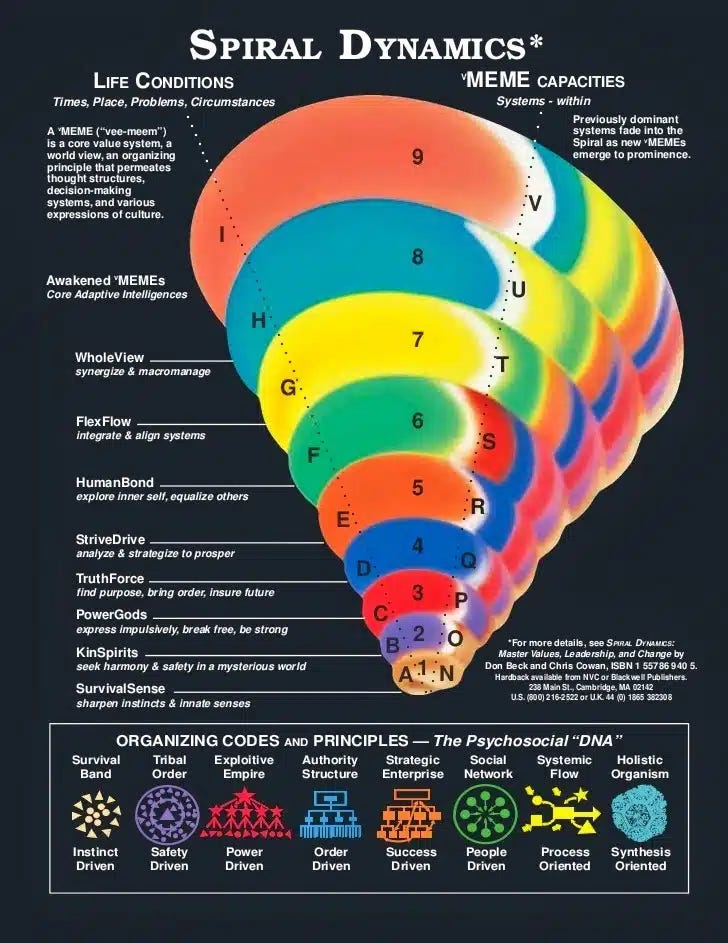
We are all at different levels of development, and each stage has a completely different relationship with the idea of “multiple interests.”
Think of it like this.
You’ve probably received advice that just felt... off. It doesn’t feel right, or that it would work for you or “your brain.”
This is due to a total mismatch between the stage the advice was designed for, and the stage you’re actually at.
Here are three stages that matter for the problem if this newsletter:
Orange - This is the achievement stage. This advice commonly says to “pick your most profitable interest, monetise it, and ignore everything else.” If you’ve ever felt reduced to a productivity machine by someone’s advice, they were speaking from Orange. It’s not bad advice, just somewhat incomplete. It optimises for output and ignores everything else that makes you human.
Green - This is the exploration stage. The person here says would say “just enjoy your interests! Don’t worry about outcomes.” This feels liberating (at first) but eventually you end up with twelve hobbies and no direction. You end up feeling scattered.
Yellow - This is the integration stage. This is where we’re heading (yes, me and you, friend!) The person here thinks “my interests are systematic and interconnected. Each one serves a larger vision.” Yellow doesn’t reject Orange’s drive or Green’s openness - it integrates them both. You pursue your interests with intention AND enjoyment, because they all feed into something greater.
If the “just pick one thing” advice makes you cringe, it’s probably because you’ve outgrown it.
You’re above that level of advice.
And once you recognise your stage, you stop forcing yourself into systems that weren’t built for you and start building one that is.
III - Philosophers have been thinking about this sh*t for centuries!
Here’s a profound idea:
This isn’t a new problem.
Plato envisioned the tripartite soul as having three connected parts - reason, spirit, and appetite.
Not three competing forces, but three dimensions of a single life that need to work together.
When they’re in harmony, you flourish.
When one dominates, you suffer.
Aristotle’s concepts of eudemonia and arete point to the same truth.
The “good life” comes from maximising your human capacities, and not by restricting them.
Arete is about excellence across all the domains that make you fully human.
So the question naturally arises: why aren’t you doing the same in trying to integrate everything toward living the life you want?
The four pillars we are going to discuss are four ancient chunks that thinkers have been contemplating for as long as philosophising has been a thing.
This is going to be our unique mechanism for achieving this, and I call it vision-anchored integration (very profound, I know!)
And don’t worry.
I won’t be talking about organising your interests in terms of mind/body/soul/business.
I want to give you a framework to use that nobody else could give you, AI included.
You need to anchor your interests by connecting them toward a vision, so they can all feel integrated.
To recap quickly:
The philosophy (Integral Theory) tells you why integration matters.
The learning science (schema theory + chunking) tells you how your brain actually does it.
The developmental model (Spiral Dynamics) tells you where you are in the process.
Together, they give you something most advice never does... a complete fucking picture!
Now, the moment you’ve been waiting for.
How to integrate your interests toward a vision
There are 6 steps in this process. Each one builds on the last, and by the end, you’ll have a clear, practical plan for managing every interest you have.
Step I - Define which interests are signal or noise
Your interests are always trying to tell you something.
Think of them like a compass of your very soul.
Individually, each interest points in its own direction, but when you put them all together, they converge on a location.
Start with your childhood interests. What did you love doing before everyone else told you what you should love doing?
This connects to Jung’s concept of individuation - the idea that the self is always trying to actualise, express, or complete itself.
Your interests in childhood are the first pieces of data your mind creates that tell you who you are.
Take out a pen and paper, or the notes app on your phone, and write down every:
Childhood interest you had
Current interest you have
No judgement, no feeling of embarrassment. This is a safe space!
Take 15 minutes or so, and you’re not committing to this right away, so don’t stress about making it concrete or perfect.
You will have a lot of ideas to start connecting and working with by creating your two lists.
Step II - Create your four pillars
This is the model that will chunk your interests accordingly.
It’s great seeing that your interests actually do have a home, but when they feel so chaotic and isolated from one another, it just never seems like they do.
Here are the four pillars.
And I’m not using mind/body/soul/business since that’s a little too basic.
Let’s abstract it up a layer instead:
Learning - Input (reading, courses, conversations, research)
Creation - Output (writing, building, making)
Movement - Physical input that amplifies learning and creation (training, lifting, martial arts, walking, rest)
Value Exchange - Where you output your integrated interests to the world to help other people (teaching, publishing, sharing)
Place every interest from your two lists beneath one of the four pillars. Aim for 2-4 for each, no more.
If some interests seem to overlap, or you are unsure of where to put them (think writing for creation and also value exchange), just pick the pillar that makes the most sense to you when thinking about that interest. This is a good signal that this is an interest worth doubling-down on.
This should take 10-15 minutes, since the framework is really just a fill-in-the-blank page to fill in. Hopefully your interests feel like they have more structure. Less chaos and more clarity and calmness when you think about them in your head under each of the relevant pillars.
Step III - Take a guess at your vision
Your vision just needs to exist. It doesn’t have to be right or perfect.
A vision is like a lighthouse. It’s for helping you with navigation, more so than giving you an exact location to reach without exception or room for error or iteration.
Fill out this one sentence for me now:
I am building a life where (outcome) through (pillars)
Use the pillars map from Step 2 as raw material to help with this.
Here’s an example:
I am building a life where I get to be creative for 2-4 hours every morning with writing my newsletters, using research as learning, and sharing the things I have created with my audience.
It’ll take about 10 minutes, and it might feel wrong to you, but that’s ok. Consider this a first draft. It doesn’t need to be perfect, it needs to be done so you can make it closer and closer to perfect.
Step IV - Identify your bottlenecks
If any or all of this still feels incoherent, this is why.
You might be dealing with any of three bottlenecks:
Your interests aren’t organised - Make sure they are all written down and organised under the appropriate pillar to increase mental clarity
Your vision is too abstract - Your vision sentence doesn’t connect to your daily habits. Fix this by giving yourself one 90-day outcome to achieve per pillar
Some interests don’t serve your vision - Compress, reduce, or reframe them. Ask yourself how these interests COULD serve your vision. If it doesn’t seem to serve it, remove it, reconsider your current vision, or simply see this as a purely entertainment-based interest, which is ok too. But just recognise that it might feel somewhat separate from this system
Thinking of obstacles in terms of bottlenecks is highly effective for overcoming them, because it gives you the mindset that they can be solved. Not all obstacles are failures on your part. Sometimes, there’s one limiting factor holding you back.
Step V - Build a hierarchy of commitments
Most frameworks tell you what to pursue but not how to actually manage it all on a daily basis.
Not every interest deserves equal time every day.
Some are daily anchors.
Some are seasonal.
Some fill the space that life leaves open.
Your interests should fall into three tiers:
Tier 1 - Anchored Habits (Non-negotiables)
These happen no matter what. They are the foundation everything else is built on. For me, that’s writing for 1-2 hours daily and lifting twice a week. These don’t get negotiated with. They happen regardless of mood, energy, or schedule.
Tier 2 - Deadline-Driven Priorities (What shifts based on the season)
These are the tasks that change depending on what you’re building or what’s due. One week, my writing time goes toward a longer newsletter. The next, it goes toward a guide I’m building. The pillar stays the same (Creation), but the output shifts based on what the current priority demands.
Tier 3 - Context-Dependent Interests (Whenever life allows)
These fill the remaining space based on what the day or week looks like. Tonight, am I training jiu-jitsu, learning something new, or seeing my girlfriend or the boys? That depends on the week. And that’s fine. These interests don’t need rigid scheduling, but rather, they need permission to exist without guilt.
Give yourself 2-3 needle-moving tasks per day, with 10-90 minutes depending on the task.
If there’s one idea to take from this entire newsletter, I think it’s this one:
Every task is defined by an outcome it produces, not an activity.
For example:
Write for 2 hours
Write 2-3 short form posts and 400-800 words of my weekly newsletter (90 mins)
See the difference?
If you fail to hit your daily needle-moving tasks, cut all your volume by 50% for that specific pillar.
Most people underestimate how little high-quality work done consistently is needed to make progress.
Constraint is a superpower for creating leverage. Especially since you’re only doing 2-3 tasks per day and not 10.
So how easy is this going to be?
Here’s a profound idea from Carl Jung that I think is almost like a shortcut to creating a solid vision.
An idea which has also been beaten to death online… but fuck it:
Until you make the unconscious conscious, it will direct your life and you will call it fate.
- Carl Jung
I want you to think about what you wanted to be when you grew up, when you were a child. I also want you to think of 3-5 hobbies that used to make time disappear.
For me, I wanted to be a filmmaker. I wanted to make movies. But I was always too shy and anxious as a kid. And I always loved writing, reading, storytelling, and thinking about ideas from philosophy and psychology. Which makes sense. This is everything my newsletter is, and is a vessel for.
In this sense, your vision very much might already be resting in who you’ve always been. But you need to look and think about this deeply.
Don’t feel like your vision needs to be rigid, too. It’s going to grow, change, and evolve as you do. It’s a living thing.
Meaning, you have complete permission to just... guess.
Take a guess at what you want in life in the next 1-2 years. Your life will then correct your vision as you live it out. And you will learn what you don’t want from life too, which is priceless data for you to reflect on.
Step VI - Exchange your value with other people
This is just my opinion, but this domain makes everything feel worth it.
When you share your unique knowledge with the world through one of your pillars, it gives you more motivation to improve them all, since every pillar helps strengthen the rest.
Ask yourself what interests - if connected - could form the basis of something you share with others. A newsletter, a community, a teaching practice, a creative project. Your interests are what you create around, and your vision is what gives them direction.
This very newsletter is my vessel for all of this.
Reading fuels my writing, lifting and jiu-jitsu and friends fuel my mental recovery, and my newsletter is my vehicle for self-education. Value exchange is what makes the whole system feel sustainable, because your interests start feeling purposeful.
The generalist with a clear vision is the new specialist.
If you followed along, you now have something most people never create: a philosophy for how your interests fit together, and a practical structure for pursuing them without guilt.
You know why integration works (your brain is built for it).
You know where you are in your development (and why old advice felt wrong).
And you have a framework - the four pillars, a vision sentence, and a hierarchy of commitment - that turns all of this into a daily practice.
Sorry, I know this was heavy.
Feel free to digest this properly over a week or so, or save it so you can come back to it across multiple readings.
Anyways, the philosophy is what you just read about, and what’s next is now the execution.
Only if you want to take this further, my Profound Self-Education Guide takes this entire philosophy, and, using a unique AI prompt I created, builds you a personalised self-education plan customised to your routine, your interests, and the specific problems you’re currently trying to solve.
The guide itself is 70 pages long, which gives you the knowledge, and the prompt helps you execute with that knowledge as efficiently as possible.
If you want to learn more about my self-education philosophy and get a customised plan, download The Profound Self-Education Guide.
If you want to improve your reading comprehension and remember more of what you read in less time, download my Guide to Profound Reading.
If you want to start writing online or look at my personal writing strategies that grew my audience to 28k+ newsletter subs in 10 months, you can do that here.
If you want to check out my reading and learning guides, you can do that here.
I know your time and attention is very valuable, so thanks a lot for reading.
I hope I’ve given you some profound ideas to think about :)
You’re an absolute legend!
- Craig :)
Continue reading on from here:


How to make your life interesting again

If I asked you right now to give me exact details on what you wanted from your life within the next 5 years, you probably couldn’t give me an answer.
“Be professionally curious about a few topics and idly curious about many more.”
- Paul Graham (founder of Y Combinator)
For personal interests, my rule of thumb is simple: if something brings me joy, I keep it. Life is already tough, so it makes sense to hold onto the things that genuinely make it lighter. If an interest starts to demand a lot of discipline without giving that joy back, I usually let it go.
This is gold. One of the best long form content page on Substack. I’ve actually learned a thing or two from here, and have written down a few things on paper about my vision (which is unclear btw). I am just gonna read it again in a few hours. Keep this up Craig!