


Everything you’re doing right now to achieve your goals is probably not going to help you to achieve your goals.
The reason why is because nobody ever taught you the theory of constraints.
And once you understand it, the way you view reality will never look the same again.
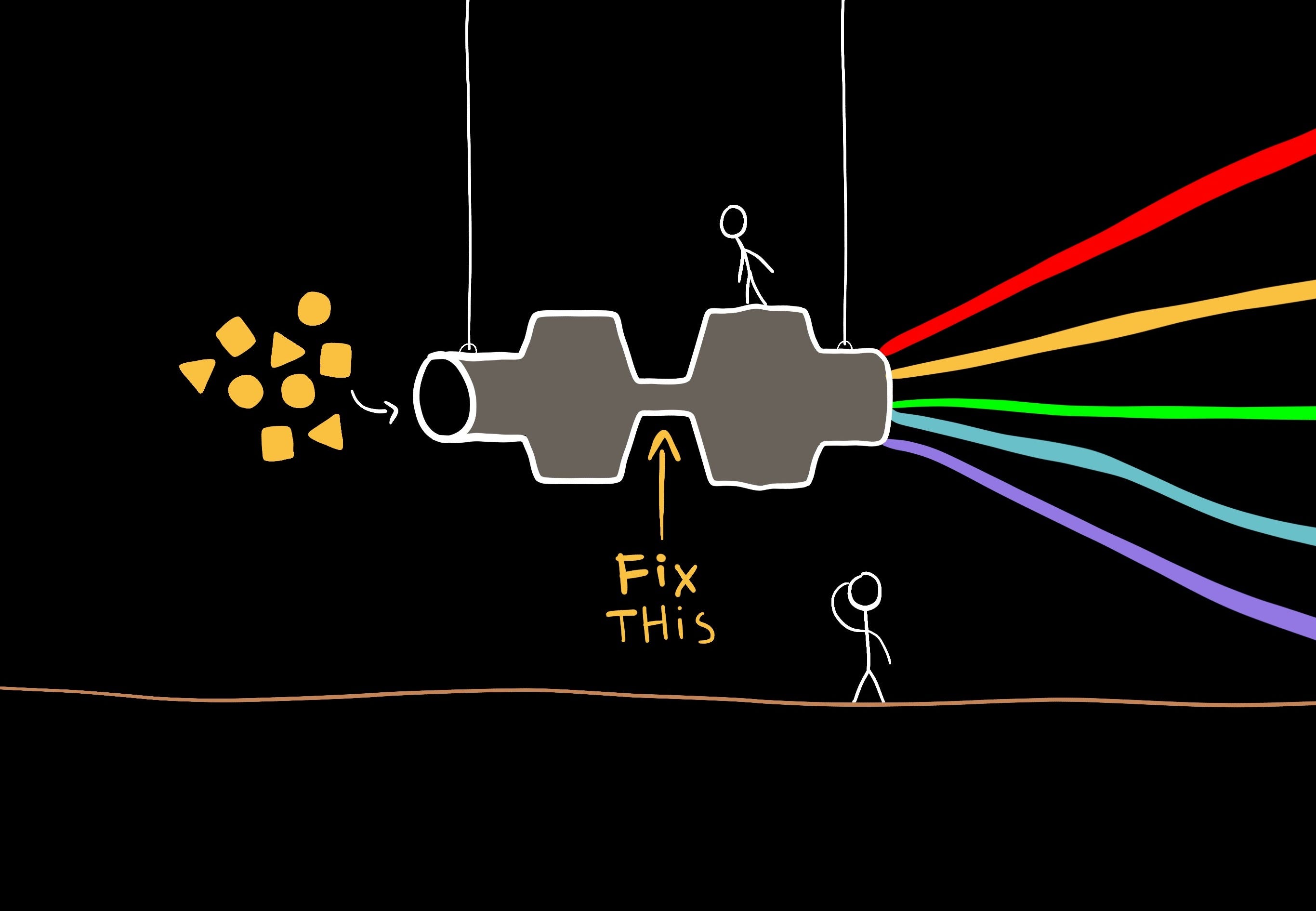
Any work that isn’t solving your constraint is pointless work.
You know what it looks like. It’s the idling around at the dreaded 9-5, the pottering around the house with no real plan on what to be doing, or the noodling around in the gym by moving from one exercise to the next, with no real sense of direction. You’ve never been taught this in school, in jobs, or at work, because those 3 things want you to do one thing:
Be busy.
Really, it’s to LOOK busy.
Being productive, however, is a different story.
I do not want anyone to be working 8-12 hours a day on meaningful, creative goals and seeing no progress. Spending 40-60 years on goals you never chose, or spending that same time on work that is busy and not productive at all… I wouldn’t wish it on my worst enemy.
Because there is a way to own your life instead of being an audience member in other people’s lives.
That starts with an aim. In other words, having goals. Even just one goal.
In this piece of writing that was supposed to be just 2500 words… because I can never seem to limit myself in trying to solve profound problems in the most extensive way possible that my still-very-much-naive mind is capable of…
Together we will create an aim for yourself that’s truly an aim that you can call your own.
And we’ll name the one thing stopping you from reaching it this very second.
The fog in your mind, the lack of clarity and the busy work will disappear if you stop trying to fix every problem you have all at once.
All you need to focus on is your one constraint.
This isn’t just any old productivity framework. Quite frankly, I think the ones you see online are really shit. They’re too complicated and they try to do so many things at once.
So I’ve tried making this as dead simple and foolproof as I can. All shall be explained, and don’t worry, it will all make sense in no time.
Here’s the plan of attack:
Why you need an aim before any of this works
The theory of constraints explained, in the simplest manner in which I can articulate myself (and why most of the work you’re already doing is pointless)
Why happiness lives in progress and not in the result
How to find your constraint in 5 steps (with an AI prompt to help you think/find it)
Let us begin with the thing you need before any of this works.
An aim.
Skip if you hate self-promotion!
If writing content is the constraint between you and the audience you want, consider checking out The Profound Writer V2 before the price increases.
It’s 50% off until Nov 22nd (2 days from now).
It’s the content-writing system I used to go from zero subscribers in May 2025 to 83,000+ across Substack and YouTube, and to writing full-time. Inside, you’ll learn to find the topics where proven demand meets your own interests, and to write one newsletter a week in 1–2 hours a day.
Onto the letter!
Idea I - You need an aim for any of this to work
When a man does not know what harbour he is making for, no wind is the right wind.
- Seneca
Nothing in this letter will work for you unless you have an aim.
Because you cannot have a constraint without a goal. An aim and a goal are the same thing, so if you don’t have something to strive toward courageously in your life, you will have no constraints to solve.
Nothing can block a goal that doesn’t exist. A parked car will never face the trouble of (and thus need a solution to) beating traffic.
Here’s a profound idea you should carve into your skull:
You see what you aim at.
My friends told me something quite interesting last Friday night.
I see them every Friday night. We call ourselves “The Big 5” (I know, it’s cringe, but that’s why we love the name). As we were bopping to Calvin Harris (as you should), one of the lads said to me that he can’t stop hearing the word “profound” being said in recent months. Next thing you know, the other lads all chimed in saying the same thing.
They all said it. And I said it too. I hear the word all the time on the radio, in lectures, in YouTube videos I listen to while researching/learning for writing these Profound Ideas newsletters.
This is not something to gloss over.
You see, this is called the frequency illusion.
Think of it like selective attention. Once something matters to you, you notice it more, even though it doesn’t actually happen more often. For example, if I told you to count how many red cars you see while driving on a motorway, how many do you think you’d see?
Exactly. A lot.
Now how many yellow cars do you think you’d see, even though I asked you to only count how many red cars you see?
I’d argue zero, with absolute certainty.
Because that’s the thing.
Human beings need structure.
Human beings need an ideal.
We don’t need freedom. Not in the sense you would think.
Because you can tell yourself “I’ll train in the gym whenever I feel like it,” and you’ll hit 3 sessions one week, 1 session the next, and go back to taking a 3-6 month hiatus once again.
If you don’t have a budget to live by, your money will just disappear out of thin air (I wouldn’t recommend trying it… but try it).
If I tell the lads we should go to my favourite nightclub in town at our weekly Friday night gathering, as opposed to saying “12 pubs is happening on Saturday November 28th, and here are the 12 pubs we are hitting”… what do you think is more likely to get them out and taking action?
Yes.
The very specific aim.
And I’ll finish this section by saying that if you don’t give yourself a plan for your Saturday off, you will stay in bed all morning, rotting away and scrolling until 1pm (or until a parent berates you into getting up).
Because you do need something to launch you out of bed. And you know that already deep down.
Freedom comes from having goals.
It stops you from drifting toward anything and everything, and it helps guide you toward something.
And having clear goals (across all games or domains of life, like body, mind, soul, and vocation for example, or even just one area of your life, like going to the gym) means you can deal with constraints.
Let me state it clearly:
A constraint is the one part limiting the whole system.
Don’t get flustered before we continue thinking on.
You’ll probably pick the wrong aim at first. You’ll walk 50 miles to cover 3 productive miles, because you’ll take wrong turns, wrong highways, wrong country roads that take you in the opposite direction, and you’ll do it all feeling like you have no map or sat-nav.
Fucked, is how you will feel.
That’s a good estimation by my book!
But you will realise you should have been aiming over here, instead of over there.
At that star in the night sky, and not this one.
Which is fine. Because you moved regardless.
An aim is iterative. It should beckon you. Think about how interest is the ultimate leverage you have in life, because that is what interest does. Why do you fall asleep reading a book you don’t care about? Because it’s not interesting to you, because it doesn’t help you reach what you’re currently aiming at (this aim might not be conscious to you).
Now if that’s not an 8.9 magnitude earthquake of an “aha moment” then I don’t know what is.
I’ve gone on for long enough, but I’ll quickly say that necking a bottle of wine and going out with the lads for a boogie is still something I love to do, even though it does not serve me in building my business, or helping me strengthen my mind and body.
Dancing is the antidote to nihilism. :)
But life isn’t the club or the pub every weekend, pissing away all your money. And it’s not 4 weeks a year sipping martinis by the pool while the other 48 are spent in a job you hate.
An aim gives you a mountain to climb, and the theory of constraints shows you the most effective way up it.
Wave to Sisyphus on the way up the mountain for me, would you?
Idea II - The theory of constraints, explained (as simply as I can possibly articulate myself)
Possibly the most common error of a smart engineer is to optimize a thing that should not exist.
- Elon Musk
Now now before you give out to me and comment saying you don’t like Musk for whatever reason, we’re here to think about profound ideas. Because if an idea interests me, chances are, it might interest you too. And if I think an idea can help you change your life for the better, I am going to talk about it.
Let us define the theory of constraints:
The theory of constraints states that there is only ever one constraint holding back an entire system at any given time.
I didn’t say problem or problems.
I said one constraint.
What do I mean by this?
Well, it means there’s one thing at a time that you need to be putting most, if not all, of your finite attention, time, and effort towards, to get the biggest bang for your buck in relation to moving toward a valued goal.
Everything else relies on the slowest part.
I want you to think of yourself as an entrepreneur. But not any old entrepreneur.
God no.
You make ceramic mugs!
…but with your own face on them (how profound!).
Here’s how your operations work:
A printer prints out 60 images of your beautiful face per hour
A heat press sticks those images onto the mugs, at a rate of 12 per hour
You can pack 40 of these into boxes that you can ship per hour
And you can ship out 50 of these per hour
Take a second or two to think about that, maybe reread it 2-3 times.
Get it? Great!
Can you tell me where the constraint is?
I won’t just tell you. I’ll actually show you what would happen if we optimised everything else but the constraint.
So if you double the amount of printers you have, and you go from printing 60 images of your face to 120 images per hour, how many finished mugs get physically shipped per hour?
It’s 12.
What if you ordered more blank mugs? You have 1000, or even 10,000 mugs, ready to have your face heat pressed onto them right away! How many mugs are getting shipped per hour?
12 again.
But wait! What if you increased your packing staff from 40 to 500! You can now put 500 mugs into boxes per hour. How many mugs would you STILL be shipping?
It’s still 12.
Do you see how nothing changes unless the constraint is solved?
It’s the heat press. 12 mugs an hour, no matter how fast everything before or after it moves. That is the constraint in this example.
A few more examples to send this idea home:
You won’t speed up a hike time by telling the fast walkers to hurry the fuck up. What do you do? You speed up the slowest walkers.
If there are ten tills in a shopping market, and only one is open, it won’t matter how fast or efficient the person sitting at the till is. You need to open more tills.
If I were to ask The Incredible Hulk to pull my silver neck chain apart that I wear out 2 weekends per month, it will break first at the weakest link. Always.
And lastly, think of a bottle. A damned plastic bottle (or a metal one, if you hate plastic). A two litre bottle will only pour as fast as its neck allows.
I hope this makes some sort of sense.
In simple terms, everything moves as fast as its slowest part.
Again, think speeding up the fastest walker vs speeding up the slowest walker. You gain nothing by speeding up the fastest walker. Everything is to be gained at the back of the group.
Here’s another profound idea:
All the returns in life, whether in wealth, relationships, or knowledge, come from compound interest.
- Naval Ravikant
If you solve one constraint at a time, making tiny incremental 1% improvements across months and years, you will be staggered by how different your life will be. Even in as little as 6 months.
Staggering.
If you set a sleep schedule or a meal plan once, even if it’s imperfect right now, that is still an agreement you’ve made with yourself. It’s done. Which means you can move onto the next constraint.
Saying that, constraints can move. They can return too. You always need to be thinking whether or not your constraint has moved. My sleep over the last week or so has become my constraint again (forget about The Profound Writer V2 launching or my weekly newsletters even!). Because I was waking up at 11am every morning with 11+ hours of sleep (I’m gonna go get my bloods done). And it’s now my biggest focus, because I’m not getting up early, and my days are disappearing, along with the amount of deep work I usually do.
Enough about me. Let’s focus on what’s important, which is you.
Multitasking is bullshit.
It’s a poison to the intellect.
Context switching will ruin your mind, brain, and life.
Learn to focus on one thing at any given time.
Chase two rabbits and you’ll catch neither; it’s such a profound idea because it’s so bloody true.
I know I know, I hear you. Life is complex, it has constraints, and every person’s individual life has context. I know that. But although you have many problems, there’s always one biggest problem.
And if you could spread yourself equally across all your problems, then why haven’t you solved them all yet?
So start with one problem. That being your constraint.
I would love to compete in jiu-jitsu again. I did every comp I could at white belt, and my one problem was always my gas tank. I would always look and feel like a zombie after one match (even tho I’m fine in my club, my cardio is never an issue, which is strange).
So I built a detailed cardio plan a few weeks ago… without realizing that my actual constraint was showing up to jiu-jitsu.
What an idiot I was. I wasn’t even going once a week. It was once every two weeks, on a Sunday. My actual constraint was showing up 3x weekly. I’ve hit that for 3 weeks in the last month or so (I was sick, fucked up my knee, and got botox in my armpits… yes, I’m a sweaty bastard with hyperhidrosis).
Why bother working on something that isn’t even your actual constraint?
Most of the work you do that feels productive, well, it’s probably not. Sorry. Because constraint work is usually (and I do say usually) very boring, long, and needs many needle moving steps taken across months. But it’s always the most rewarding work, for all the reasons and examples we’ve thought through together.
Some boring work can be pointless too. If it’s not your constraint then it’s not your constraint.
No diet will beat 5 hours of sleep a night. Getting a pay rise won’t fix the $300 you spend on takeaways per month. You’ll just end up buying more. Posting one newsletter per month won’t grow your business, no matter how good your product or service is. No extra amount of date nights is going to fix you staring at your phone the entire time your SO is in front of you trying to lock eyes.
And if you don’t have an aim or a set of goals for yourself, even just one goal… that’s right.
You will stay in bed until 1pm on every Saturday.
Speed up your slowest walker, and the entire group will reach the top of the mountain faster.
Did Sisyphus wave back? I hope so.
Idea III - Let’s change your relationship with dopamine
I am going to start this section by reading a passage from Notes from Underground by Fyodor Dostoevsky.
All shall make sense in about 60 seconds.
Shower upon him every earthly blessing, drown him in a sea of happiness, so that nothing but bubbles of bliss can be seen on the surface; give him economic prosperity, such that he should have nothing else to do but sleep, eat cakes and busy himself with the continuation of his species, and even then out of sheer ingratitude, sheer spite, man would play you some nasty trick. He would even risk his cakes and would deliberately desire the most fatal rubbish, the most uneconomical absurdity, simply to introduce into all this positive good sense his fatal fantastic element. It is just his fantastic dreams, his vulgar folly that he will desire to retain, simply in order to prove to himself—as though that were so necessary—that men still are men and not the keys of a piano, which the laws of nature threaten to control so completely that soon one will be able to desire nothing but by the calendar.
Source: American Literature
Now why on god’s green earth have I shown this to you?
Just an important note: Dostoevsky is arguing about free will here. Specifically, his reasons for why human beings would turn paradise into hell (because of spite and free will).
But I think there’s another profound idea to take from this passage that’s lurking beneath it too.
You are built for challenge.
You need challenge.
Have you ever heard of that Shock study? You know, where they left men and women alone with their thoughts in a room, with nothing but themselves and a buzzer that you could press, and give you an electric shock (participants were told about this before they entered the room). 67% of men and 25% of women voluntarily gave themselves at least one electric shock rather than sitting there doing nothing.
Let me tell you a jiu-jitsu story.
I know I always talk about the same interests, but they’re mine, and maybe they’re yours too. Just a heads up. I’m not trying to sound arrogant here, or ungrateful. Life is very difficult, and I do not say that lightly. I don’t think enough people understand the severity of that idea.
How and ever.
My first year in college has been the best year of my life so far. I was also the happiest I have ever been. I remember sitting against the steamed up windows at a Sunday Open Mat (which is a 1-2 hour session where you do hard sparring rounds non-stop), and I had a thought. An idea, if you will.
“If I could live like this for the next 60 years, I’d die having lived a perfect life.”
I’ve reflected a lot recently on this time in my life. Why was everything just… working?
Well, I was doing jiu-jitsu 4 days per week and doing a ton of competitions. And I haven’t been as happy since, or fulfilled, or whatever you want to call it. And now, for the first time since that time, I’ve done 3 weeks in the last month or so where I did 3 sessions in a single week… and I can feel myself turning into the old Craig again.
It’s like that Simpsons meme of the guy saying “My goodness, what an idea. Why didn’t I think of that?”
It’s hard to understand unless you’ve actually done it. But the week leading up to a competition is like nothing else. You’ve stalked every opponent’s Smoothcomp profile checking how many wins they have. You’re doing shark tanks the 1-2 weeks leading up to it. Hard hard rounds, with your coach amping you up, there’s just no better feeling.
I got wins and losses. 1-2 golds, and a couple podiums too.
But all the meaning I felt was always in the build up.
Always.
And I used to ask myself… why bother?
My answer was always… because.
And my follow up answer was always because it just makes my brain feel so damn good.
I was unwavering. No insecurities, because I had no time or attention leftover to compare myself to what anyone else was doing with their lives. I always judged myself against my own aim. An aim that I MYSELF had chosen. I keep talking about me me me here, I’m sorry. I’m trying to be a bit more personal with this letter.
What I’m trying to get at here is that you NEED your OWN AIM.
I aimed at training hard and consistently, eating healthy, passing college (at minimum), and improving my wrestling, footlocks, toe holds and especially my triangle chokes.
I just couldn’t imagine how miserable I would have been if I had no aim, and just: go to college, come home, scroll for 5 hours on my bed, drink to escape every weekend. No disrespect to anyone living like this. I’ve talked about how much I love going out every once in a while and having a dance and some Rosé.
Don’t be a black and white thinker. You need both sides of the fun and productivity equation.
But I’m happy I didn’t do all that. Although I do wish I had gone out drinking and socialising more. I wish I had been less strict about my training, and made more friends in college while having a bit more of your stereotypical “college life.” Fuck shyness, I suppose. But I’d still take going to a Sunday open mat and doing 8-10 hard rounds over flopping on my couch like a dead fish all day.
Hedonic adaptation is an interesting thing.
Which means (in simple words) that the brain adapts.
If you buy yourself a nice Porsche, I guarantee it will lose all its original zest and wonder within 6 months.
Choose your aims carefully.
That is what I am warning you with.
Because your brain does mostly show you what you tell it to aim at.
Your life will look completely different if you aim at slow and steady contentment (like on a 2 hour walk with no music or phone, and just thinking) vs aiming at massive dopamine spikes 24/7 (ah yes. scrolling!). Because the spikes will bombard your senses until you’re numb. And in response, you will fill your mind with open loops, and set off a self-destructive cycle of trying to out-numb yourself.
How fun.
My point being that the good feelings are in pushing the rock up the mountain and not in reaching the top. At least not as much as you’d think.
Maybe that’s why we have to imagine Sisyphus happy on a dopaminergic level.
Fella is pure progress and no results.
Happiness is found in progress. That’s the profound idea folks. You’re happiest when you’re moving towards something that’s trying to make you 1% better than who you are right now.
I did a lot of waffling.
So how do you find the one thing worth moving toward right now?
Let’s find your constraint.
How to master the theory of constraints
Most productivity systems try to do too much all at once.
So do one thing well.
Zero to one is an infinite improvement, and after that, 1% incremental improvements add up like compound interest.
Step 1: PICK ONE AIM
If you don’t have an aim, you will be given one.
Call it a goal if you prefer. Same thing.
Let’s use an example to make these action steps feel effortless to follow along with.
Our aim is to have a morning routine you stick to for 4 out of 7 mornings across every week.
Feel free to give yourself 10 minutes to choose an aim like this. Make it specific and concrete as possible, and think about something you could achieve (and should achieve, as if you were caring for yourself like you were caring for a loved one) in 30-90 days.
The morning routine example could be achieved within 2-3 weeks easily.
Step 2: FIND YOUR CONSTRAINT
Here is what I want you to think about:
If this improved tomorrow, would everything else improve?
For a few weeks, my constraint was how I started the day:
I reached for my phone first thing every morning.
Writing was the only thing I did consistently, every day, for a couple hours in the morning. Apart from that nothing in my day had a set time. Lifting weights had some structure (Mondays and Thursday; plus or minus a day) and I had jiu-jitsu on Sundays.
But that’s still not a lot of structure. Think of how many hours there are across a full week.
To be honest, I never knew what to do with my days. I felt pretty lost, like Stitch in the movie Lilo & Stitch when Stitch realizes he doesn’t have a purpose outside of being an absolute war-machine.
I still had a ton of goals but I had no idea how to reach any of them.
Vagueness and anxiety. Ew.
And it all started the same way every morning. Phone first… then the day was gone.
It’s like being stranded in a desert.
You have a million ways you could go, and yet, you still don’t know which way to go.
Use this AI prompt to give you clarity.
Copy and paste it into Claude, ChatGPT, or Gemini, and turn on the voice/dictate feature so you can talk instead of typing, and get outside and walk for 15-30 minutes. Sunlight is good for you.
I want you to help me find the one constraint holding me back from a goal. I’m talking to you by voice while I walk, so keep every reply short: one question at a time, no lists, no lectures.
How this works (the theory of constraints): any system moves only as fast as its slowest part. My life works the same way. There’s one thing that, if it improved, would make everything else toward my goal easier. Your job is to help me find it. Don’t tell me what it is. Ask questions until I can say it myself.
Go through these stages in order. Don’t move on until I’ve finished the one we’re on.
My aim. Ask me what I want to achieve in the next 30 to 90 days. If my answer is vague (like “get fit” or “be happier”), tell me it’s vague and ask questions that make it specific: a number, a date, or something you could see me doing. Then ask: does working toward this feel good to me, or only the idea of having it? If it’s only the idea, help me find an aim that’s actually mine.
What’s in the way. Ask me to list everything I think is stopping me. Get the full list out before we judge any of it.
The slowest part. For each thing on the list, ask: “If this improved tomorrow, would everything else get easier?” Push me to describe it in plain, specific words. “I’m tired” isn’t enough; “I sleep 5 hours a night” is. If I name something that’s really a symptom, ask what’s underneath it.
Check my answer. Ask whether I’m working on something that feels productive but isn’t the constraint (like planning, researching or buying gear). Challenge me once: “Are you sure that’s the slowest part, and not ___?”
The first move. Ask me for the smallest thing I could do this week to get more out of my constraint, and one thing I could stop doing that drains it.
When we’re done, give me this, filled in with my own words:
My aim is ___.
My constraint is ___.
This week I’ll ___.
I’ll stop ___.
Start by asking me what I want to achieve.
Tell the AI your goal.
If it’s vague, say so!
Let it question you and make it less vague.
It’s easy to think you’re thinking when you’re thinking inside your head. Speaking, however, talking out loud, it tests you on recall (retrieval), it helps you reach insights, and it helps you connect ideas in real time as you’re piecing together words while you’re in creative idea flow.
This step will take 15-30 minutes at most. Even if you set up the AI chat and answer just one question, that’s a huge win. You can do this across the week if you need to.
Step 3: GET THE MOST OUT OF YOUR CONSTRAINT
Start with one tiny piece to the puzzle.
Start with a breakfast. Then see if you can add some sunlight too, and then can you do a full 45min morning routine.
You need to experiment. Run tests. Live like a scientist, you know. I’ve tried journaling, meditation, walks vs no walks, going outside, breakfast vs fasting, and supplements too, and I’ve kept what made me feel better from those things.
For the last 3 weeks I’ve done the following with 80-90% consistency:
Phone stays in another room for the first couple of hours (on most mornings)
Chocolate oats and milk
Eat that outside (sunlight in eyes)
Take fish oil and creatine
Maybe electrolytes here and there
I like being anti-framework, don’t get me wrong.
I think the super complex morning routines that are 4 hours long, they do everything to avoid the work that needs doing.
But due to sleep inertia, which means that the body needs about an hour to wake itself up to feel fully alert and cognitively ready to attack the day, I’m going to wait 45-60 minutes to do my work regardless.
Might as well use that time wisely instead of wasting it.
Because I’ve tried waking up, making a coffee, and starting work at my desk within 10 minutes of waking and I never feel like I can actually think doing that.
Zero to one thing added is an infinite improvement.
Add in one tiny anchor, or in other words, one habit. Don’t try to do a million things at once. See if you can do it for 4 out of the next 7 days.
I’m sure you can.
Step 4: CUT WHAT DRAINS IT
Anything that drains your constraint gets cut.
Everything else can stay a problem for now, because it isn’t the constraint.
Example:
I don’t work before sleep inertia disappears
I don’t journal or meditate first thing in the morning anymore
And I stopped fasting (I need more calories atm)
Give yourself 5 mins to think about cutting out one thing that drains your constraint.
And it has to be something that you could stop doing, that you should stop doing, and most importantly, that you would be willing to stop doing.
Negotiate with yourself here.
Step 5: KEEP CHECKING IF YOUR CONSTRAINT HAS MOVED
This is important.
Constraints can move and also come back.
Even though my sleep schedule was all over the place, I still did my morning routine in the first 45 minutes of every day.
The routine stuck. And the constraint moved from my phone to sleep.
If the constraint is still your slowest moving part after a few weeks, truly invest in it. Boring work takes a long time, and it might take a long time for me to sort out my sleep.
Nothing new there.
When your constraint does move, go back to step 2 once again. Just keep it in the back of your mind, the question as to whether or not your constraint has moved. And once a week, ask it out loud. Every Sunday maybe, and spend 5 minutes pondering whether or not your constraint has moved.
I’ll shut up now.
Thanks for reading.
You’re an absolute legend.
Go think about what your constraint is and I hope you find great success in solving it.
- Craig :)
P.S.
The Profound Writer V2 is out now. It’s my system for building an audience by writing about your genuine interests: 42 modules, and a custom AI that knows every one of them.