


I have tried every productivity system there is, watched all the videos, read most of the books, and after years of doing that, I still had no idea how to reach a single one of my goals.
Until I found these five words, that is.
To not waste your time here:
All the advice on how to achieve your goals is so complicated and vague.
And all the advice online only gives you tiny pieces of a much larger picture.
People are addicted to doing things that simply don’t matter.
Some people swear by deep work. Others swear by time blocking. Some promise that analog is superior to digital. Or no, digital will always be better than analog, because you have the newest productivity app or software getting vibe coded each day. What about Notion templates, and morning routines! Wait… no morning routines? Which is it?
Sorry.
They are all tiny nodes in a spider’s web. Individual pieces to a big picture puzzle that are pointless in isolation.
Most people will spend their lives doing pointless things that feel productive.
You’re doing it already.
You’ve done it today, yesterday, and you’ve wasted more hours than you can count across your ten fingers.
All your life problems exist in the vague. Because fear and laziness don’t live in the specific.
You’ll believe you’re lazy if you don’t have a plan.
You’ll live your life in fear unless you clear the fog in your own mind.
These five words are your guiding light for clearing that fog.
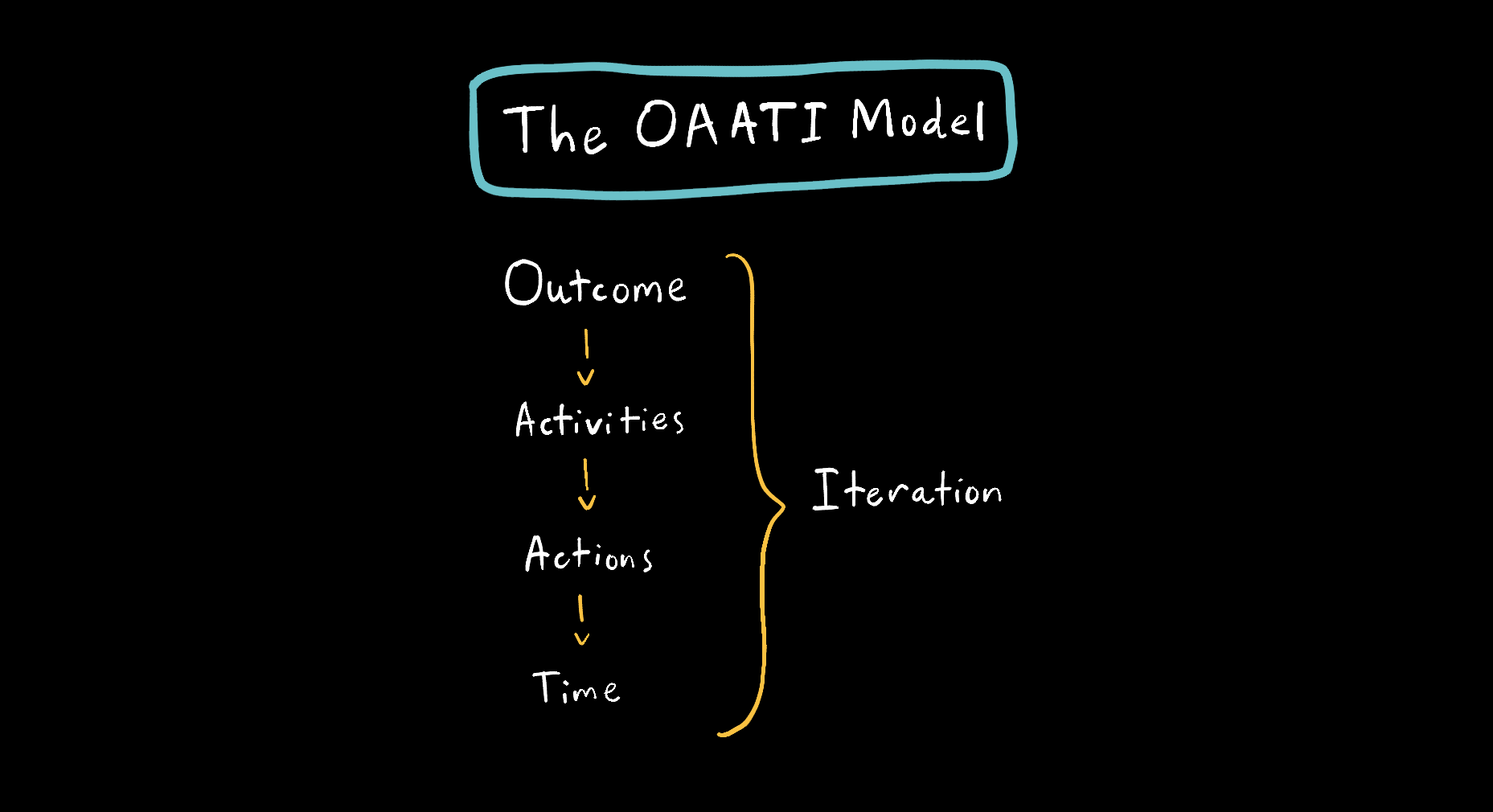
Outcome → Activities → Actions → Time → Iterate
I call it The OAATI Model (pronounced “oat-ee”).
This newsletter has a single purpose:
Give you absolute clarity on what to do for achieving anything.
I can’t promise this will be the most emotionally investing piece of writing. We have lots of logic to run over.
This will be dull for a lot of people.
Which is why a lot of people will never achieve a single one of their goals, ever, and live an 80-year life of quiet desperation.
The only thing I can promise is that you’ll have everything you need to build upon what I’m going to give you.
Here’s how you can achieve any goal with this model:
Define one clear/measurable outcome
Break it into activities, lists of single actions, and time needed to complete each action (so you can time block with a calendar)
Test every part, and cut what fails
Find your one constraint limiting you from launching into the next stage of your life
Systematize everything else
Iterate and course correct until you achieve your outcome
Ready to have absolute clarity on how to achieve literally any goal?
Me too :)
Let’s do some profound thinking together!
Listen to this while on a walk you beautiful human:
1 - There is no difference between a goal and an outcome
(a) What is a goal?
Let me ask you.
When you have a goal, what appears in your mind?
Well, it’s a vision of reality.
It’s an image of something physical, tangible, and measurable.
Have you ever heard of a man named Stanley Kubrick? He’s considered to be one of the greatest filmmakers who ever lived. Kubrick once said a very profound idea, that if it can be thought of, it can be filmed.
You’re allowed to view your goals in the same way.
I’ll tell you a story.
I was catching up with my dad during the week, and I was telling him about The OAATI Model. I used a relevant example for him.
Golf.
I haven’t played much golf, and I’ll try keep this brief. Just so I don’t bore you if you haven’t either.
I actually think using an example of something you do find boring actually reveals a lot more about goal setting that you might realize.
If you have what’s called a single handicap in golf, you’re considered a golfer.
Put simply, a golf handicap is a number that measures your golfing ability so that people of different skill levels can compete fairly against each other.
The single outcome (goal) for this example is 9.9.
Remember.
This is a clear and tangible outcome.
You can see and measure it.
See how unvague it is? It’s more concrete than a brick wall.
The insight:
You need one outcome.
It can be anything. Learn to write high-impactful long form content under a personal brand, get to a single handicap in golf, cook nicer fillet steaks, build some fucking confidence that lasts longer than 30 seconds, watch Game of Thrones as fast as possible (especially the last season)…
ANYTHING.
But is has to be one thing. The clearer you define the outcome the better. It can iterate and evolve, so you just need any outcome to begin with.
Direction is more important than having a perfect outcome to begin with. But it still has to be a single outcome.
(b) How to pick your goal
Have you ever heard of a man named Sisyphus?
I never go too long without mentioning this book, I’ve written about it a lot.
Sisyphus is that guy who got condemned by the Gods (ya know, as you do) to push a rock up a mountain for eternity. And just before it reaches the top, it will roll back down again, every time, repeating for the rest of… you get the idea.
Let’s use Sisyphus as our role model here.
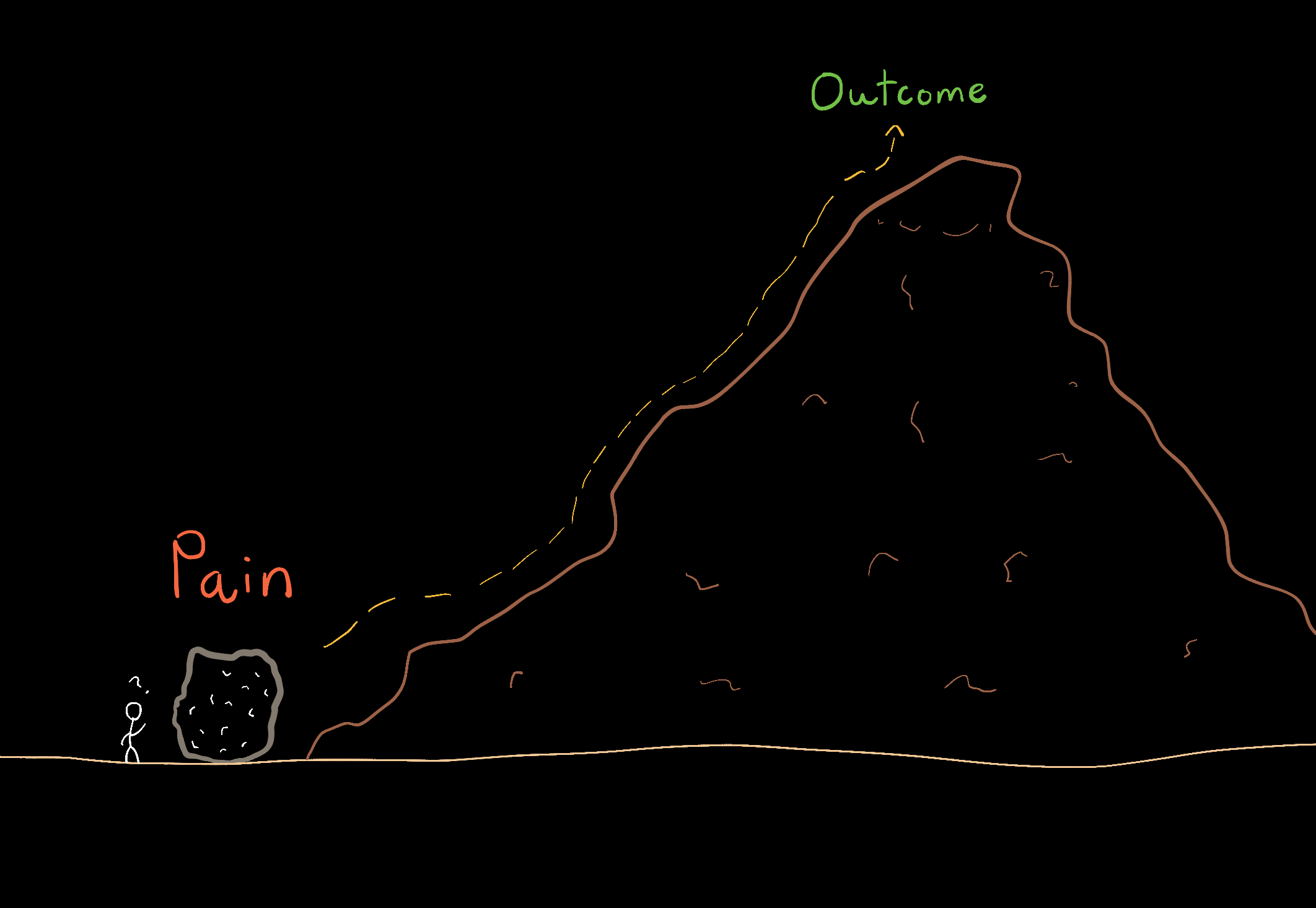
You need a mountain.
The top of the mountain is your outcome. That’s the summit.
The bottom of the mountain is your current pain. That’s your baseline. Whatever suffering you will continue to endure unless you start climbing.
You need to pick a heavy rock to push. Like Sisyphus.
And you need to choose your own mountain. It’s all well and good pushing a rock around in circles. But going in circles will never lead you anywhere other than in a circle.
You need to push upward as opposed to around.
(c) Define your goal (and its opposite)
How do you define your outcome, the top of the mountain you’ll be climbing?
Well, you ask yourself some questions.
What would it feel like?
What would it look like or appear like in conversation or a specific setting?
What would you be feeling, thinking, saying, and doing?
That’s your summit… but what about your baseline?
You invert your summit.
Flip it.
What would it NOT feel like?
What would it NOT look like or appear like in conversation or a specific setting?
What would you NOT be feeling, thinking, saying, and doing?
Motivation comes from urgency. Which means you need an enemy to run from.
Profound Idea: Sometimes the best way to launch yourself into a new way of life, is to give yourself a fire under your arse that actually gets you sweating a little.
Think of exactly what you do not want.
Reverse engineer why that failure would have happened. What mistakes were made? From there, make your version one mountain. Think of this like a first draft you know will get destroyed, rebuilt, and always keep evolving.
Something specific enough to act on and start getting feedback from (which you can use to evolve it as you yourself evolves through iteration).
Our first step is to define one outcome.
Then define the bottom of your mountain to climb away from. The outcome you don’t want.
My 23 years of being alive has taught me so much and so little. However, I personally believe there are voluntary, meaningful, and better problems, as opposed to involuntary, avoidable, and worse off problems.
I’d much rather take my pick from the first boat as much as possible.
You have to pick your poison, because either way, you’re all in.
If you don’t have a mountain, if you can’t define your baseline and summit, if you can’t give yourself just one single outcome to aim at, good luck.
I don’t know what to tell you if you can’t start with that. Even a poorly defined single outcome at first.
Just choose one, then do this.
2 - Every outcome breaks down into activities, a single list of actions, and time
(a) What to do once you’ve picked a goal
The outcome always comes first.
You work backwards from the goal you want to achieve.
Which will lead you onto the next few letters of the model:
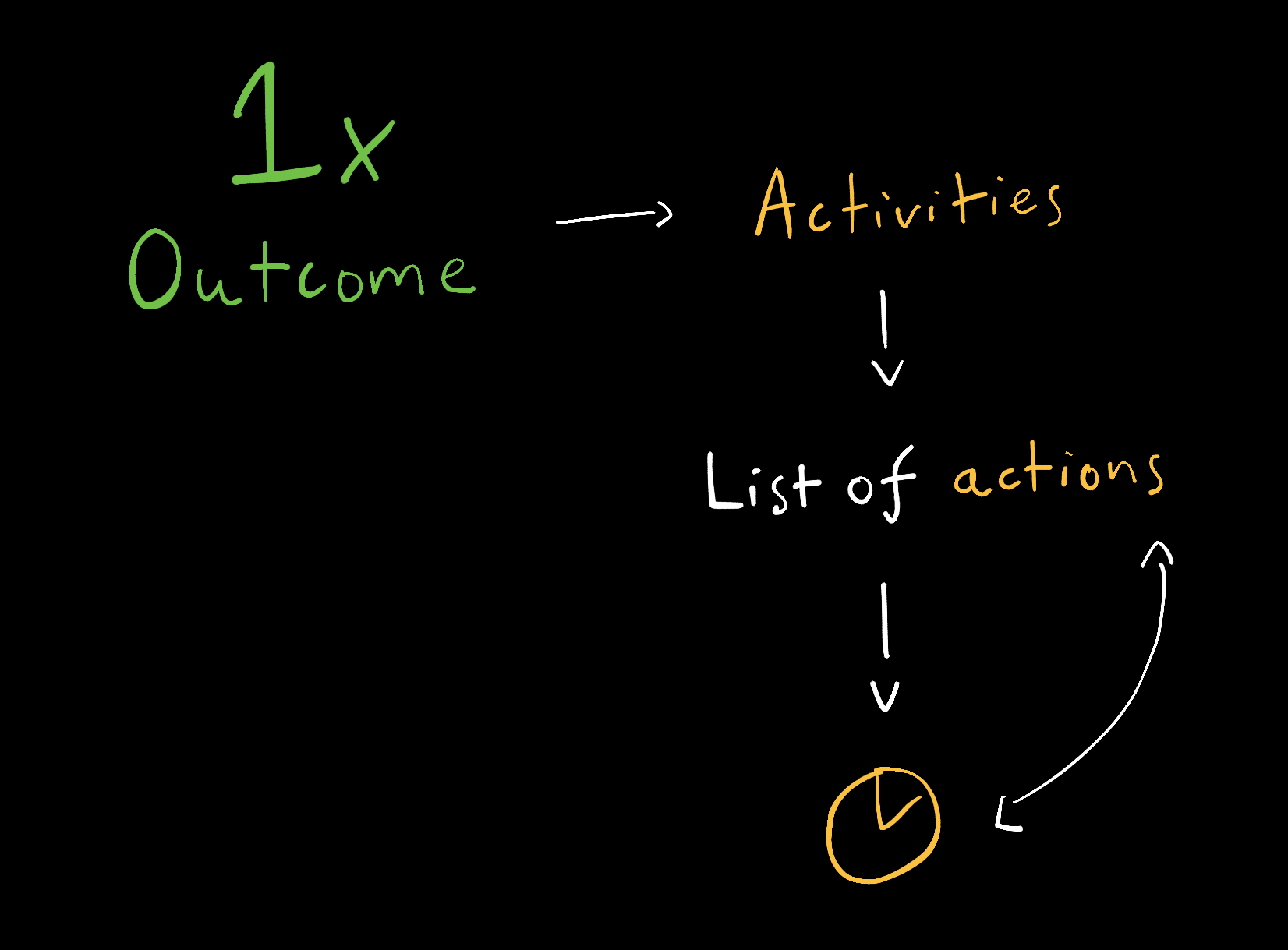
Activities are categories of work that each consist of a list of single actions in sequence
Actions are the deathly specific tasks within each activity
Each action takes a distinct amount of time (you time block or use a calendar to schedule time to complete actions)
Notice, finally, how every other productivity system only ever gives you fragments of this big picture?
That objective big picture is what nobody seems to talk about… for whatever fucking reason. Or in a clear, simple way at least.
Back to the golf outcome we had:
Single handicap is the goal. The 9.9 handicap.
Although I don’t know much about golf (it’s been years since I’ve played), while talking to my dad, I myself broke that outcome down into three activities:
Driving the ball from the tee spot
Getting the ball to the green
Putting the ball into the hole
This is far from being a perfect breakdown of activities.
But it’s done.
You can’t iterate (improve) something that does not exist.
More on iteration later friend.
Listen.
If I myself had more reps from playing golf, which means more feedback from reality, I would have broken down the activities list with more confidence. I’d have more confidence on what single actions I would need to make too for each activity. I really want you to understand this idea.
Your ability to break down your goals into its parts improves as your experience does.
Experience requires feedback.
You need to do things.
Live your life. Reflect on your mistakes. What went well or not. Then you iterate somewhere across those five words across the OAATI model.
This entire model is quite literally everything you need to achieve your goals.
The only other thing you need is iteration so you can course correct.
(b) Two types of action steps for achieving any goal
What about each activity itself?
Well, you have a list of single actions (an example will do wonders for you here).
There are two types of action steps:
Rigid Steps - These are mechanical. Like editing a checklist, organizing your calendar, or brushing your teeth all the way from grabbing toothpaste to cleaning those sparkly whites
Loose Steps - These are creative. Think idea generation, painting (as opposed to mechanically taking out your paints, brushes, and canvas) or live rolling in jiu-jitsu
Both types of steps are specific, but neither is vague.
Vagueness is the enemy, not specificity.
There’s two sides of the internet that love to go to war with each other. The productivity group love to systematize everything, and the creativity group assume they live hollow lives, and feel shallow on the inside because they live like robots. They don’t do anything for the sake of itself… which is why the creativity group usually get nothing done, and can’t market the value of their content for shit, and don’t achieve as many real world outcomes as opposed to the productivity group. On the surface, it looks like a battle for success and wholeness between the two groups - and that you can’t have both.
Wrong.
Understanding the distinction between rigid and loose steps is what integrates both sides here.
Productivity and creative freedom.
If you understand that rigid steps build the foundation for creativity, flow, and adaptation, you will win.
Rigid steps can’t be ignored. Things like making a long-form content template or checklist, or curating topics to write about, or making a system for how to go about outlining a long-form post, those things can be systematized.
They don’t require creativity.
But they build the groundwork to let you dance upon, and be creative about what you write about in your long form post, or how you let your taste define the finished product, or what key points you choose to place within your outline.
Rigid steps maintain order so that creativity can dance chaotically and freely.
Another example, just to send this point home.
I am a jiu-jitsu blue belt. A shit one, to say the least.
The rigid steps, for me, involve showing up twice per week, warming up with these weird hip stretches I do (or not warming up at all… yikes!) and drilling a specific footsweep I want to work on that week.
The loose steps are where I get to let loose.
You can’t script what happens in a live round. You can’t predict it. Do you think anyone can predict exactly what might happen in a boxing match or a UFC fight? No, but the rigid steps serve the unpredictability. The creativity.
How I engage with my opponent, how I respond. Do I wrestle or pull guard, do I attack the legs or look for a triangle choke?
My point is that principles and chaos are allowed to meet.
You will become more creative and to a higher quality once you give yourself constraints.
(c) The more skilled you are, the less action steps you need to track
The more skilled you are, the fewer actions you need, or the less specific you have to be about doing them.
This is all built upon the philosophy of SOPs (standard operating procedures).
An SOP you’re running for the first time writing a Substack newsletter from blank page to published post might have 80 steps.
I’m being serious.
But an expert might only have 50 steps after cutting, asking “why am I doing this” at every action and activity, and separating the wheat from the chaff after iterating that SOP (to improve it based on data/feedback) after writing 10 long form posts and getting tons of feedback doing so.
All of this probably seems very overwhelming for you right now.
But please know that all things you’ve never tried before feel like that.
Profound Idea: New things feel uncomfortable at first, until you do more of those things, before getting better at those things.
Once it’s written down once, the entire SOP from activity one, action one, to the final activity and last action, you never have to do it again.
You only have to improve it from there.
Write it all down, every activity, list of action steps (rigid or loose), and the time it takes to complete each activity, even if none of it is perfect at first. Do it in a word document in Notion, Eden, Obsidian, or the notes app in your phone.
You only need one document. It’s that little.
Then you can improve it. Because it exists now.
I promise that you will not believe how much clarity you will gain. Let alone how much progress and iteration and thus learning and self-development you can do in 2-3 months with a single SOP document.
One word document for achieving one meaningful outcome you’ve kept failing to achieve until now.
3 - Test each part by asking what, why, and how, and cut like a maniac
(a) Ask yourself what-why-how for each activity
That was heavy, what we just went through.
As I always recommend, you should listen to this on a walk or on multiple walks.
For what actions you take, so, the rigid and loose types beneath each activity, use the what-why-how framework.
What is this action?
Why am I doing it?
How does it move me toward my outcome in relation to where I am right now?
This is how you (1) build out your action steps when starting all this, and (2) how you maintain it during iteration.
The reason you can’t move forward within any domain of your life, is almost always because you’re doing actions that you can’t explain WHY you’re doing them.
I want you to pause and think about what I just said for 20 seconds…
(b) Example: me being an idiot
Let me tell you a little story.
I was building a learning system for a long time. 2 months at least. And all I kept doing was building and updating the system, trying to make it perfect. But I wasn’t reading. I wasn’t reading books. I had no feedback because I was doing everything but move toward my outcome… build a broad but intuitive understanding of the books on my reading list.
Using the what-why-how:
Why am I updating this system right now? So I can improve my comprehension skills while reading.
Does doing this right now move me toward reading more and understanding more books? No, because I’m not actually implementing enough and getting real feedback that would justify making updates to my system.
So why fucking do it?
That was the aha moment for me.
(c) This works for abstract goals, not just physical goals
What’s the difference between the two?
Think “improve my confidence” as opposed to “build this IKEA shelf.”
You just need to be incredibly clear and precise with defining your summit (what would confidence feel like to you, look like to you and others, and appear like to you and others in conversation?) and your baseline (the opposite of your summit answers).
Then you would break those down into activities, with each activity having a single list of actions.
Then you test the life out of each one by asking what-why-how WHILE you are going out and following the damn actions and activities with your time.
It’s harder, dirtier work to do this than with say a physical, concrete outcome.
You need to be even more specific and clear about what success looks like for achieving an abstract goal, compared to a physical goal (getting a single handicap is more measurable than a 50% improvement in confidence).
But the model still works. You just have to be willing to do the dirty work that is necessary.
Here’s something that annoys me (that most people cannot do).
Most people can’t state what they believe clearly, let alone why it is true or how it is relevant.
So do this for me now:
Take your current list of actions for each activity (assuming you defined those, even poorly for now)
Question each activity by asking what, why, and how
Then question each action within each activity by asking what, why, and how
Cut or restructure anything that fails that test
You can read more about how to use the what-why-how thinking framework for making your thinking clearer, and therefore more deadly, by reading this post (once you’ve finished reading this one).
4 - Most of the work you’re doing is absolutely, totally pointless
There, I said it.
What you need is to find your constraint instead.
(a) Theory of Constraints
In his book The Goal, written in 1984 (and it’s still relevant today), Dr Eliyahu Goldratt outlined his concept known as the theory of constraints.
It states:
Every system has at least one constraint limit it’s performance, and improving that constraint is the only thing that improves the whole system.
Goldratt got this idea while on a hike with boy scouts. He noticed that the slowest walker determined the pace, and thus the arrival time of the entire group. Speeding up the fastest walkers wouldn’t have done anything… but the slowest walkers?
Glorious. It’s almost too good an analogy to use.
Find your slowest walker and light a fire under their arse.
Maybe don’t do that… I’m being metaphorical here trust me (haha).
Your activities and actions are the scouts. One of them will always be the slowest. ALWAYS. And when one of them no longer becomes the slowest walker, another one will.
That is the theory of constraints.
Guess what?
The what-why-how framework will help you find yours.
(b) Example: me being an idiot (again)
When I was in secondary school I spent four hours each night studying from 6pm to 10pm…
“studying”…
I say studying and not learning.
I never identified the specific gap between where I was and where I needed to be, in relation to what the curriculum required.
You know those learning outcomes you see at the start of each chapter of your school books?
Or the learning outcomes they talk to you about once, in one 15 minute conversation at the start of the school year, and forget to mention again or even call back to while teaching, and instead give you vague instructions on what you need to be learning, and why it’s relevant, in their eyes, and not based on what you are very specifically getting tested on at the end of the year…
Yeah.
If I had found my one constraint (either a subject or concept that was limiting my progress the most) I could have spent one hour learning each day, and spent the rest lifting weights and playing guitar and doing anything else.
I made a painful mistake (a time costly one too) of sacrificing quality of work for the metric of hours worked.
(c) Strategic thinking is finding your constraint and destroying it
Pointless work is a symptom that you have not found your constraint.
I had my last ever shift at my job last week and I’m officially a full-time writer.
My job right now is nailing down the one constraint limiting my business right now - there’s only ever one at any given time - and nuking the hell out of it.
This is my definition of strategic thinking.
You have an outcome in your mind.
You find your single point of leverage for achieving it (across your activities and lists of actions for each activity).
And you ignore everything else.
Focus is the removal of options, in my eyes.
Quality should never be sacrificed for volume, not ever. I’d rather you write 500 words of a long form post and let your idea quality be great, rather than writing for 3 hours straight and publishing when your brain is fried and wondering why nobody reads or clicks.
Profound Idea: Less is more when less is aimed at your constraint.
But how do you systematize the work that isn’t the constraint, so you can spend more time dealing with it?
5 - If it doesn’t require deep thinking, systematize/automate/delegate it.
(a) More → better → new
Here’s a framework I fucking love from Sir Alex Hormozi:
More, better, new.
You can’t figure out what needs to be better without feedback. So you do tons of reps. Then you improve based on the data you get from doing those reps with systematization, refinement, and incorporating leverage using AI.
And only when the activity is maxed (you don’t know how to better any parts of it) that is when you experiment with trying new things… which almost always causes an initial 20-40% drop in performance.
What’s the insight here?
Profound Idea: You can only systematize or bring in leverage somewhere to what you’ve done enough times to understand.
You need reps. Then you systematize. THEN you test in tiny increments. 10% here and there, ask “what ifs,” and trial and error.
Iteration.
Back to my reading system example. I was trying to 10x the efficiency of a process I didn’t have enough reps in. I needed to be reading more books, before making it better, before trying anything new.
I’ve done the same with prompt libraries and checklists within my writing workflow, but they’ve always felt incomplete to me (which is why I’ve always dumped them after 2 weeks) because I was treating these tiny components as if they were the complete system.
(b) The SOP is the complete system
The SOP is the complete big picture, whereas prompts and checklists are pieces within it.
That’s why you used the what-why-how framework for each part of more, better, new.
SOPs, templates, checklists, AI prompts, meal prepping, batching content creation, recording yourself doing a process once, these things are all examples of systematizing the setup. So all that’s left is doing the work itself.
Enjoy it!
You won’t need to remember to take out your paint and brushes and canvases, that part will be part of your SOP so you can enjoying painting.
The SOP is the highest form of systemization because it contains everything.
Outcomes.
Activities.
Every list of single actions within each activity.
Time needed to complete each action.
Checklists or prompts for various activities (and completing actions in less time).
Iteration.
(c) How to actually build and iterate your SOP
I like using a notebook to plan my days so I don’t rely on tech all the time.
I’ve systematized how I outline my days:
starting with my 2-3 tasks, then my midday responsibilities, then any other brain dumped ideas or tasks, so I can focus on the ideas themselves, and not constantly having to build out this structure each day.
That outline structure took me dozens of reps to build. Now I can plan my day in minutes as opposed to dossing around for half the morning figuring out what to do inside my head.
My point:
Something that might have taken 80 hours to build, and a hell of a lot of mental effort, now takes 10.
AI is not infinite leverage. As a lot of people love to go around saying.
It’s about 4-8x times more leverage if you know where and how to use it correctly.
Where is AI actually useful?
Well, for building and updating SOPs with feedback you’ve written down in your notes on your phone.
The basic system for updating and iterating SOPs:
Write down feedback you get on your phone (what feels good, what doesn’t, if you skip parts or if parts feel irrelevant, write it down!)
Hand that written feedback to an AI chat, including your one word document that outlines your SOP from start to finish, and has everything written from single outcome to the time it takes for each action
Keep iterating that document while following it across each week, across your time blocks, and repeat
And now for the final concept that makes this entire model run…
6 - Iterate weekly with short feedback loops
(a) What is iteration?
Strategic thinking is iterative thinking.
Your thinking should always come back to one part of this model.
If it doesn’t, that means you’re not thinking strategically.
What does iteration mean?
It looks like this:
Do something -> get feedback (data from reality) -> reflect on that feedback -> adjust how you act next time -> do something with a degree shift toward your outcome
You only need to be moving a percentage or two each day or week toward your outcome. These tiny, high-quality needles being moved compound like crazy across months and years.
I like how a lot of this is pure physics.
Physics is harsh. You either win the competition or lift the weight in the gym or you don’t.
Always always always reflect on feedback and keep testing your SOP in relation to your outcome.
(b) The walk back down
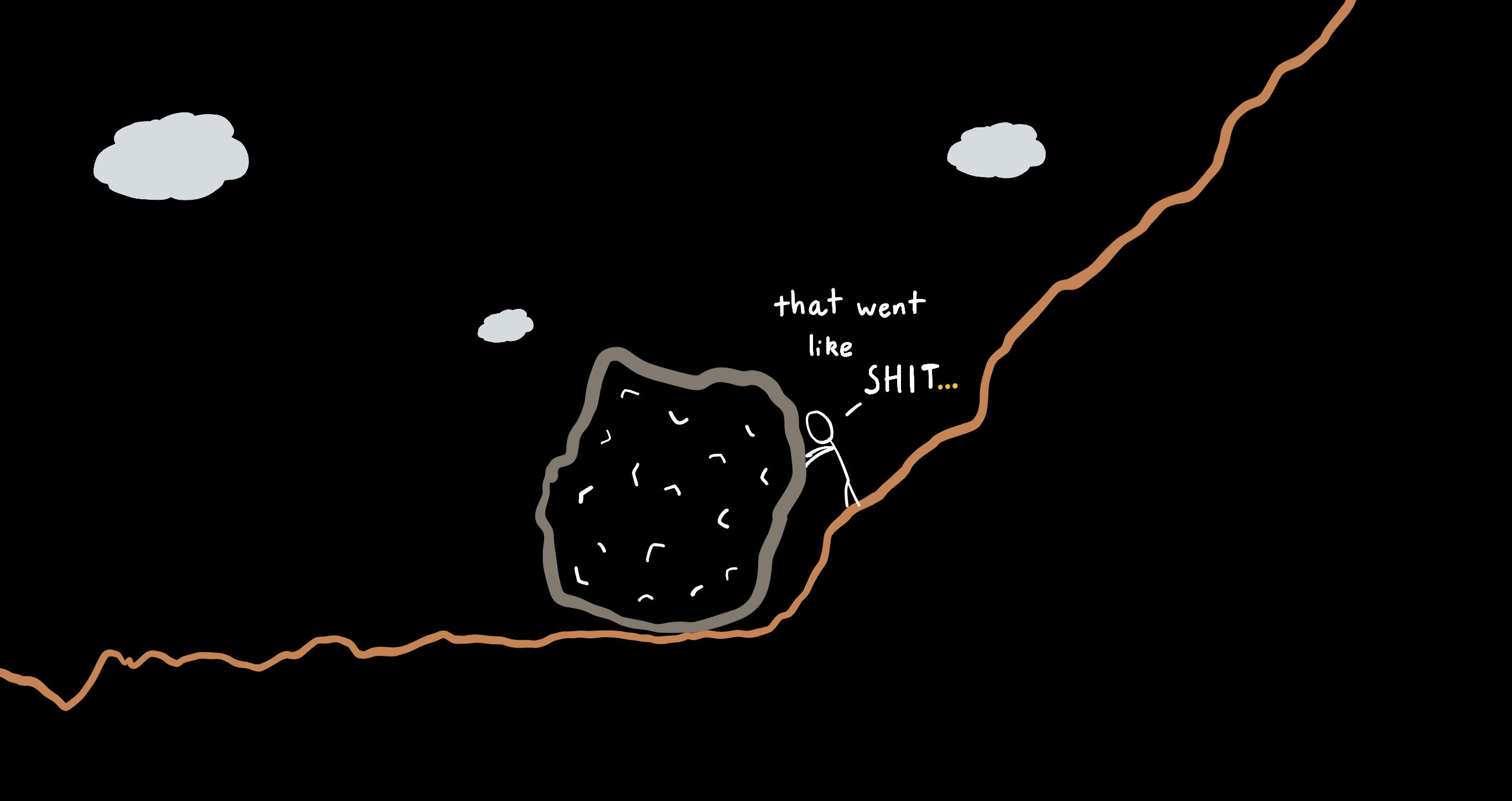
Sisyphus was condemned to push a rock up hill for eternity.
We all know that story by now. Everyone talks about it online.
But what if the most important moment is his walk back down?
His “hour of consciousness” as Camus calls it. Where he’s fully aware of the activity he’s doing, and keeps doing it anyway?
Camus wrote we must imagine Sisyphus happy. Because happiness doesn’t come from the outcome itself but from taking the risk and responsibility of moving toward it.
Iteration IS the walk back down the mountain.
You reflect.
You see what worked.
You make an educated adjustment.
You push again.
The SOP is the route up the mountain (your goal/outcome), and the walk back down is your review of the push (iteration).
No matter what you do you’re pushing a rock.
You are aiming toward various outcomes in your life even if you haven’t consciously chosen any.
Whether it’s voluntary, meaningful, chosen outcomes, or involuntary ones, because you never decided to do the dirty work of getting more specific than most people are willing to be, about what defines your definition of living a successful life.
You’re all in no matter what you do.
Pick your poison.
(c) The dirty work nobody wants to do
It’s not 10,000 hours.
It’s 10,000 iterations.
10,000 feedback loops. Learning loops.
Iteration does not mean repetition. Repetition is mechanical.
Iteration means doing something, pausing, reflecting, seeing how well it worked, making an adjustment, and going again ten thousand more times.
My golf breakdown wasn’t perfect. For me to make it better I would need to play lots of golf.
I’d keep improving it.
If I had more reps and feedback I would’ve broken it down better.
All good and bad thoughts or feelings are feedback.
Profound Idea: All good and bad thoughts and emotions are feedback.
Getting rejected is feedback, as is losing the jiu-jitsu tournament or hating going to the party or the pub last weekend.
There’s a cool idea from spiral dynamics (a model for how humans develop in response to problems) which states that people encounter the same problems at different levels of development, but with new levels of understanding from accumulated feedback.
In simple terms, you face the same problems constantly, but every time you face them, again and again, you’ve evolved, so you confront them with more knowledge, understanding, and perspective for solving them successfully.
Instead of going around in circles you move up. Like a spiral.
If you lost motivation after a week of doing all this, that’s feedback. You might not be doing relevant activities or actions, or you just need to grow up and do the work. The work might just need doing. This is likely.
None of this is a fancy Notion template or productivity app. Which is why most people don’t want to do it (and would rather choose Notion templates and productivity apps that make you feel productive instead of being productive).
It’s ugly. It’s actually very boring and not sexy. It requires the dirty work of writing down your outcome super clearly. Every activity, every single action, every time for each action, and iterating each based on feedback.
But it works in a way that would make you question the online productivity space itself and how fucking pointless most of it is.
Keep capturing feedback on your phone in a notes app. One document, call it “Feedback.”
Hand it to an AI chat along with your SOP document.
That should be one doc too.
Update your SOP weekly.
Do it in minutes, not hours (thanks to AI).
Always experiment with adding and cutting away 10% here and there, and please remember that this will never be perfect. There’s no finish line with this because it will keep evolving as you do.
You will not believe how much clarity you will gain from doing this.
Let alone how much you can achieve in 2-3 months.
I’ve given you my knowledge.
So how can you act on it as efficiently as possible right this second?
I’ve made an AI prompt that will guide you through making your very first SOP for achieving one specific goal you have.
It will guide you through every step so you can just focus on executing with what you’ve learned.
You can keep that same AI chat somewhere safe and let that be your chat for updating your SOP weekly with feedback. It might take you a while to create your SOP, and it won’t be easy, but hey. Nothing that’s worth it is easy. Which is what separates most people from a select few people.
Thanks for reading.
You’re an absolute legend.
- Craig :)
P.S
If you’d like to understand how I write these newsletters each week (for Substack and YouTube) you can check out The Profound Writer. It’s an evolving course for those looking to learn how to write long-form content people can’t help but read.
This feels less like an essay and more like a blueprint for doing what 99.996% won’t. Absolutely loved this. An exceptional piece to manage our goals.. Can't thank you enough for this piece, Craig!!
Just an Exceptional Piece!! 🔥✨
I feel like I am in my Project Management class! Applying those principles to my day to day life has helped me achieve goals so much more efficiently.