


I have recently discovered a problem that silently plagues hundreds of thousands of readers and they are all completely unaware of it.
When I was younger (I’m 22 now) I used to be obsessed with taking notes on what I was reading.
I always had such an intense fire in my heart, and I was willing to spend 4+ hours everyday taking notes in Obsidian.
I wanted to be intellectually jacked, my mind full of knowledge about everything. And I thought linear learning (the way we are taught to learn in school) was the way to achieve this.
But that’s not how reading works.
You might know by now that I once tried to memorise Aristotle’s The Nicomachean Ethics line-by-line. This sounds like a terrible idea, but there’s something a lot more sinister to it than you might think:
I was trying to memorise knowledge linearly in terms of chapters and headings.
This felt like a type of hell for me, because I always wondered how the greatest philosophers and thinkers of the past understood so much, from so many books they read. But I could barely retain and understand one book. And this is what I’ve come to realise now.
Most people read books linearly.
They try to learn everything linearly.
They think of everything linearly.
Thus, they try to learn everything equally.
And you wonder why your mind always feels overloaded, and why you don’t understand anything that you read. So, if you want to become a profound reader, understand this:
Profound Idea: If you can understand what you read on a intuitive level, you will realise that most 300 page books contain only 30 pages of knowledge you truly need.
The keywords here are (1) you and (2) truly need.
Again, I think everyone is wasting hours reading without actually understanding or retaining anything. We aren’t thinking about what we read in the right ways, because school teaches you the exact opposite. It’s all linear thinking, which I think is a type of disease that destroys any desire for enlightenment.
We’re programmed to read and the write down what we’ve just read in our own words without thinking. Zero processing. Using bullet point notes. Expected to know every point in perfect order off by heart.
But the most profound thinkers understand that knowledge doesn’t look like my 6th year Geography notes copy, it looks like a spider’s web.
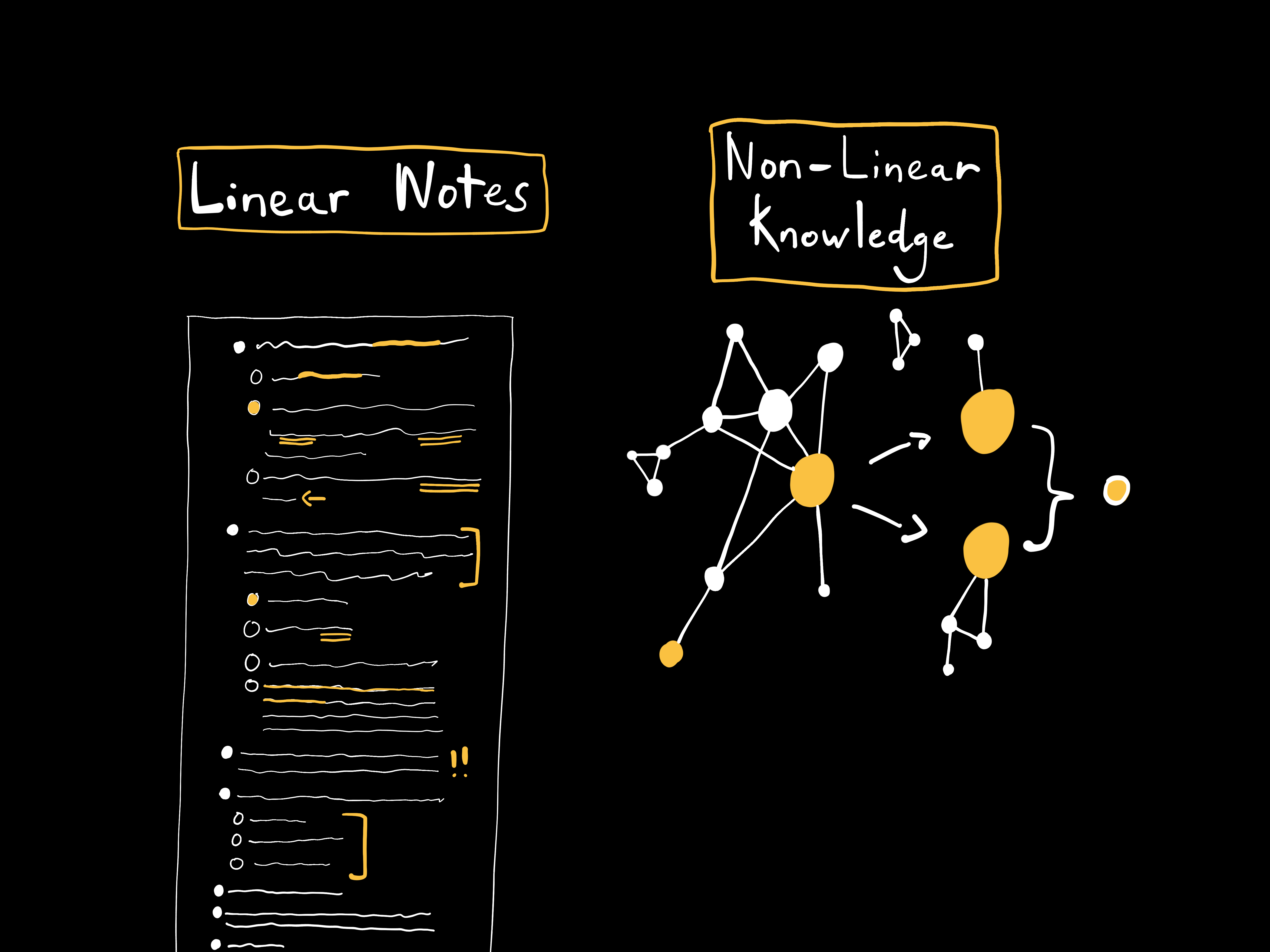
There is some good news, however.
Profound Idea: Knowledge growth becomes exponential - it multiplies - when you stop trying to learn everything linearly.
You don’t buy an 8 hour guitar course to learn how to play a C chord; you google it, and address your problems and gaps as you go in real-time.
The same applies to reading anything.
You must address knowledge gaps as they appear, and not memorise or remember everything you read.
This is a pivotal shift you must understand. The shift from wanting to remember everything, to know everything, to addressing the knowledge gaps in your own understanding that actually need addressing. This is what will help you escape the disease of linear, isolated learning.
This is a 2-step reading system for helping to improve your reading comprehension, and understanding more of what you read in less time.
Let’s begin my fellow thinkers!
Books are not words but webs
Profound Idea: You don’t need to memorise something when it’s already intuitive to you and how you live your life.
Most people treat books like instruction manuals.
Linear learning says if you want to read a book, you start on page one. You try to remember everything you read in the exact order you read it. Chapter by chapter, heading by heading.
This could not be further from the truth.
Books are not instruction manuals but knowledge webs.

Profound Idea: Not all things you read need to be memorised or processed equally.
I will say that line, one more time.
Not all things you read need to be memorised or processed equally.
Why?
I once spent 5 hours watching a jiu-jitsu course on a certain position (half-guard passing) when in reality, all I needed was to learn to test myself on one specific detail. I was making a mistake in the same scenario constantly. I thought watching a 5 hour course would save me.
A better example would be like if you have the question, “how many planets are in the solar system;” you don’t read a 300 page book on the solar system to get your answer.
Because not everything in that book needs to be integrated into the knowledge web inside your own mind.
This is the big problem with trying to learn everything equally: your brain has limited processing power. Just like a computer. Your mental processing power is the RAM. For example, if you try to learn, remember, or memorise everything you read equally, you are basically trying to watch Ted Lasso in 4k on Netflix while having 103 browser tabs open in the background. To conclude, your show will be laggy as fuck and your computer might crash.
The biggest issue that comes from trying to learn everything you read equally is cognitive overload.
Cognitive overload occurs when your brain becomes overwhelmed with information and it needs time to process it.
Notice that anytime you read an easy-to-understand book and feel bored?
And then, notice that anytime you read a hard book and get overwhelmed within two pages?
This is exactly what I’m trying to address here.
When your mind gets bored while reading, you are not challenging your understanding enough.
When your mind gets overwhelmed while reading, you are challenging your understanding and thus need time to stop reading and think about what you’ve read.
But you don’t need to think about everything you read, and here’s why.
A book has a linear structure (chapters, headings etc.) in order to explain the author’s understanding of the concepts and arguments they wish to communicate. Which means, you don’t have to learn everything the author is saying if what they are saying is intuitive to your understanding.
If you already understand something, do you really need to sit around trying to understand it more?
What about the 10% of the book you don’t understand at all?
A lot of readers get this completely backwards. And no wonder. We aren’t taught this in school or at university.
Most people spend the bulk of their reading energy trying to remember and process information that’s already intuitive to them. They’re reprocessing concepts and ideas they already understand, when in reality, the bulk of their energy needs to be focused on extracting the 10% of information that addresses the real knowledge gaps they need to fill inside their own brain. Inside their own personal knowledge schema’s - their own spider’s webs of knowledge.
This is the profound idea we need to make intuitive in our own reading. I struggle with this myself, still, but it’s important to try our best here.
Profound Idea: A book is a mental model that an author explains through words, paragraphs, pages, and carefully structured chapters, all in a linear way. But real knowledge is non-linear, and it’s your job as a profound reader to read between the lines, in order to discover what this mental model might look like in a way that makes the most sense to you.
Realise this, and you will be shocked when you learn that most 300 page books today have only 30 pages worth of valuable insights. The rest are explanations that help communicate the authors non-linear understanding of the concepts and insights in a linear way that’s easy to understand for a complete beginner.
A cool but shitty drawing that explains why
Your brain is a supercomputer.
But it has a limited amount of processing power. Like the RAM in a computer. If you have one hundred tabs open on your desktop or laptop, the computer will become slower than a 90 year-old road runner trying to escape the coyote from the Looney Toons.
No matter how hard you try, you won’t be able to do anything of practical value without closing all your tabs first.
This is exactly what reading is like, the second part of our reading system to be more precise.
You cannot fill and overflowing glass with more water and expect it to stay in the glass. You need to drink from it first before you can add some more.
When you reach cognitive overload, new dots and connections are trying to be formed, but instead, there’s too much going on in order for you to deliberately make those connections yourself. Information is flowing through your senses and getting binned straight away. If you want new information to connect to your knowledge web - to get integrated - you need to process the information. You almost have to stop and physically make these connections yourself through thinking and questioning.

When your mind reaches cognitive overload (brain gets overwhelmed, too much information, not understanding everything you’re reading) you need to reduce it.
You do this by thinking about what you’ve read.
