


The minute you realize your mind is a garden and not a storage box, is the same minute you will finally stop being an information hoarder.
Because you don’t actually need to remember everything you read.
Most people think being informed is the same as being enlightened.
They think reading more books makes you more knowledgeable.
They highlight and annotate and underline everything they read.
They (more-or-less) rewrite entire books and topics in the form of linear notes, which they forget as soon as they write the notes down.
I wrote 70,000 words worth of linear notes in Obsidian from 3 books.
The Problems of Philosophy by Bertrand Russell
The Nicomachean Ethics by Aristotle
The Republic by Plato
That’s thirty five 2000-word newsletters I could’ve written.
And I learned nothing from writing out all those notes.
This visual explains why I think taking linear notes is a disease:
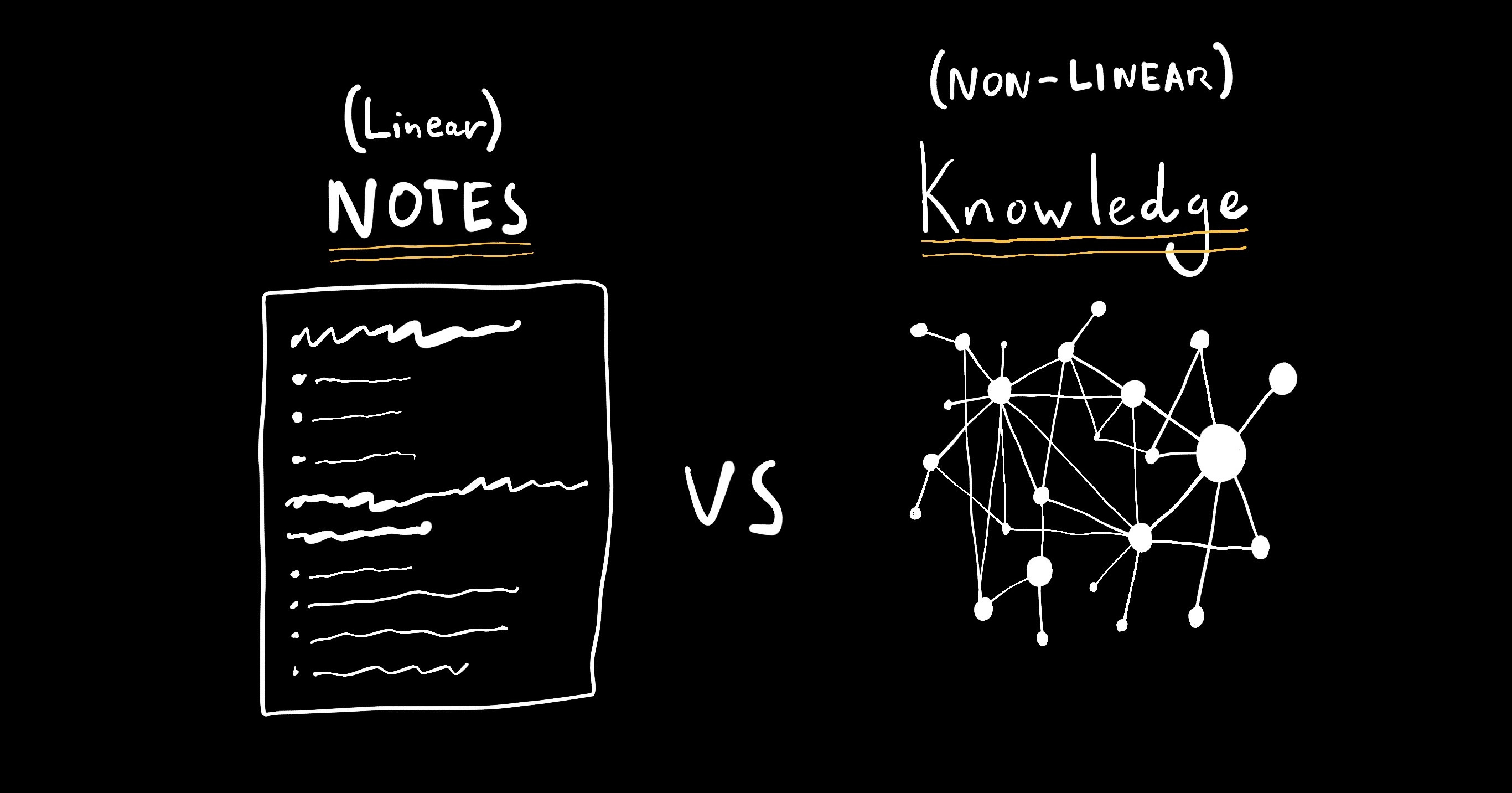
Real knowledge looks like a spider’s web, not a page full of notes.
Obsessing over memorization kills your reading comprehension.
Reading is not a receptive process but is secretly a creative and an iterative one.
The value of reading a great book has nothing to do with memorizing what the author is saying.
The real value comes from how you evaluate and build your own mental frameworks.
And no two people read the same book because each mind filters and rebuilds differently.
Let’s begin!
Your brain wants survival while your soul signals interest
Your brain is hardwired to forget anything that’s not important with regards to your survival.
I remember sitting at my kitchen table in 6th year in school, wondering why I was finding it so hard to remember everything I was reading, memorizing, and writing notes about.
It’s because I didn’t fucking care. This is the first major insight (or profound idea) into retaining what you learn: interest is leverage.
And this isn’t a bug, but rather a feature of your own mind.
When you don’t care about complex numbers, tombolo’s, or The Picture of Dorian Grey (I think I need to give this book another shot) the information is going to feel quite isolated.
It feels like it doesn’t have a purpose inside your spider’s web of knowledge.
But when you have an interest in what you are learning, like jiu-jitsu or Albert Camus (I’m loving him at the minute), it feels like you can retain it so easily.
Why?
Profound Idea: Interest is the best leverage you have in achieving anything you want in life.
Because if your brain is interested in learning something, it becomes easier to see how what you’re learning fits inside the big picture. In other words, the information is integrated and connected to other ideas and concepts. If you can relate what you are reading to a famous Danish philosopher, a Substack article, and that one time you went on a drive with the lads around the Irish coastline until 2am one Friday night, your brain is going to retain that information better because it feels relevant - it feels connected and thus it has a purpose.
It’s almost like you’re tricking your own brain to believe that certain information is important for your survival (because your brain hates learning new information) and if you are interested in what you are reading and learning about, what will feel like work to other people will feel like fun to you. Think about how much further in life you would get past everybody else if you started hearing your own interests. I will not get into this right profound idea right now, but really think about that.
It’s scary once you realize that a lot of people think of learning or education as something that can be completed and finished for life.
Your mind isn’t a bloody box to place toys in. It is a living, breathing environment. It’s a garden of knowledge that must be grown and cultivated across your entire life.
Isolated information gets weeded away while connected knowledge develops roots and becomes immovable.
Your mind is not a vault. It is a spider’s web. This is why you need to view books as raw materials to use in building your own webs of knowledge, which is what people mean when they mention building mental models or mental frameworks.
But you need to be interested in what you’re reading. If not, none of this will be enjoyable or work as well as you’d hope.
The important step that nobody follows
Profound Idea: Consumption without thinking is effortless, and you cannot grow without effort.
True comprehension requires you to continually destroy your understanding through constant evaluation and reiteration.
I’ll repeat that sentence again.
True comprehension requires you to continually destroy your understanding through constant evaluation and reiteration.
Reading has never been about storage; it’s about change. Transformation.
The evaluation process looks like this:
Build a rough mental model
Test it against new information
Evaluate the model
Rebuild it
Consume more information and evaluate/rebuild and so on
It’s like trying to achieve any type of goal in your life.
You have a desired outcome in your mind. You act, and try to achieve it. You gain data and thus feedback on whether you moved closer to your goal or not. You evaluate and reiterate. And you try again, hopefully with more skill this time.
Here’s what this might look like in terms of a mental model:
Desired outcome → Guess at how you’d achieve it → Act → Mistake → Data & Feedback → Evaluate & Reiterate → Act again → Repeat
Let’s say you want to start a newsletter here on Substack. You write for an hour each day. You realize it’s too much. You notice you feel sharp for 30 minutes and start losing focus after that. Change your routine to 30 minutes daily. Quality of writing improves. But you notice another problem… repeat.
Even in jiu-jitsu. You try a takedown or a new submission and you fail. And maybe, you realize that you’re not a baby trying to walk for the first time. You don’t tell a baby who couldn’t walk after its first attempt to sit down and stay on its arse for life. You think about what went wrong and learn from it so as to achieve what you want.
This is how you develop literally any skill.
An example
Here’s an example of how I did this last week reading The Myth of Sisyphus by Albert Camus.
Just a quick note, I’m not an expert in any of this. I’m only trying to learn this for myself and the best way to learn something is to practice teaching it, and maybe you can find some value in this too. That’s why I’m writing this newsletter today :)
This is what my mind-map looked like after having read 19 pages.
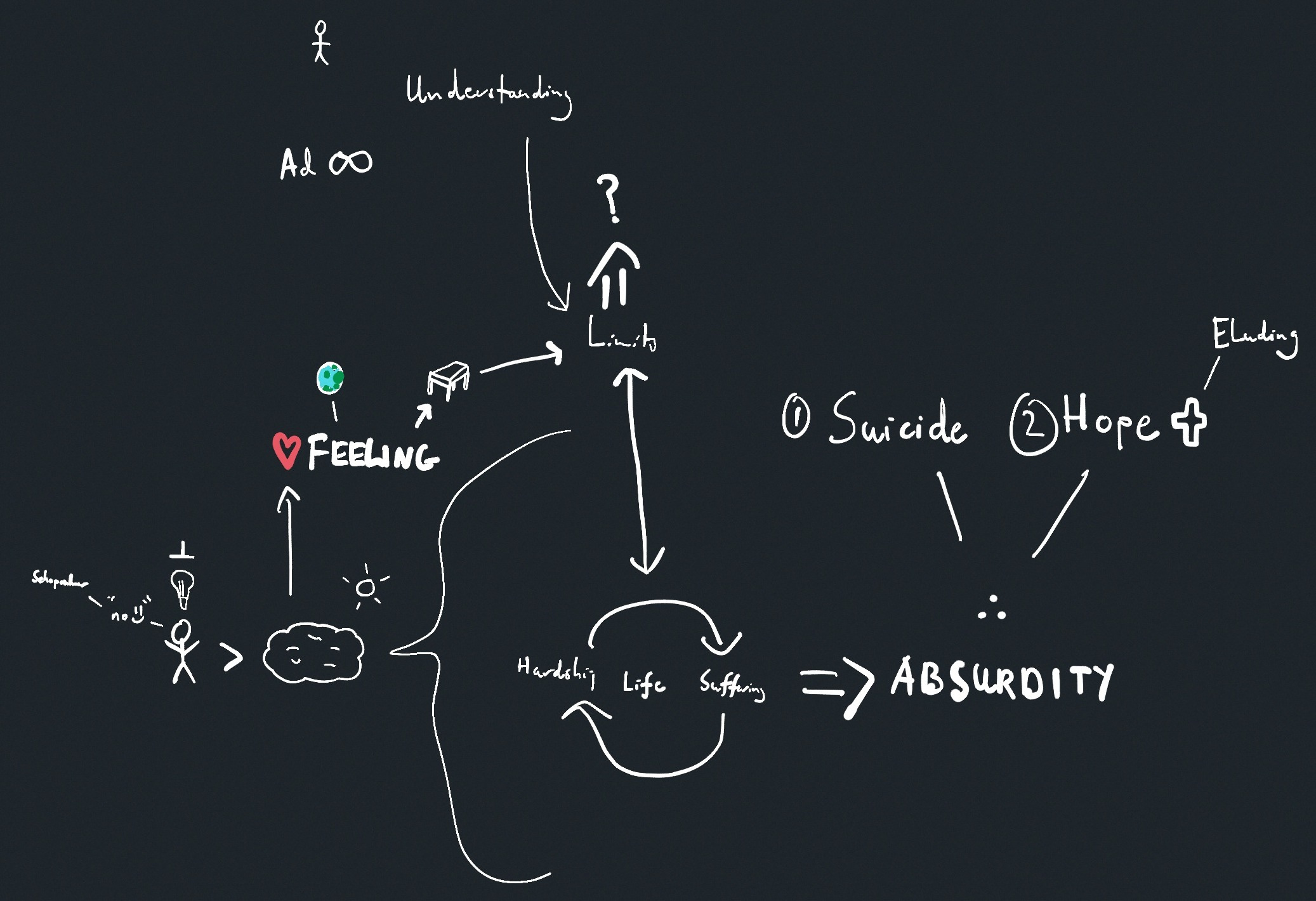
This is at least my 5th iteration. And if you’re wondering why there are so few words, its because I don’t need them written down. They’re inside my brain which is what matters.
Anytime I come across a keyword or a concept, I add it to the big picture, and as a result, the big picture changes.
I find a new concept, I evaluate it, and then I re-visualize the relationships and connections on my mind-map.
The whole mind map gets evaluated, destroyed, and rebuilt, and the entire process of doing this helps me to think about what I’m reading.
Thinking happens inside your head, and it should always happen there first; before you ever touch pen to paper, or Apple pen to iPad.
I try to force myself to think for at least 20 seconds between reading and mind-mapping.
The process once more:
Read
Build a rough mental model
Test it against new information
Tear down what doesn’t work
Rebuild stronger
The reason why this is so effective, that constant destruction-rebuild cycle, is because of what’s called the hypercorrection effect.
This effect shows that when you are wrong about something, you actually remember the correction a lot more than if you were just uncertain about it in the beginning.
Have you ever wondered why you always remember the situations where you’ve been corrected by somebody, even though you thought you were right for certain?
So, when you are reading, you should draw or visualize a mental framework and accept that it is probably wrong. But it’s just a hypothesis. You want to come across new information so you can evaluate the model and rebuild it. This allows for deeper processing and encoding of the material.
Build your mental model with confidence → let new information reshape it → your brain will retain the correction far more deeply
Profound Idea: If you’re trying to remember everything you read, you’re just memorizing and not actually thinking.
True reading is about evaluation.
Let’s get into our thinking system now. Here is a 3-step process that will help you to remember and retain more of what you read through evaluation and reiterative mental-model building, and not just pure memorization.
Although I’m still learning this myself, and this framework is not perfect, it will save you hours of learning right off the bat. My comprehension has already increased tenfold using these principles.
Framework
(1) Pre-Learning
The reading process begins before you open any book.
You want to prime your brain with information it can start making connections to immediately. Spend 5-10 minutes doing what I call pre-learning:
Flip through some pages
Look out for headings, chapter names, key words or concepts
Read a line or two here and there
This step is for simply exposing yourself to the text. That’s it. Just skim, and then take a guess as to what you’re going to read.
For The Myth of Sisyphus, my scan of the first few pages led me to my (incredibly vague) hypothesis:
“I think The Myth of Sisyphus will be about the story of a man pushing a boulder up a hill.”
Upon beginning my reading, I had to correct my hypothesis because the book had a lot more details and descriptive examples than just Sisyphus. And from my skimming, it appeared to me - to my surprise actually - that the section on Sisyphus is actually quite short. Hypercorrection in effect!
I noticed the following key words from my pre-learning phase. These concepts interested me the most (leveraging interest here like we have said):
Absurdity
Absurd sensibility
Absurd reasoning
Absurd walls
Suicide
Eluding
Hope
Absurd feeling
Consequences
Limits of understanding
Meaninglessness
I scanned across the first 30+ pages or so.
This step is what creates mental scaffolding for building your own understanding, and not just for helping you to memorize isolated pieces of information. You are evaluating and rebuilding your understanding as you learn.
(2) Reading
Here are your two profound reading rules:
Read until you come across a key word or concept that causes you to re-evaluate your mental model.
Read for 10-15 minutes max before stopping to revaluate and rebuild your mental model.
Because when this happens, you’ve found a piece within the big picture. Thus, your entire mental model needs to change. And because of the hypercorrection effect, you don’t want to write all your concepts down and then mind-map later. You want to be building, evaluating, destroying and then rebuilding as you read.
Profound Idea: Thinking happens inside your head first, then on paper. Any type of thinking on paper (notes, mind-mapping etc.) should help you think inside your head. But most people think on paper in order to skip doing the hard work of actually thinking with their brain. That’s why highlighting and annotating is pseudo-work; it feels like you’re doing work but you’re just tricking yourself.
I spent one hour doing this in my first reading session this past week, and I only read 15 pages. Most of my time was spent evaluating the concepts inside my own head (which is where the learning happens) and rebuilding my mind map. Any type of questions I had, I just wrote them down in a notebook beside me, which I used Google during my evaluation and rebuilding time to answer those questions, which I then used to improve my mental model.
Here’s some additional tips on when to know when to stop reading:
You feel confused
You feel overwhelmed
You realize you didn’t full grasp something from 1 page ago
Your mind starts wandering
You’re starting to feel bored
You’ve hit your 10-15 minute reading limit
You don’t have to do a mind-map for any of this. But it definitely helps with the evaluation process. Like all study tools or “techniques,” they are only as good as the learning they seek to aid inside your own head.
I’ve said this in a few newsletters but I’ll say it again: learning happens inside the brain, not on a page or on a screen; anything happening outside the brain should be helping your learning inside your brain (thinking, evaluating etc.)
Because what matters when it comes to reading is comprehension, not page count.
Read to comprehend. Read to evaluate. Read to destroy and rebuild. Read to separate the wheat from the chaff. Read not to memorize but to understand. Read to think, to visualize, to become someone new.
While you are reading, always ask:
Where does this fit within the big picture?
How does it relate to other concepts?
What do I need to correct and rebuild in my mental model?
What patterns can I see or potentially visualize?
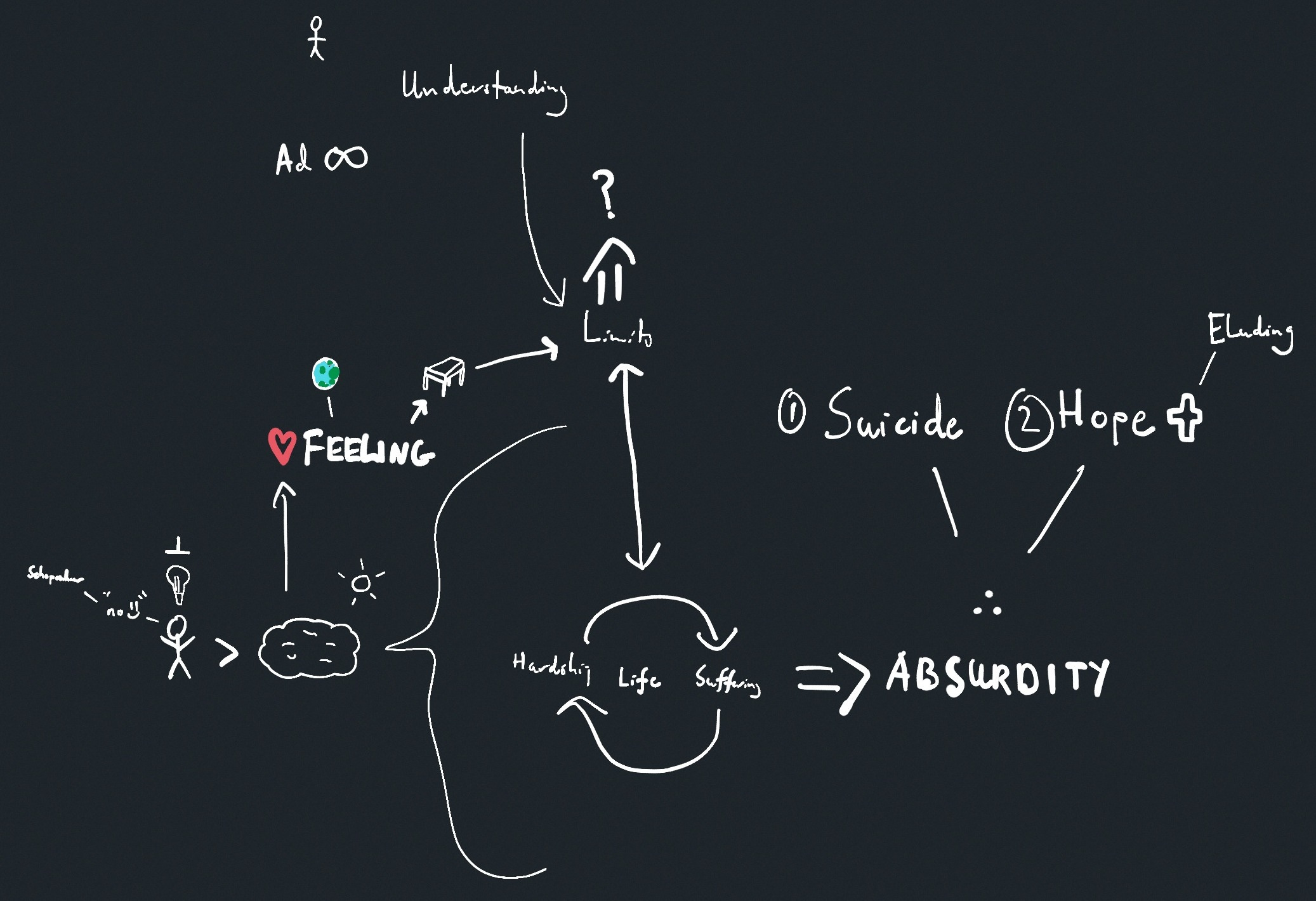
Here are some images of how my mind-map evolved through two reading sessions and multiple iterations while reading about the Sisyphus fella:
My mental model after 19 pages (shown once more):
My mental model after 29 pages:
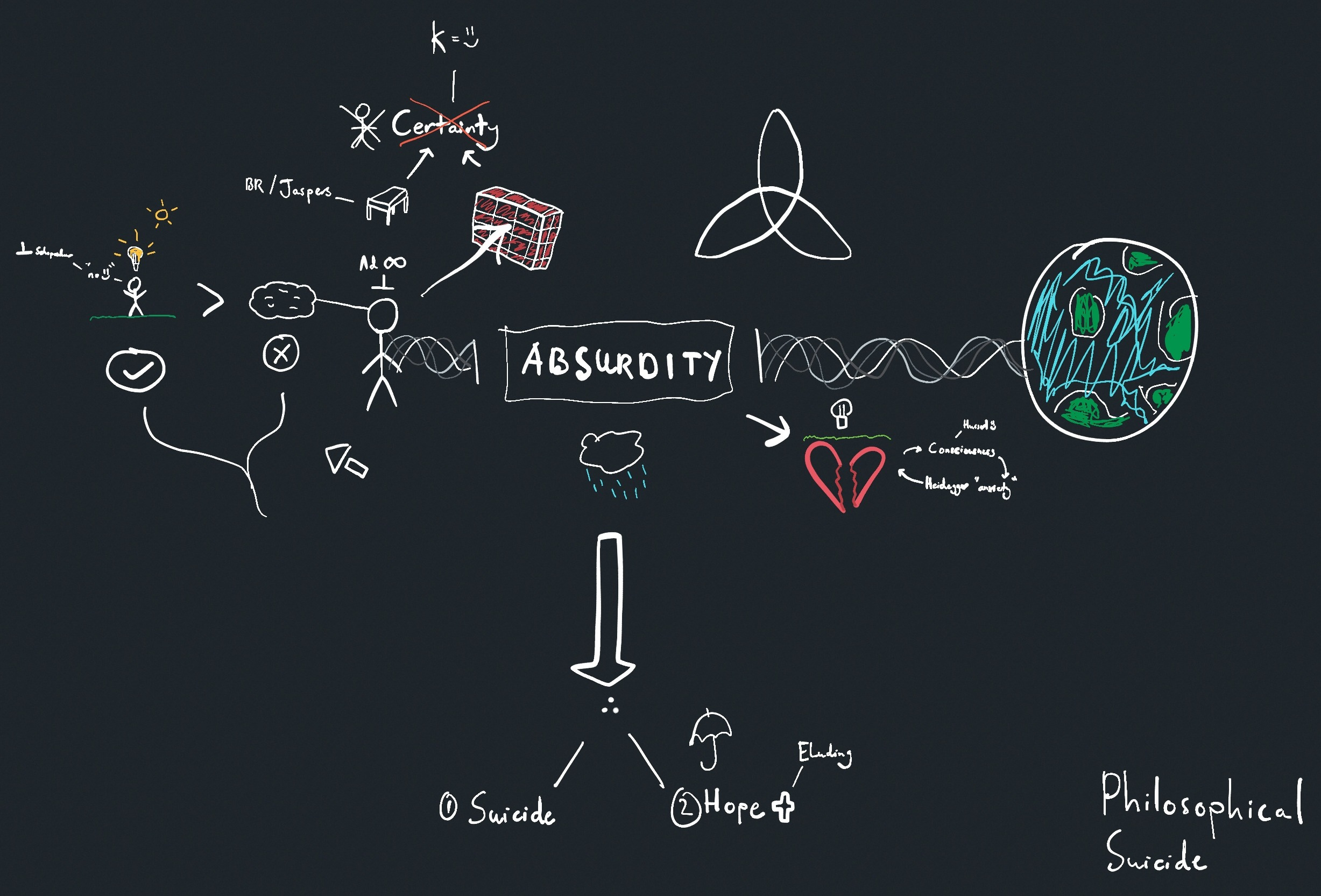
I did a lot more iterations but I forgot to screenshot them. But you can still see the evolution and how my thinking has changed across time. This is going to look completely different after my next reading session too, and that’s exactly the point.
Now, onto step 3.
(3) Consolidation
For this step, I like to teach my mind map out loud.
I watched this 40 minute video on How Olympic Athletes Train by Dr. Justin Sung (please check out his work if you want to learn all this properly; I’m only trying to learn this for myself through writing about it. I have learned so much from him, so giving credit where credit is due, check out his work please).
So, I’m currently trying to build my own learning/feedback system for improving my jiu-jitsu.
Here’s the mind-map I came up with from watching the video. This took multiple iterations too, I believe about 7 or 8:
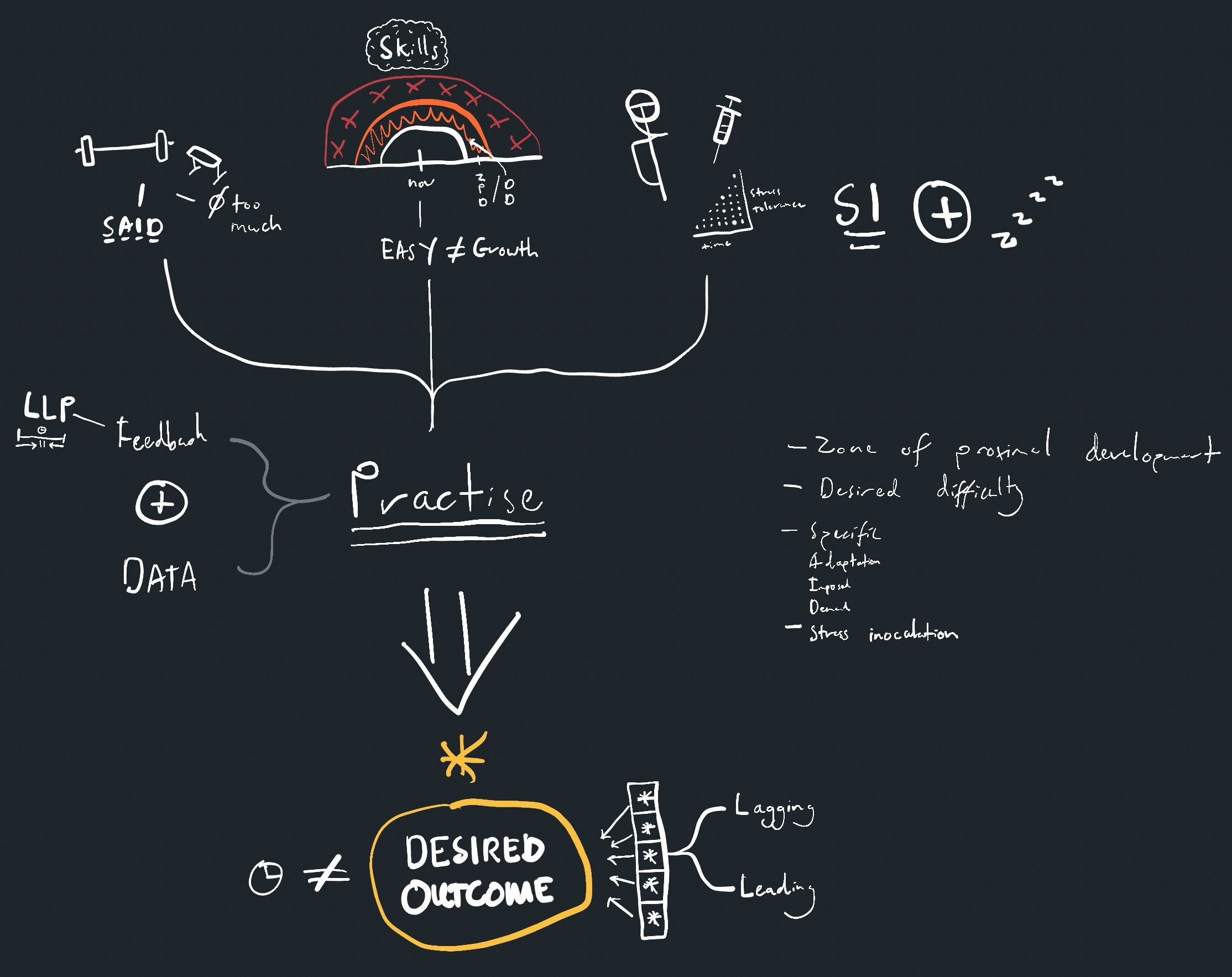
I practiced explaining this to my Dad. He was telling me about some golf lessons he’s been taking, and I thought this information would’ve connected to his practicing quite well.
This step on consolidation is about being able to understand and comprehend information inside your own head. That’s why there are very few notes on the mind map above. For example, I know that LLP means “latent learning period.” It’s just inside my brain and not on the page, which is what truly matters. That symbol beside the injection is a reference to the TOOL album Fear Inoculum, reminding me about fear inoculation and how it improves stress tolerance. In simple terms, do lots of something and you will get more comfortable doing it.
This is why taking hundreds of pages worth of notes on everything is a waste of time - your notes need to be in your head.
Profound Idea: Use the Feynman technique to explain your mind-map out loud as if teaching someone who has never heard of these concepts before. This exposes gaps in your understanding that you can go fill in.
Then, it’s about reviewing your mental model or mind map over time. Spaced repetition. A few times per week, then once per week, then once a month and so on.
This newsletter does not do justice on what I’ve been trying to learn.
There are so many better sources out there. Dr. Justin Sung has been incredible to watch and learn from, so I would highly recommend checking out his work. Again, I’m not an expert in any of this, and I am not trying to say I have invented any of these learning processes or systems. I am merely trying to learn this for myself, and the best way to learn something is to create something (this newsletter) and to practice teaching it (also through this newsletter), and maybe you’ll learn something too.
If you’re skilled at mind-mapping, please leave a comment telling me where I could improve. I’m always looking for ways to improve and thus help you guys out. If there are gaps I need to address, please tell me!
Let me know what you think. Send me a DM of anything you’ve been learning, or any mind-maps you’ve come up with. I’d love to see it.
Anyways.
Thank you for your time and your attention, I know it is quite valuable.
I really appreciate you.
You’re an absolute legend!
And have a great day.
- Craig :)
P.S
If you want to start writing long-form (essays, articles, newsletters etc.) and build an audience of readers by writing about your genuine interests and profound ideas, check out The Profound Writer.
If you want a complete reading system with step-by-step protocols and evaluation frameworks, you can download my Guide To Profound Reading.
Reduced price ends on December 9th.

How does this only have 300 likes? This is one of the most useful things I’ve ever read on Substack, I loved it and am definitely going to try! My only question would be if this also works with school, like learning for a history test. In the first few years of school I could get away with memorising but now I really need to understand what I’m doing and I feel like this method could really work!
I enjoyed reading it. Being READER and NOTE-TAKER myself, I have been confused about how to do it systematically. Thanks Craig.