


Yes.
The world is designed to make you consume and comply, rather than think and create.
You are told what to think by the media.
You are not taught how to think by formal schooling and education.
The natural order of the world is conformity.
Scrolling and listening.
Not speaking.
Not building.
I’ve said this before that we all know this by now. But only a select few are actually acting as if they know it.
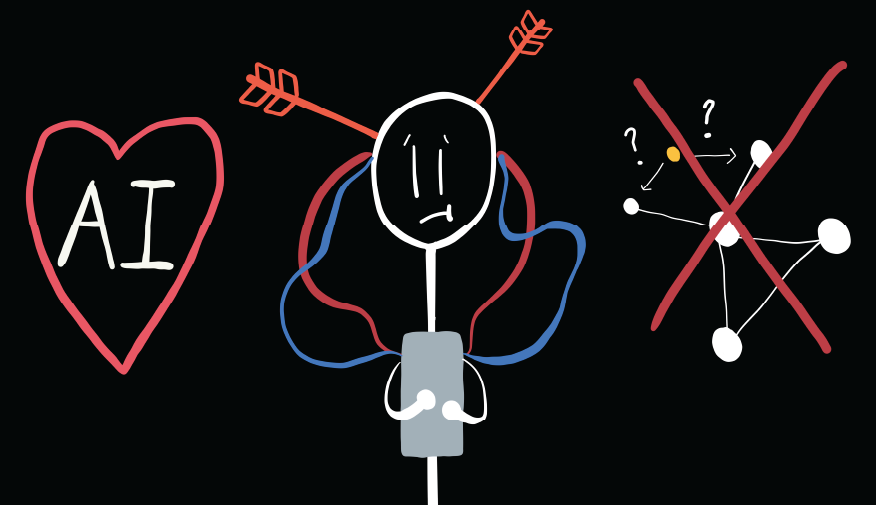
I got a comment a week or two ago asking me to write about the topic of reclaiming your creativity and your ability to think and in all honesty I didn’t have a fucking clue what I would write about.
But it made me realize a couple things right away.
Sometimes I catch myself reading books or using AI passively.
With AI it’s mainly to help me brainstorm ideas with my own thinking partner prompt, or on whatever questions I have about my current reading of The Myth of Sisyphus (on page 105 now).
I really like using AI and I think a lot of people misunderstand it in some sense because they don’t use it correctly.
AI is just another source for gathering information.
AI is information, but it’s not knowledge.
Knowledge exists inside your own head, and in order to gain new knowledge you have to evaluate and create your own connections with information, if you want to turn that information into new knowledge.
My solution has been to incorporate mind mapping into my writing process.
Yes. I know it doesn’t make a lot of sense to draw mind maps to help with typing letters on a keyboard.
But anything I consume from research sources or from AI chats (every generation it creates in response to the context or questions I give it) I mind map my thinking in the form of a mind map.
Using a mind map forces my mind to engage in higher-order thinking (evaluation and creation) through mapping relationships, questioning the big picture and its connections, and constantly evaluating, destroying, rebuilding, and re-evaluating my understanding while I turn information into new knowledge that I can then synthesis and use to create my own unique solutions to problems in my newsletters.
Be prepared, I’m going to make a lot of profound connections in this one.
Profound Idea: My mind maps are a revolt against passive thinking, they force my mind to think, to evaluate, to create with agency.
This is just one of four steps for reclaiming your creative ability.
If you want to learn to think again like you once could, read on. If not, don’t.
This is what I call “the silent illusion”
Profound Idea: We live in a paradise that’s designed to keep you sleeping.
The world we live in today (despite how much people love to shit on it) is actually a pretty good one.
Think about that for a second.
There has never been a better time to be alive and I mean that quite literally.
You have a computer to buy and access any information source online. You can track, store, and retrieve any idea with a second-brain software and AI. And we don’t need to bust our asses off working 10 hour days like how it was during the Industrial Revolution in horrible working conditions. If you want a further reality check on all this go read the first half of George Orwell’s The Road To Wigan Pier.
If you want a new gratitude practice you should read about the coal mines.
You have Amazon and pornography; you literally have all the freedom and rights you could possibly ask for. But there comes a toll with freedom and rights:
The first step you must take in reclaiming your creativity is responsibility.
The only thing stopping you from living on Pleasure Island from Pinocchio is responsibility. In Aldous Huxley’s Brave New World (great book btw) the citizens of the World State are conditioned from birth to consume every sort of superficial, expedient pleasure. Sex, a happiness drug called soma, consumerism.
Why?
Because pleasure without a purpose is control.
That’s a profound fucking idea, and it’s also where things start getting scary…
Social media is purposefully designed to keep your attention “hooked” by easily presenting the opportunity to watch thousands of reels an hour. It’s not going to get you thinking deeply. It’s not going to get you feeling fully. And it’s not going to get you fully embracing your fucking life. It’s why I think our phones our numbing our minds until we die without even realizing it.
So.
How does all this relate to reclaiming your ability to use your head?
The answer is in every way imaginable.
Profound Idea: The danger here is that our world doesn’t need you to engage in higher order thinking because you don’t need to worry about survival.
When survival is no longer a problem we default to the lower levels of thinking because it’s easy and opportunistic. Isolated thinking. Unable to consider the big picture. Scrolling and consuming all day as an escape from boredom.
Because why bother thinking when it’s so easy to get by without it? Who needs to make evaluations in paradise? Who needs to create a solution to a problem when there are none to solve?
Time to make another profound connection :)
The changes I have seen in my life since beginning The Myth of Sisyphus have been fucking huge. Expect a thorough newsletter on that soon. But there are two things that I think make someone an absurd individual, someone who actively embraces absurdity without running away from it (like the existentialists did through what Camus called philosophical suicide, which is the reason why I don’t like the phrase “what’s meant to be won’t pass you by”).
I would call these absurd traits:
The first is general awareness.
The second is being aware of illusion specifically.
Responsibility, our first step, stems from awareness of the silent illusion.
The world is designed to make you consume and comply, yes. And now having read this section you are aware of the illusion it offers. You probably know people in your own life (I do in mine) who scroll for hours every day, and the real reason isn’t because it’s fucking fun. It’s because they likely don’t have enough awareness to avoid getting sucked in by the illusion. It’s like an absurd comfort that numbs you into compliance.
Like fuck. How many hours in your lifetime will you waste doing something completely meaningless? I’m not completely against social media. If it wasn’t for social media I wouldn’t have grown my audience to where it’s at right now. I wouldn’t be getting paid (literally) to self-educate and write about what I learn online. In the last few months I’ve received an overwhelming amount of messages from people all over the globe telling me how much of an impact I’ve had on their life. There’s no way of saying that without sounding arrogant but it’s crazy, and I genuinely don’t know how I feel about it.
None of this would be possible without social media.
Social media is great... but in the right dosages with the right level of individual responsibility to control how you use it.
The big insight I want you to take from all this is to wake up from this illusion.
Because it’s definitely real and it affects more people I know than I’d like to admit, and that does kill me.
So, we can now present a pathway forward.
A way to slingshot yourself out of this hell-hole.
It takes individual responsibility to reclaim the intellectual prowess you absolutely do and should have. You need to escape the lowest-orders of thinking that the world hands you by default. You must learn to stand up straight with your shoulders back and fight against the tide, even if it means being called weird for disagreeing with what everyone else believes to be true online. Because real life is experienced offline, and nobody else online, not even AI, is going to force you to think.
Thinking is done offline, inside your own head.
And that my friend, is on us.
Especially you.
Creativity
Profound Idea: Creativity is synthesis. The ability to think is the ability to create. To create a solution, a response to a question. To create a meaningful outcome in an absurd, meaningless world. To create is to revolt against the status quo of how life is by making it deliberately become what could be in relation to a purpose, a throughline vision you seek to achieve.
Creativity is the choice of building, doing, or saying something meaningful in a world that doesn’t require it and that’s exactly why most people don’t make the choice.
As discussed in our previous section, most people aren’t making that choice due to the silent illusion. But there also are those who do wake up from it, and who still don’t know what creativity actually is.
Creativity requires two learnable cognitive skills:
The ability to evaluate (make judgements)
The ability to create (based on your evaluations)
Most people don’t develop either of them.
If you haven’t read any of my past newsletters, I say this enough, but I believe there are so many profound ideas we just aren’t told in life. I went on a drive last night around the Irish coastline with my friend Eric who said to me “it’s mad how much deeper life is when you think about it and nobody really questions anything.”
We went on the discuss a long list of ideas we just aren’t told, and this idea was actually one of them.
I was never taught in school how to think.
How to think in an integrated way (higher-order thinking) versus an isolated way (lower orders). We were always told to read this sample essay or that book chapter and... learn it. But what does that even mean? Learn it. Most people in my class didn’t know. I didn’t know.
I think a lot of people consume and never evaluate what they consume. I also think this is the underlying issue behind the doomscrolling epidemic and the attention economy and all that jazz. Most people consume but never evaluate what they read through passive consumption. Zero questioning, connecting, or challenging. Even good consumption like reading a book or two every few weeks produces nothing to show for it other than you simply “know” things.
Aristotle said the purpose of knowledge is not knowledge but action.
And action needs a purpose or throughline to give it direction.
Profound Idea: Consumption must fuel your creativity. Creation is what stops consumption from feeling stale, purposeless, and numbing on your soul.
There must be a vision, a purpose, a throughline. Without it, you’re just hoarding information in a box to be locked away for safekeeping.
So, what is the gap here?
Consumption without evaluation - passive absorption without questioning, connecting, and challenging
Evaluation without execution - ideas staying inside your head without ever becoming or shaping a real-world outcome
Reading without evaluation is entertainment, and evaluation without creation is pointless work.
Because everything in life is for an outcome.
If you’re scrolling all day with no physical real-world result, you’re doing something wrong.
If you’re training jiu-jitsu four, five, six times per week but not evaluating each session and creating a target for practicing a new technique, you’re probably doing something wrong.
So what do you do if you don’t have a clear purpose?
You start anyway.
Profound Idea: Clarity comes from action. Most things in life take months of trial and error with no clarity whatsoever until one minute it clicks and intuition suddenly emerges as if it’s been there all along.
You don’t need a perfect throughline before you start building.
But you do need to start solving your own problems without hesitation.
Write to solve your own problems. Research to solve your own problems. Mind map to force your mind to evaluate information, turning that information into knowledge, which can be used to solve your own problems.
Naval says the best way to learn anything is to do.
If you don’t know how to evaluate something, just try.
If you don’t know what to create, build anything.
Just try, and try repeatedly until the minute comes when it all clicks.
This is how I’ve grown my audience to 14,000 subscribers, with 9000 coming within the last month. Solve your own problems and share the solution if you want to get paid to be creative.
How to reclaim your highest order thinking skills
Profound Idea: Reclaiming creativity means reclaiming your capacity to evaluate your own problems and not outsourcing that evaluation to AI, Google, or someone else’s framework.
Important note:
Everything you do must encourage, if not force higher-order thinking inside your own brain. You can use AI (I’ve been messing around with it in a new way myself which I will talk about in future newsletters once I have a system that works well) but only to amplify the thinking that’s happening inside your own brain. Same applies to reading any source of information or writing anything. Evaluate with your own brain, and don’t let anyone else - AI included - do it for you.
1) Learn to mind map
Mind mapping forces higher order thinking.
Why?
Creating a mind map forces you to evaluate concepts and how they can be grouped together. It forces you to make connections in a non-linear way, in a big picture way. Relationships, questioning them inside your head, evaluating them, re-evaluating them after you’ve read something new, destroying your mental model and rebuilding it.
Deciding what spider’s web makes the most sense to you, in the most simplified way possible, you cannot do this without higher order thinking.
You can read and reread information all you want. But evaluation is what turns this information into knowledge inside the brain. A lot of people online see the antidote to reclaiming creativity as to “create more”... and that’s as far as the advice goes.
But the underlying problem beneath a lack of creating is a lack of evaluating, because how do you know what solution to build, what newsletter to write, what product to sell, what book to read, what question to ask, what advice to give, what problem to solve?
Evaluation fuels creativity, and mind mapping forces you to confront everything you consume.
For helping me write this newsletter, I created this mind map:

I’ve been trying to incorporate mind mapping into my writing system.
For this newsletter I created a mind map that synthesized everything from my thinking partner session (30-50 ideas I had brainstormed) and forced myself to see where each idea fit inside the big picture inside my own head with my own evaluative thinking. I did the same with every research source I read.
It’s all information at the end of the day and mind mapping is what turns this information into knowledge inside my brain. I think there’s a lot of learning potential with AI that I am yet to explore, and I am ecstatic to test new things over the coming months.
The process looks like this.
I read something (from a book, an article, an AI output), then I stop and ask myself where does this fit in my mental model (or knowledge schema)? How does it connect to what I already know? What needs to change in my mental model or be simplified? Then I redraw the relationships on my mind map. This is me physically thinking, evaluating, and creating. The whole spider’s web gets evaluated, destroyed, and rebuilt. And the entire process of doing this forces me to think about what I’m reading.
Any questions I had (question are knowledge gaps!) I wrote in a blank document to come back to once I felt ready to take a step back and reconsider the big picture.
2) Don’t use AI the wrong way
Delegate lower order thinking to AI.
Do not, I repeat, do not delegate higher order thinking to AI. You want to be doing higher order thinking inside your own brain, and using AI to help amplify the higher order thinking happening inside your brain.
Use AI to act as a thinking partner, or as a research assistant. Use AI to help YOU evaluate and create your own buildings blocks to help you create what you want to create.
I need to spend some time learning more about AI, because I don’t know what perspective I have to offer you with at least a good level of confidence. But I can say this: don’t offload the thinking that makes you human, that makes you stand out, that makes you authentic. Your taste and judgement have the final say and these are higher order thinking skills that require evaluation.
I love using AI to amplify the higher orders of thinking inside my own head, which I can then use to help me build my own mind maps and build new knowledge inside my own head. Not to replace my thinking but to enhance it.
3) Create in the morning
This small habit has brought about massive improvement for me in terms of focus, clarity, and reducing friction when sitting down to write each morning.
Turn your phone onto airplane mode before you go to sleep. It can be right before bed or earlier in the day.
This means when you wake up and turn off your alarm you have no notifications open. No notifications means no open loops running in the background of your mind.
What this does is it creates an opportunity for choice.
You get to decided what you want to focus on with p u r e f o c u s.
I’ll say it again for dramatic effect.
P u r e f o c u s.
Create first thing in the morning when you have the most clarity, the least amount of open loops running. Spend 1-2 hours first thing building the thing you wish you had 6-12 months ago. A newsletter, essay, or solution to a problem you have or had.
Every newsletter I have written and will continue to write does this. So does my Guide to Profound Reading.
Profound Idea: The world is designed to fill every gap of your life with consumption and this practice is for protecting your thinking time like it’s a matter of life or death.
4) Solve your own problems and develop agency
Never wait until you absolute clarity or the perfect idea or plan.
Start.
Do.
The best way to learn is to do.
Without doing or trying you have no feedback, and how can you expect to gain more clarity or improve anything without feedback?
I really like this as a practice, even for coming up with content ideas.
Write down every problem you’ve had in the last year and pick one of them to solve. This will probably involve writing of some kind, which is good. You solve problems through writing. The word essay means “to attempt.”
So, attempt at solving one of your own problems and own that solution as your own.
Agency is the tendency to initiate action towards a goal without outside prompting, instruction, or permission. - Dan Koe
Agency is the ability to create your own direction, to do what’s required to solve the problems you care about solving and the problems you have assigned to yourself. Life is infinite temptation. Endless opportunity. And the ability to develop agency is like building your own coat of armor that makes enemy archers fear you. Arrows will bounce off your chest like throwing stones at a brick wall.
To have agency is to be distraction-less.
You have a path, a direction, a purpose or throughline, and everything you do moves you towards it.
You know what to spend time evaluating.
You know what to spend time building, what problems to solve and which to avoid.
You know how to iterate, and you understand that consistency alone does not lead to success but consistent iteration does.
Creativity is the ultimate form of revolt. I would add evaluation to this idea now too. It’s deciding to say something when all the world wants from you is to listen and agree. To create and evaluate is to take your place in the world as a high-agency individual, a profound thinker.
To think is to live.
Thanks for reading.
You’re an absolute legend.
- Craig :)
Free and paid stuff:
If you want to develop your evaluation and reading skills, check out my Guide to Profound Reading. You’ll get a 2-month free trial to my Substack paid-tier if you do. Paid subscribers can read it here for free.
If you want to build your own habit plans with Aristotle’s golden mean philosophy and a unique AI prompt, download that here.
If you want to build your own purpose, your own throughline to work towards with a vision, anti-vision, and goal-setting template for doing deep work daily, download my Life-Engineering template to help you do just that.
My free eBook and template include a secret 30% off link for my Substack paid-tier, as does the welcome email if you choose to subscribe to Profound Ideas.
Feel free to leverage or ignore the link.
The distinction between consumption and evaluation is crucial and honestly uncomfortable to sit with. I catch myself consuming constantly without that evaluative layer. The mind mapping approach makes evaluation tangible and intentional. Starting anyway without perfect clarity is also important. I've always waited for the right conditions that never arrive. This piece connects theory to actual practice which is refreshing.
Hope i have now got the profound image of it..thanks alot