


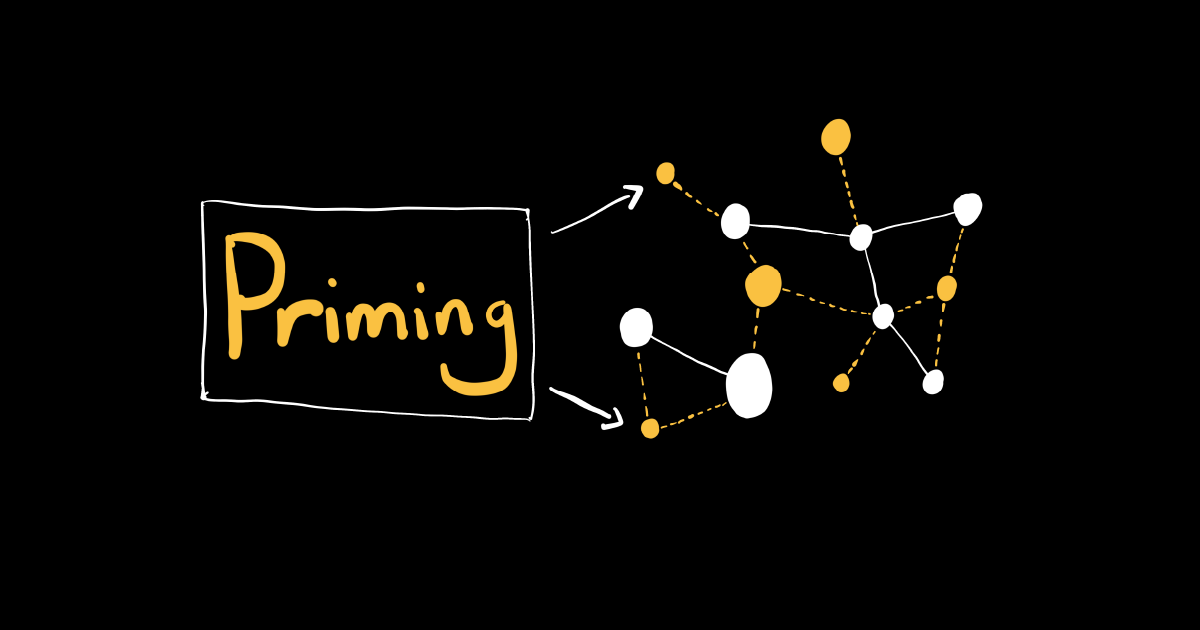
Here’s what my current learning system looks like:
Priming → Encoding → Retrieval Practice
Priming is for getting an idea of the terrain of information I wish to explore.
Encoding is for restructuring and processing information, evaluating it, and creating new spider’s webs of knowledge - or mental models - to store in my long term memory.
Retrieval practice is about using the knowledge (mental models) I have encoded into my long term memory to solve problems, answer questions, or even pass an exam if that is my goal.
How I use my knowledge ultimately comes down to the purpose or outcome I seek to achieve with my knowledge. The clear outcome you want to attain with your new knowledge is the foundation of this entire process. This is very important with regards to how you will encode your information, and thus how you plan on retrieving said encoded information.
This is going to be a very short but thorough walkthrough of my current priming process.
If you want more details about priming, how and why it works, you can read this free newsletter to get you started.
It already gives you all the knowledge you could possibly need to start priming within your current learning system (whether you think you have a learning system or not, you do, you just might not be aware of it).
That free newsletter gives you the knowledge, but this guide is for helping you with the execution.
We will be priming our brains to learn a brand new topic alongside each other.
That’s right, you and me!
You can use this guide as a comparison.
To help you with your own priming process. To make your own evaluations, and to help you develop the agency needed to self-regulate and iterate upon how you learn - your current learning system.
Maybe this guide will be the first step in helping you build your own learning system.
Now.
We will be priming our minds for no more than 5-10 minutes, and we will be learning about existentialism via the Stanford Encyclopedia of Philosophy page.
Here’s the link:
This is why I have chosen this topic specifically:
This is a free resource we can both look at together
I know practically nothing about existentialism, and I have never seen or read this page before (even as I am writing this very sentence)
I am interested in getting to know more about existentialism myself, mainly to help me offer new perspectives in my newsletters (my writing)
I will now start my 10 minute priming timer and track what I am doing on this page while I am doing it. I will also be including any of my thinking in an unedited block of text for you to see how I am evaluating the text and engaging in higher order thinking (and not the lower levels). Any questions I have, or any connections I am making (familiarity and relevance create purpose within your learning; I want the information to feel as integrated and therefore purposeful as possible. This is how I am trying to make connections with the big picture).
I have my iPad open beside me to create my hypothetical mind map (my guess as to what we will be reading about) and I will be using this guide to “think out loud,” almost.
Let’s begin!
Step 1 - Pre-exposure & writing down key words/concepts
This took me about 6 minutes.
I skimmed through the opening section and the complete table of contents in this time.
Here are the key words I wrote down:
Existentialism
Death
Freedom
Meaninglessness
20th Century
Nihilism
Engagement
Detachment
Existence
Essence
Freedom
Ethics
Modernity (I had to google this)
Truth
Perspectives
Being
Choice
Knight of Faith (didn’t have time to google this)
Overman
Resolute Dasein (didn’t have time to google this)
Self-recovery
Impact
You don’t want anymore than 10-20 key words.
If you don’t understand a key word or concept, spend 20 seconds or so googling it. You only need a basic idea of what it means right now.
You’re not trying to understand with this step, but you should be creating a general foundation to build knowledge upon and correct.
Step 2 - Making a hypothetical spider’s web (guessing what I’m about to read)
This is the mind map I made.
I would have liked to have added some more concepts, but I ran out of time.
I used my remaining 4 minutes creating this:
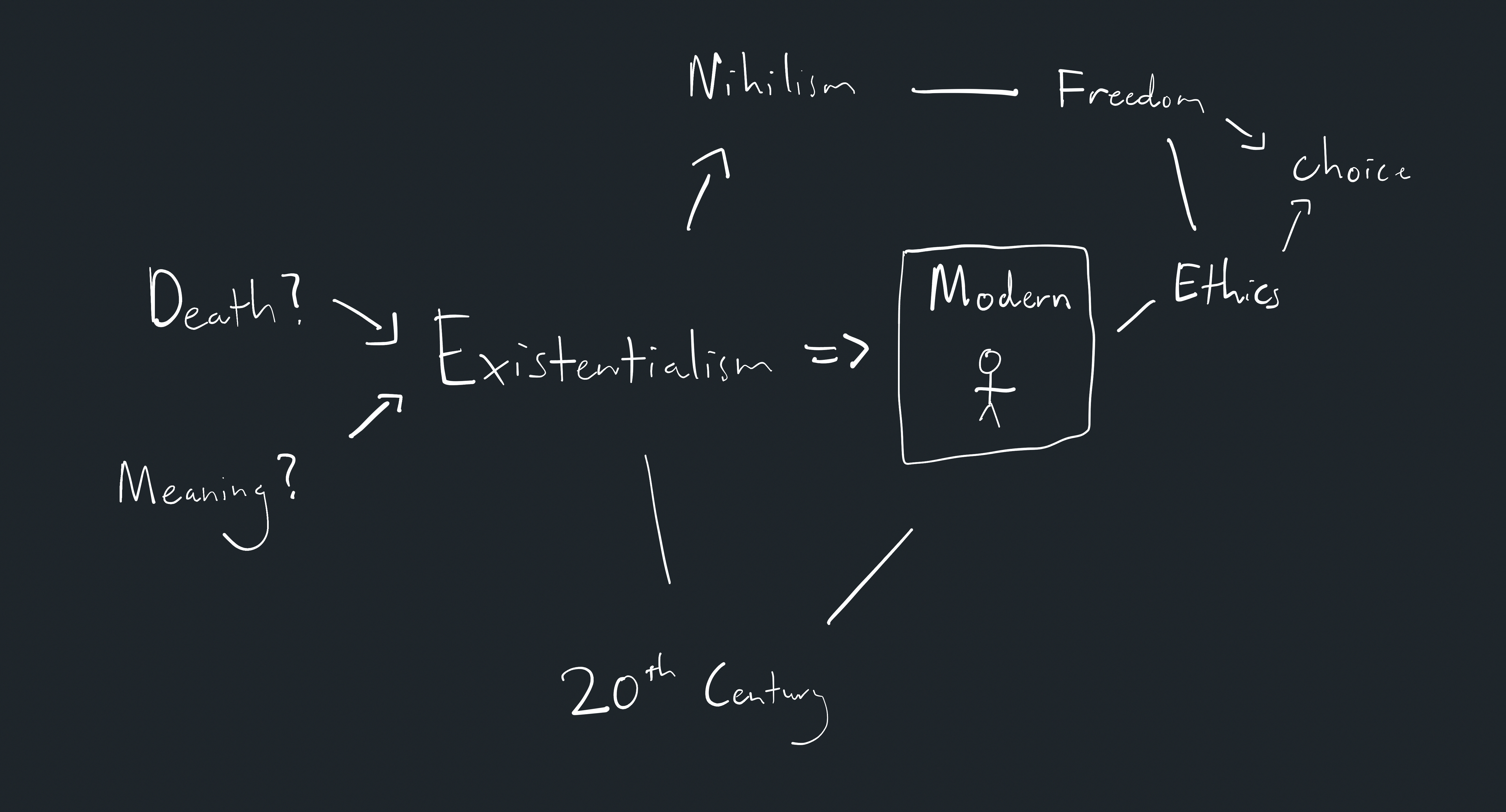
I know for certain that there are a lot of gaps in my knowledge with regards to this mind map.
I don’t feel very confident in it, and I have a lot of questions, but that’s a good thing.
This will activate the hypercorrection effect once I re-evaluate, destroy, and rebuild my model.
What I am thinking now that I’ve finished priming, and what questions are in my mind
My completely unedited thinking during the priming process:
