


Before we begin,
If you want to improve your reading and learning skills, you can download my new,
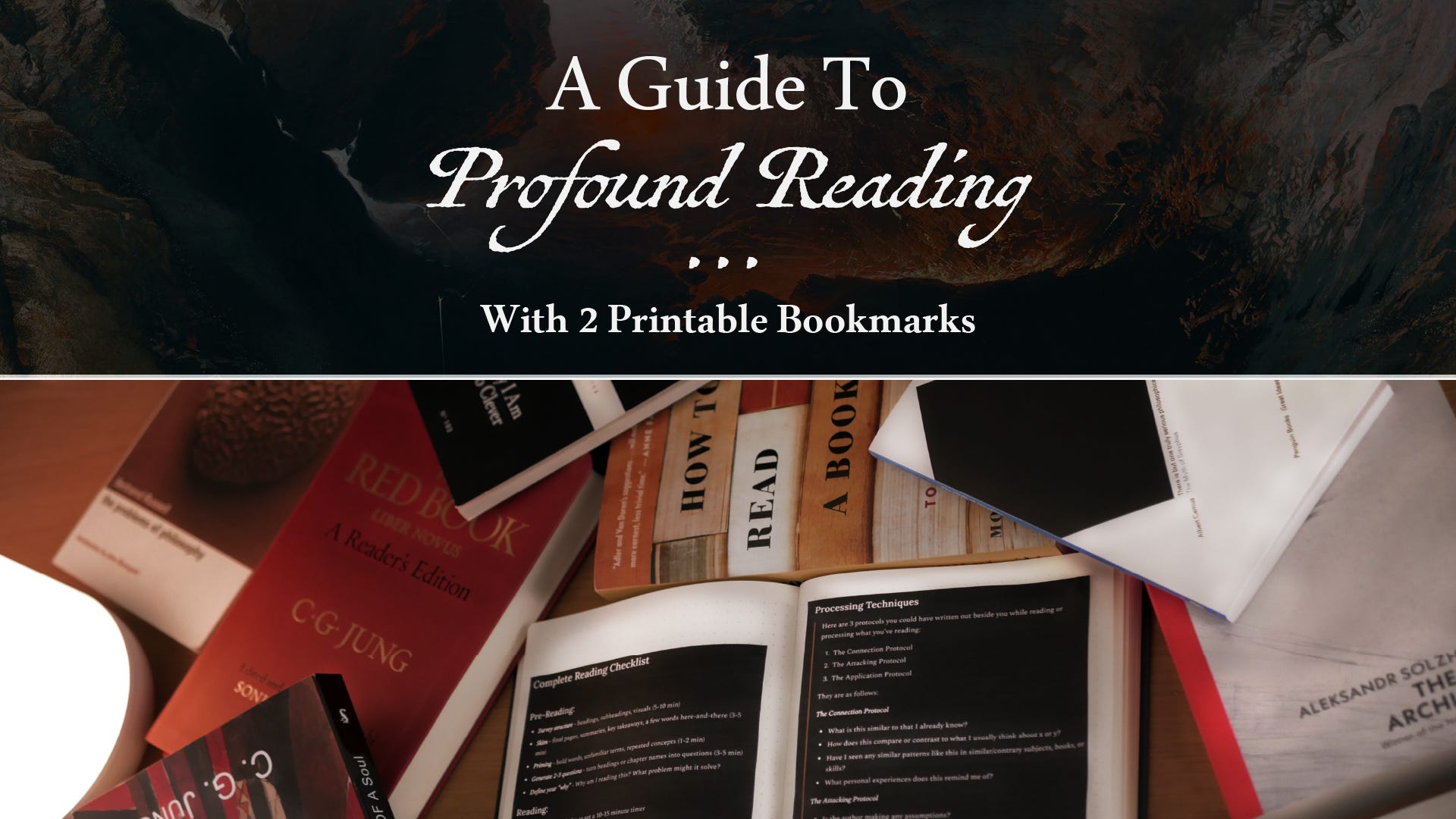
6000 words and two printable bookmarks to help you read more actively while remembering, understanding, and retaining what you read forever.
If you do download it, you’ll get 2 months free access to my paid Substack tier (valued at €16).
The reading guide is 20% off until December 9th.
Paid subscribers can read the guide here.
Now, onto the letter. The research for this one terrified me.
Your mind is not a vault but a garden.
Stop trying to remember everything you read.
Throw away your linear notes, your highlighters, and stop building your second brain.
Because what if everything you have been taught about learning is completely backwards?
The education system teaches you to conform.
To be dependent instead of being capable.
We are deluded into thinking that the purpose of learning is to gain credentials.
But real learning is about building agency.
By agency, I mean the ability to identify and solve your own problems, rather than being assigned other people’s problems to work on.
Sure why would it all be completely backwards?
School testing and grade levels have destroyed the desire for enlightenment.
The education system prepares you for tests and getting high grades, and not the one thing it should prepare you for - navigating your own life.
Degrees showcase how compliant you are, not how competent you are.
Because true intelligence has never been about credentials, as Naval says it, but whether you get what you want out of life.
The education machine was built to create problem followers, not problem solvers.
If you don’t build your own purpose, you will be given one to build.
If you don’t solve your own problems, you will be given other people’s problems to solve.
So, you are brilliant at solving specialised problems for other people - like a bug (poor Gregor Samsa) - but you have no idea how to solve the range of problems in your own life. In your daily life. Plaguing your mind, your body, and your soul each morning when your iPhone alarm wakes you up at the crack of dawn.
Is this not what education is supposed to help you with?
The problem here is that most people don’t have a clue how to learn properly. And thus, they don’t know how to navigate the world, and they suffer unnecessarily and stupidly.
We think being informed is the same as being enlightened.
We think studying equals learning. But studying is merely your tools and techniques that should aid the learning processes inside your own brain. Because learning happens inside your brain, not on a page or on a screen.
We fail to realise that learning is building your own ability to solve problems.
Full.
Fucking.
Stop.
We forget that the most important problems to solve are our own ones, and that the real way to learn anything is to weaponise them.
Education is for distinguishing people based on whether they can recall and understand what they have been told to think. If you get an A+ on a test, you are smart. If you do well in standardised tests, you can go on to do harder tests, get a degree, a masters, a PhD. But they’re all just titles. None of them mean you are smart. None of them mean you have any real skills.
The smartest people in the world get what they want from life, and you don’t need a degree for that.
You just need to learn how to learn properly.
Smart people get what they want out of life.
But first, some profound ideas that will change how you look at the education system forever.
Here are 3 truths you must know
Hold onto your butts.
Because this is where things start getting hairy.
Truth 1) The education system was never designed to make you smart
Good students wait for a teacher to tell them what to do. This is the most important lesson of them all: we must wait for other people, better trained than ourselves, to make the meanings of our lives. The expert makes all the important choices; only I, the teacher, can determine what my kids must study, or rather, only the people who pay me can make those decisions, which I then enforce.
John Taylor Gatto
Education has always tried to destroy agency and individuality.
Most of us first think about the Prussian-style education model in terms of the origin of our modern day education system but there are also other examples of this.
The Spartans would take children away from their families in order to condition them young, to obey the state’s rules and ideology. Even Plato understood the importance of controlling education from youth in his Kallipolis in The Republic. But it was Martin Luther who first advocated for compulsory schooling, being at “war with the devil,” to indoctrinate minds into his belief system.
Because the education system is about controlling your beliefs, not with helping you to come up with your own.
Education has always been about belief management. It has never had anything to do with awakening intelligence.
It is a factory model, designed to make obedient and conforming workers to fuel economic growth.
I got 589 points in my Leaving Certificate, the highest in my year and school’s history at the time (sorry for sounding arrogant but it’s true). But I fucking hated school. I just memorised everything using linear notes and rote memorisation. I was never interested in learning what I was told to learn, but I did it anyways.
I just put my head down and did the fucking work
And I was always living a double life. I would spend all day memorising and learning things I had no interest in “because I had to,” and I was a self-directed learner at night. I spent every second of free time watching Jordan Peterson lectures (regardless of what you think of him now, his ability to think and synthesise knowledge, I think, is very profound), alongside Academy of Ideas, Eternalised, Andrew Huberman, Joe Foley’s Unsolicited Advice, and Jared Henderson.
In other words, I was trying to fix my head and my own life.
It wasn’t a great time for me in 5th-6th year and I was suffering a lot for reasons I won’t explain right now. The same thing applies to when I was in 1st-3rd year trying to process my mam passing away. Cancer sucks, but we embrace the absurdity of it all, and we keep pushing our boulder upwards even when it falls back down on us :)
During school hours I felt like I was fighting a losing battle, putting my head down to earn pointless credentials that said nothing about me.
But at night, I was doing real learning. Solving my own problems. Building up my own understanding of the world, an understanding of my world.
Because we all have the same desks.
The same boxed classrooms and lecture halls.
The same standardised tests on the same subjects.
And this is how you survive.
Yet we are all different, and this is how workers who can just put their head down and do the work, even with lots of struggle, get weaned out from those who can’t.
I learned this last week, but the 40 hour work week was only introduced in the last 100 years to fuel economic growth. It’s strange that you are also expected to engage in high quality learning for the same amount of time in school and at home through studying - which just isn’t possible.
True intelligence isn’t about credentials; it’s about the ability to solve problems competently to improve one’s life.
Truth 2) The difference between “studying” and “learning”
I have spent tens of thousands of hours writing linear notes and not learning a fucking thing. So please understand this so you don’t have to suffer like I did:
Learning happens inside the brain.
Studying consists of the techniques that help with the learning processes happening inside your brain.
Most people don’t distinguish this, and think that studying for time makes you a better learner, a better worker. This is because you have been made to believe that time is the key to success. But it’s not. It is the quality of your output - the final outcome.
Being informed is not the same as being enlightened. Just because you know something, does not mean that you actually understand it.
Just because you are engaging in a study technique, does not mean you are actually learning anything.
Taking linear notes does not mean you are learning.
Writing out flashcards does not mean you are thinking.
Highlighting sentences from books does not mean you are reading actively.
I remember when I bought Aristotle’s The Nicomachean Ethics about 2 years ago in Easons. I tried to memorise the book’s entire logical argument line by line. After 3 weeks and more hours than I would like to admit, I had carefully marked up the book and memorised each line in the exact order in which they were written, from the first 3 chapters.
But I didn’t understand any of the book in my own words. I only understood the book in Aristotle’s own words.
The reason why I learned so much about human psychology and philosophy in my self-study time back in school is because I was thinking about what I was learning. Applying it to my own problems I desperately wanted solved. I was making connections.
Which leads me onto arguably the worst truth of the 3.
Truth 3) School has taught you anti-learning
There is only one thing worse than thinking too much. Linear learning, through taking linear notes and attempting to memorise them in isolation, is a disease. A real, actual disease.
Because true understanding, true learning and comprehension, is non-linear.
I’ll say it again.
Non-linear.
The knowledge inside your brain doesn’t look like a page of linear notes.
It looks like a spider’s web.
Lots of dots (concepts) connecting to one another to form a knowledge schema, or a mental model or a mental framework.
This is what knowledge looks like - it’s non-linear.
Your brain doesn’t want to learn pages worth of notes in order. It wants connections, it wants a purpose inside the overall big picture.
Your brain is hardwired to forget information not relevant to your survival. If it’s not connected or integrated with other information inside your own spider’s web of knowledge, you won’t retain it.
Linear learning, the method of “write down these notes from the slides on screen,” actively works against how your brain processes and encodes information non-linearly.
It encourages linear learning and linear thinking. Not the opposite which is what you actually want.
And everyone I know in education right now is still being told to do all this.
Like. What?
Taking notes or rereading them merely helps you to understand someone else’s non-linear understanding in a linear way.
That’s why a book is formatted into chapters and not just one 300 page paragraph.
The information is presented in a particular order. But your job is to reconstruct that information into knowledge inside your own head in your own way, in your own order with your own connections.
Documentation does not equal understanding, so avoid taking linear notes like it’s the plague.
True learning is an internal process of making connections and building a mental knowledge schema. It is not something that happens on paper, but in your head.
This is why you always forget what you read.
Everything you learn. It’s all isolated. Disconnected. There’s no interest in discovering connections and making innovations - by creating solutions and solving the problems that matter to you.
But there is a way out, and it’s a method that works with how your mind actually learns, not against it.
How to learn anything: The 30-60 minute daily practice
You need 30-60 minutes per day to learn anything.
30-60 minutes of working based on how your mind actually likes to learn, in order to build real agency and independent thinking.
No learning goals.
No learning curriculum.
Your problems are your learning plan.
And this practice is daily.
Because your mind is not a vault. It’s a garden that needs careful conditions in order to grow. You can’t just force feed it fertiliser for 10 hours straight. You need to plant seeds, and water them just enough each morning so as to let them grow naturally throughout the rest of each day.
Here’s how the daily practice works:
1) Plant Seeds (Consume for 10-20 minutes max)
Thinking happens in your head, not on paper.
Have a problem in your mind you care about solving.
Read or listen to something you’re genuinely curious about understanding. This is important. If you don’t care about the problem you are trying to solve, you won’t have any reason to learn, and you will get bored. See how this connects to school?
Real learning is an internal process of making connections.
Real learning is not external note taking.
Have you ever wondered why you always seem to get your best ideas when you’re not learning?
Going on walks, resting between rounds at jiu-jitsu, drinking a mocha at your favourite breakfast spot with someone you care about?
It’s these idle moments that allow your unconscious mind to make connections, which reveal themselves to you when you don’t consciously think you’re thinking.
But your mind is always thinking.
Within your 10-20 minute consumption window each day, you are only allowed to consume for that time.
The rest of your session is for thinking.
You can consume for the whole 10 minutes and then think afterward. You can consume for 2 minutes and think for 4 minutes. Consume for 1 minute and think for 5. Read a paragraph and think until you’ve processed it.
Your learning session is about improving your craft of thinking.
Once you hit a concept you don’t understand or you’ve reached an interesting idea, stop. Don’t write anything down, and process this now.
2) Let Ideas Grow (Think for 20-40 minutes)
Connect everything to everything
You are spending two-thirds of your whole learning session thinking.
Strong memory, increased understanding and articulation; these things come from connections and not from repetition.
You only need repetition if you don’t understand something intuitively.
If you need to reread a paragraph one hundred times, it’s because you’re not connecting it to something. You’re not integrating your learning.
This is where the magic happens. Not on paper, but in your head. Think of this like a plant receiving sunlight. You can’t see it happening, but the most important growth is happening beneath the surface.
When you stop reading, stop for 20 seconds minimum and try to connect the concept or keyword to as many ideas as possible. Then, once this time is complete, now you can start drawing your mind map if you want to.
This ensures that you are actually thinking and processing what you’ve consumed, and not just offloading the hard thinking work to the page.
I’ll say it again, thinking happens in your brain and not on a page.
Force your mind to connect ideas.
Write down one idea on a piece of paper and try to make 36 connections to it. If you want to learn about a concept, force yourself to find a connection somewhere within your personal life, your interests, your favourite foods or even your music taste (Linkin Park and TOOL for the win).
Make as many connections as possible. It will make your learning feel like it has purpose.
Always ask yourself “how does this connect to what I learned about x, y, or z?” Group contrary philosophies and opposing viewpoints. Force yourself to do it.
Force yourself to think within the big picture; go outside the box of isolated learning.
If you’ve always felt as though you’re not smart, because no matter how hard you try you just always seem to forget everything you read, you’re only forgetting because you are not connecting.
3) Plant More Seeds (Weaponise for the rest of your day)
Forget about having learning goals. You want daily ignition for profound ideas.
You need to consume so little information it’s actually insane.
Here is the profound secret:
Don’t set rigid targets that don’t reflect actual learning done (your thinking).
The main thing I don’t like about learning goals is that they encourage status-seeking behaviour when the thinking is what matters. Reading 3 chapters of The Myth of Sisyphus this week doesn’t mean anything if you haven’t thought about it and processed it.
Minimum viable commitment. 30 minutes of learning a day is more than enough. Most people have busy lives with lots of responsibilities.
Focus on your depth of thinking. Who cares if all you read today was a few paragraphs.
I did this learning about the AQAL model. I read about it for 10 minutes one morning but spent the next 10 hours of that day thinking about it.
Your mind is always thinking, which means your mind is always learning.
Go on a walk. Talk to someone about it. Teach them what you know. See what connections you can make. Stop thinking about it even, and see what ideas your subconscious mind throws at you.
If you don’t have any ideas to connect, just start with connecting two concepts. Philosophy and psychology. Biology and psychology. Dostoevsky and Kafka. Jung and a random Substack newsletter even.
If you find yourself still forgetting what you’ve learned, slow down. Consume less and think more with less.
Connected knowledge is self-reinforcing.
Connect.
Connect.
Connect.
All of this is a small bit of fuel igniting your thinking for a whole day.
This is how you build a profound thinking capacity that compounds daily. Do not ignore the power of small but effective learning doses.
Charles Darwin wrote 19 books in his lifetime along with thinking up the theory of evolution by working 2-4 hours per day.
He sprinted, then rested. He studied, then spent his day walking, thinking, and resting his mind.
And yet, students are expected to achieve remarkable grades by studying more than double that amount per day.
No wonder everybody fucking hates school. Myself included.
So stop stuffing your mind with facts that don’t move you closer to achieving the life you want. Start growing a complex understanding of the world instead, so you can learn to navigate life.
I hope you enjoyed reading this.
Again, if you want to massively improve your reading skills and remember and retain far more of what you read, you can download my reading guide here.
If you do, you will get 2 months free access to my paid Substack tier.
Thanks for reading.
You’re an absolute legend.
Go learn some cool shit.
- Craig :)
Keep on reading more profound ideas:
5 Ways to be Bored this Weekend

If you keep avoiding boredom like it’s the plague, you will never learn this profound secret:
How to Become an Expert in Anything FAST (and think like a genius)

The video version of this newsletter:
Self-Education Guide: Learn ANYTHING Faster than Everyone (30mins a day with 3 profound principles)

If you’re not learning, you are dying.

It's good when you have the automany to learn by your own way but to live in the society you need to file the system and most importantly you need strategic which are effective to learn
My opinion is if you are struggling to learn read the book MAKE IT STICK
This just made me realize how i had waste lots of my time learning on youtube watching one video after another not able to remember anything. During those time i felt i was improving and learning something but everything fades. Thank you for this post. It is a must read especially who were into self improvement.