


If there was one word I could carve into your skull for helping you to retain, understand, and comprehend more of what you read, learn, or think about - at any age, in any domain - it would be this:
Connections.
Most people nod along to the saying, “if you have to memorise it, it means you don’t understand it.”
I think most people are missing something when they say this.
Something important, and rarely discussed.
I prefer this profound one-liner instead.
If you have to memorise it, it means you haven’t integrated it yet.
Because obsessing over memorisation kills comprehension. And even if you do understand something like a concept or a book chapter, it’s dangerous to understand it in isolation.
Because integrated understanding levels up comprehension tenfold.
Isolated information gets weeded away while connected knowledge develops roots and becomes immovable.
Isolated knowledge is like breaking your own ankle before a jiu-jitsu competition, thinking it’ll help you win because no opponent can break it now.
If you’re planning on entering your first jiu-jitsu comp, do not do this please.
So if you want to truly comprehend what you read and think about, you need to leverage two concepts:
Local coherence
Prior knowledge connections
As it is mostly discussed online, reading can be broken down into 2 parts or phases; consumption and digestion.
The consumption part of reading is the same for everyone all round, but this is where we start digging deep into the part of reading which involves digestion, or the mechanism or layers behind why two people can read the same book and walk away with completely different understandings.
And if you want to know why, understand this:
Books are an authors understanding or explanation of a particular topic or solution to a problem, a knowledge web they have created inside their own brain.
That’s where we start.
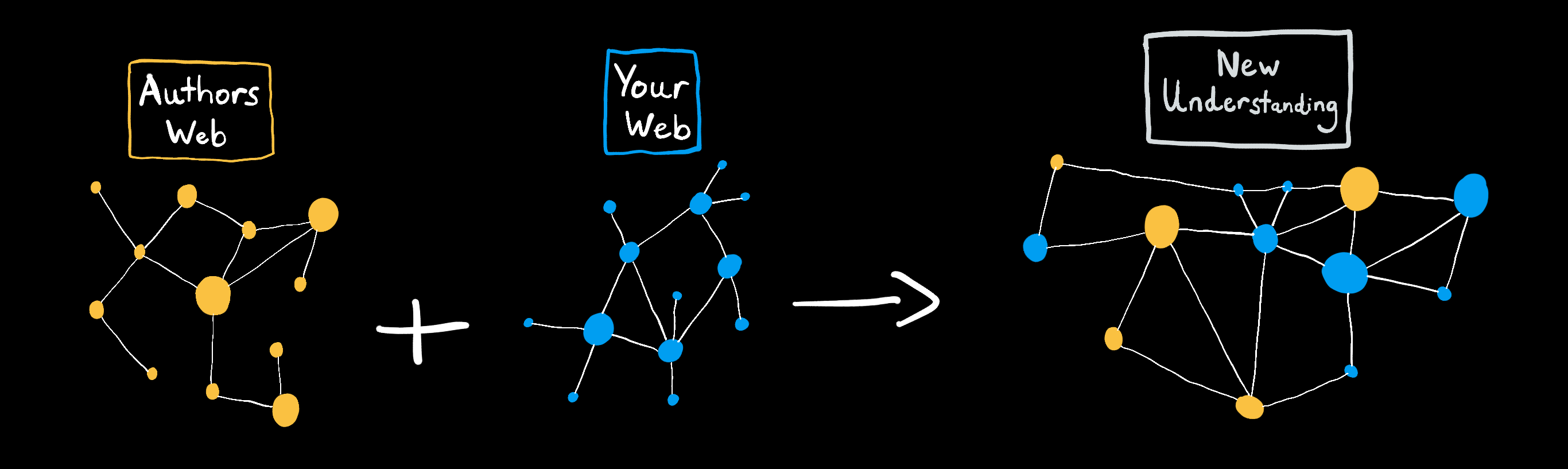
Your soul is the filter
What you take from a book is what your mind makes of it, not necessarily how the author’s mind has been made.
No two souls read the same book.
The same chapter or the same sentence in the same way.
No two minds build the same understanding with the same building blocks.
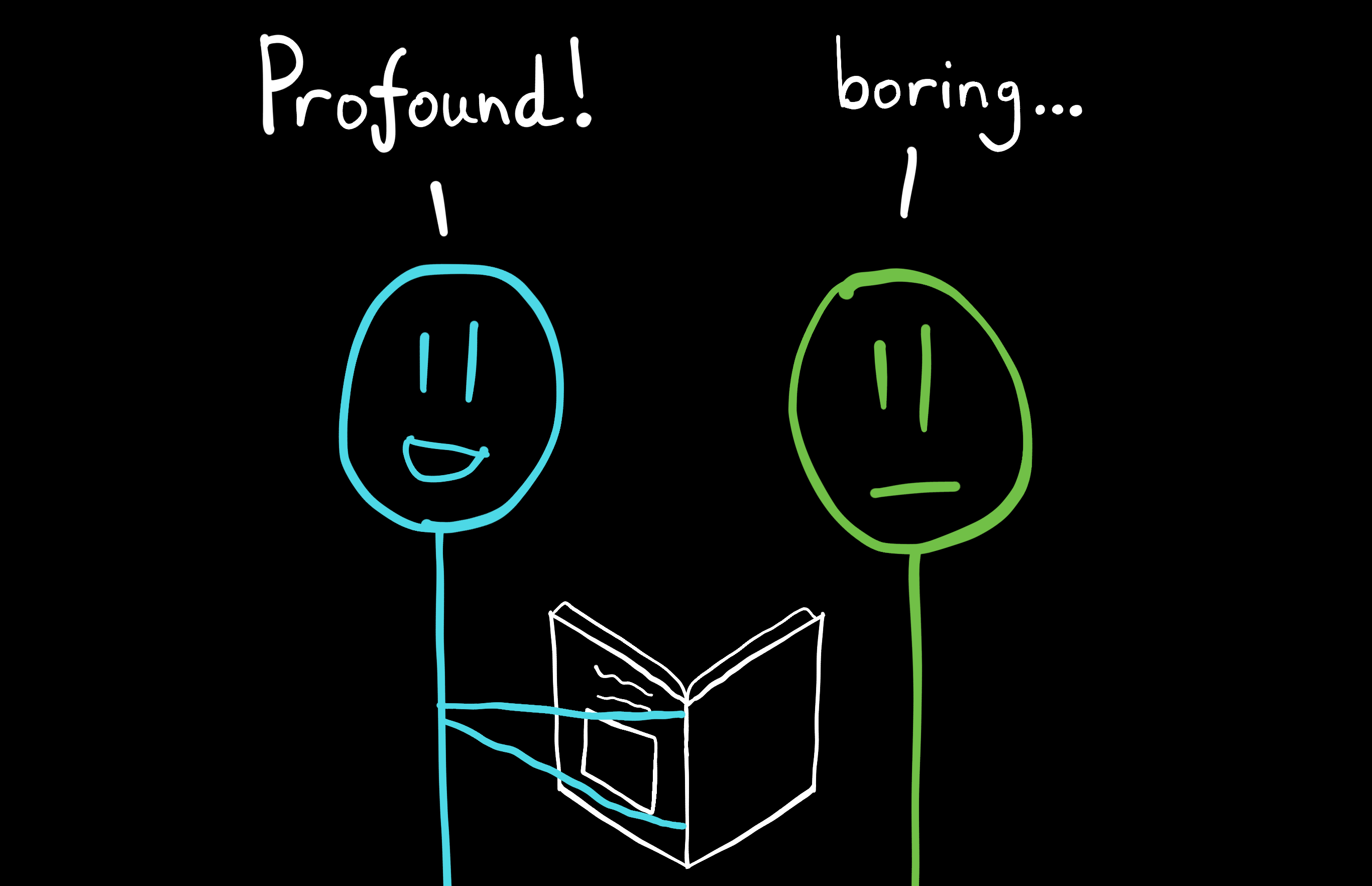
This is what makes you, and every one of us different as thinkers.
Your brain fucking HATES learning new information because the brain is hardwired to keep you alive. It’s an ancient survival strategy, and this makes learning... complicated to say the least.
It only integrates information into long-term memory if it feels relevant to your survival, and the signal for survival-importance is interest.
If you’re interested in something it feels easy to learn.
When I was in primary school I knew exactly where to find any material while playing Minecraft creative mode with the lads for this reason. How I miss super-flat worlds and redstone... but even with jiu-jitsu, or reading, or writing this very newsletter!
And naturally, if you’re not interested in something your brain will try to reject it without thinking.
The reason I hated studying for my Leaving Cert sitting at the end of my kitchen table for 4-6 hours after school every day, drowning in cups of Lyon’s tea trying to remember everything I read with linear notes and rote memorisation - pure fucking torture - was actually quite simple:
i did not fucking give a shit.
I had no interest in what I needed to learn, so it didn’t feel relevant to my brain. And what doesn’t feel relevant does not stick. If you don’t believe me, then try learning an entire terms and conditions page. Get back to me in one month if you prove me wrong, because it means you’re literally a different breed and I would like to learn a thing or two from you.
Your prior knowledge is yours.
It’s shaped by your past experiences, your curiosities, your obsessions.
There’s a profound idea I learned only last week, or the real name for it at least, called epistemic humility.
The acknowledgement that your knowledge is and always will be limited.
You will only read so many books, have so many conversations, live so many experiences. Your web of knowledge inside your head will never be complete.
But I think this is a strength and not a weakness.
Your perspective is not a law others must follow. It’s an offering you give to the world. It’s valuable not because it’s right but because it’s yours; being shaped by the specific collisions only you have experienced.
This is what makes thinking and creativity limitless.
Every incomplete web offers something no other web can.
You escape competition through authenticity, and authenticity is forged by the specific shape of your incomplete web.
So, when you read a book, you’re not just downloading Albert Camus’s understanding of absurdity while reading The Myth of Sisyphus.
You’re colliding his web with yours, and what emerges is a third thing.
Not the book. Not what you previously knew.
Something new.
Here’s a profound idea:
When you read a book, you almost become the person who wrote it.
Think about that for a second, and pay attention to what I did there.
You’re reconstructing the authors thinking inside your own mind, yes.
But the reason I say “almost“ is because you’re not just receiving their web.
You’re colliding it with yours, and this collision is what sparks change.
The purpose of memory and therefore learning is literally to fucking change yourself so you don’t repeat past mistakes and suffer stupidly in the future.
This is why I think learning is actually quite fun and important, despite how most people think of education as being something you can “finish,” and why I think taking linear notes is a genuine, real disease for a curious mind that wants to think.
Because thinking is where collision can occur.
If all you’re doing is copying notes from a whiteboard or lecture hall, you’re not colliding. That’s collecting. And the notes you copy are the author’s collision points and not your own.
The mind isn’t a storage box. It’s a fucking web.
I will go to my grave saying that.
Comprehension is not reception, but rather, it’s collision. And if you can leverage your interests as collision points, things start getting scary. Your rate of comprehension improves. Everything you read feels relevant. The more you follow your interests outside of reading, the more collision points you give yourself while reading.
Your perspective shapes which collisions happen. Nobody can decide what connections to make for you. That happens inside your own mind while being guided by your own taste and judgement.
That’s why taste is the new intelligence.
That’s why I think judgement and perspectives are the new oil.
This is why your soul is the filter.
Now.
How does this “filtering” actually happen?
The answer is through two layers.
Comprehension happens in 2 layers
Comprehension happens through two layers working together.
Layer 1: Local coherence
how you connect what you’re reading to what you just read. Sentence to sentence, paragraph to paragraph, chapter to chapter. This is the author’s web you’re constructing in your head.
Layer 2: Prior knowledge connections
how you collide the author’s web with your own. This creates a third web, distinct from both the book and what you knew before.
Here’s what each layer helps you to achieve.
Local coherence moves you from isolated memorisation to isolated understanding.
You won’t feel the need to memorise if you already understand the big picture of the author’s web.
Prior knowledge connections move you from isolated understanding to integrated understanding.
It’s all good understanding The Myth of Sisyphus and everything Camus was trying to say, but how does that web fit within your perspective on life, your web of knowledge?
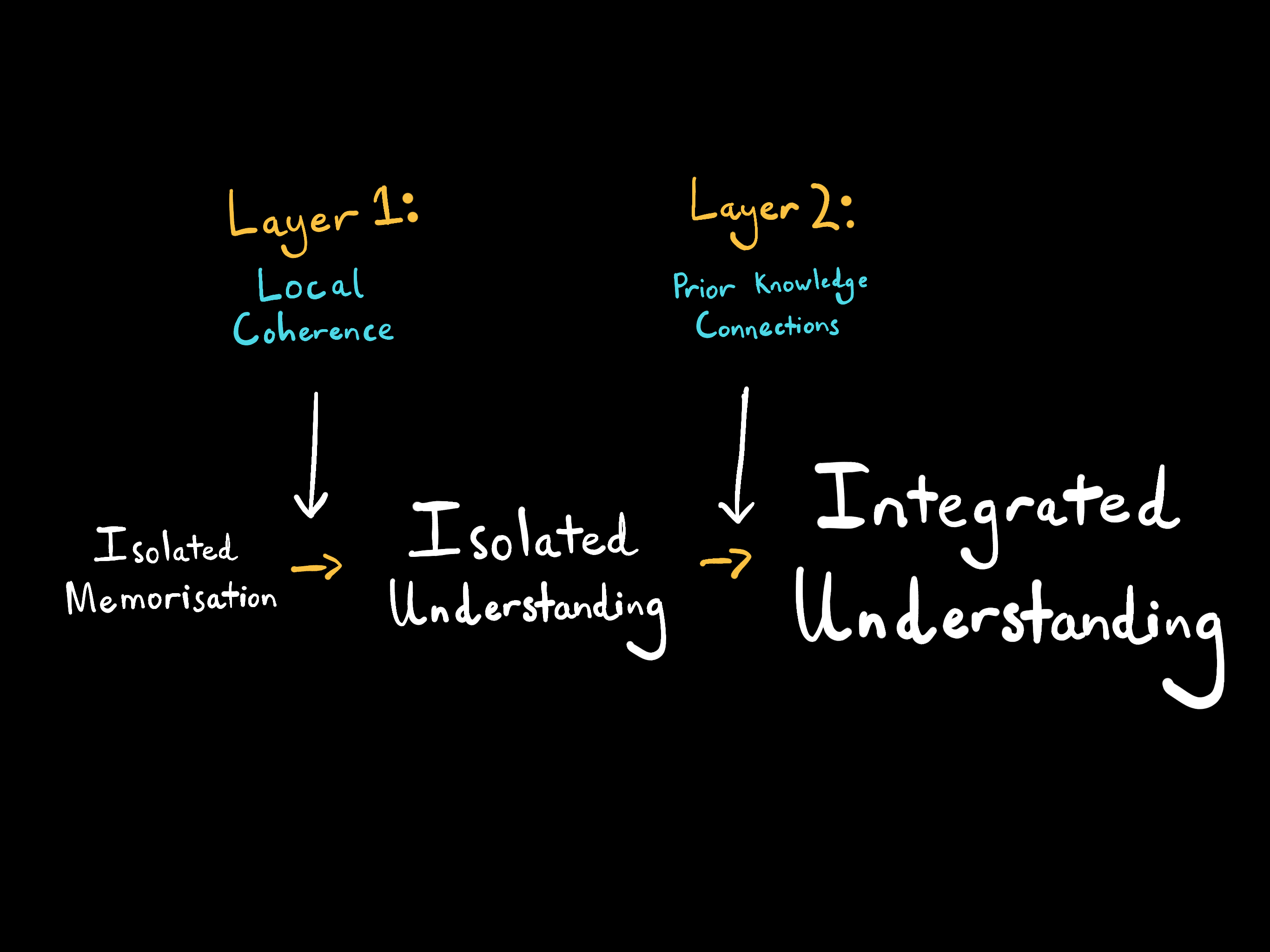
Both layers are skills, two opposite sides of the same coin.
Let’s go deeper into each.
Layer 1 - Local coherence
Local coherence genuinely blew my mind when I first read about it. I came across the concept while studying the encoding Wikipedia page on a 3-hour flight to Copenhagen.
It’s about tracking how the sentence you’re reading connects to the last sentence.
Sentence to sentence.
Sentence to paragraph.
Paragraph to paragraph.
Paragraph to chapter.
Chapter to chapter.
Chapter to book.
You’re building the author’s web in your head as you read, getting to grips with their understanding of whatever topic you’re learning about.
Without local coherence, words still register. But they won’t form a structure.
It’s like hearing individual music notes but never piecing them together into a song that makes you feel something. Structure is the vessel for understanding.
Personally, I’ve always struggled with local coherence. I find it more challenging than making prior knowledge connections. The latter I can do quickly. The former is mentally intensive, which is also good thing. It means it works, and you cannot learn without the right type of hard effort.
Thinking back to when I was in secondary school, I used to memorise my Irish essays sentence by sentence. Even my history essays. Because I had no clue what the big picture looked like in my head in a non-linear way. I couldn’t understand it outside the linear structure of my textbook.
It was the type of torture you would punish someone with, who belonged in the boiler room beneath the 9th circle of hell in Dante’s Inferno.
Sure, I “learned” the material.
I could recall it well, I was a high-achiever, I got the highest exam score in my school’s history at the time. But I didn’t understand jack-shit. I lacked local coherence. I never fully grasped the thread of the arguments.
Isolated learning is a fucking disease. It makes me squirm thinking about how I used to learn through rote memorisation.
Ew.
Long story short: if you’re not making connections, you’re not making a web. And without connecting dots, how can you expect to integrate them inside your brain?
Here’s a not-so-nice symptom of having a local coherence problem like I did (and sometimes still do):
You read a paragraph at the top of a page and forget it by the time you reach the bottom. You finish the chapter, the section, the whole book. But you can’t explain what the author was trying to say.
David Deutsch called science merely a series of explanations (I can’t wait to read The Fabric of Reality hehe).
Knowing a few details is great.
But if you can’t explain the points the author was making, you’re not really thinking like a scientist, a physicist, a learner, a reader, a writer... basically a thinker.
The solution to this problem, is simple.
