


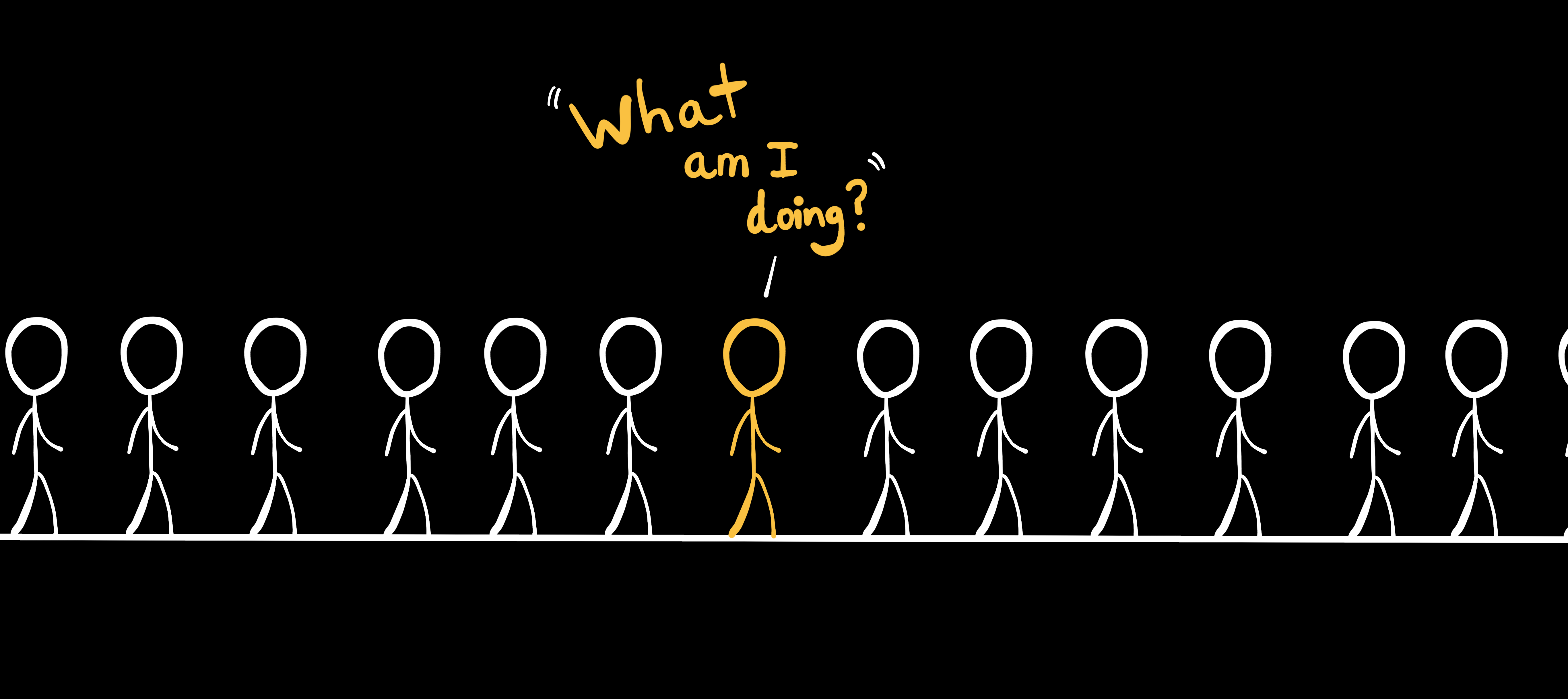
I don’t have to agree with everything you say, but I should attempt at least to understand it, for the opposite of mutual understanding is, quite simply, war.
- Ken Wilber
Bad explanations are secretly wrecking your life.
Now, that might seem like the stupidest thing you’ve ever heard.
Allow me to explain.
Most people can’t articulate what they feel.
They can’t defend what they think.
They can’t negotiate for what they want.
They can’t even offer a perspective because they’re not sure they have one.
And so, life just keeps happening to them.
If you are anything like I was as an anxious, insecure kid, you know exactly what this feels like.
I never offered any perspectives because I was terrified of being wrong.
I felt inferior to everyone around me for most of my life, but I could never explain why.
Which was exactly the problem.
Everybody else explained who I was to me.
And I believed every single explanation as gospel, because I didn’t have any better ones to refute them with.
It wasn’t so much a confidence or discipline issue, either.
It is an explanation problem.
And it is insidious because bad explanations are invisible.
They don’t announce themselves.
They just feel like the way things are.
They feel like your life.
What I’m going to share with you today is the most meta-solution to almost every problem you have.
It will show you exactly why your problems exist, no matter who you are, and what level of thinking is required to solve them.
I am not an expert. I’ve been studying this map of knowledge for over a year, and I still forget it exists from time to time. I am only human (for now). But the difference between who I was before I found this map and who I am now is great enough that it would be a disservice not to write about it.
Because the ideas are nothing short of... you guessed it! Profound.
There is no way to make this a 5-minute read. You can’t learn how to think like the top 1% of people (I truly mean it when I say this...) in a TikTok short.
If you’re looking for a quick cheap-dopamine fix, go doomscroll.
But if you stay with me, this will determine most, if not all outcomes of your life.
One more thing before we begin. If some of these ideas don’t connect with you today, save this post and come back to it in 3-6 months. You might find it reads completely differently when you yourself have changed.
Also: there’s a reason the smartest people you know are sometimes the quickest to make the dumbest decisions, and thus suffer the most because of it. So we’ll get to that.
Where to begin?
This letter is easier to grasp with visuals. Watch it in full, here:
You can listen to this while on a walk, on my Spotify:
Explanations - More Powerful Than We Think
There is only one way of thinking that is capable of making progress, or of surviving in the long run, and that is the way of seeking good explanations through creativity and criticism. - David Deutsch
There is nothing that will make you more deadly than the ability to explain something.
Explanations are how we, as humans, make sense of reality and experience. Every thought you have about why something happened is an explanation. Every story you tell yourself about who you are is an explanation.
Good explanations are hard to vary, and they still work, despite always being somewhat impartial; but bad explanations always collapse when the right type of pressure is applied.
For example, showing up to a party and none of your friends are there, might have you thinking that you should hide in the corner until they arrive. This explanation more-or-less saying that “this is not a good situation for me because I don’t know anyone here.” That is going to reinforce certain beliefs about yourself.
You won’t see new situations as opportunities. You won’t see social settings in which you know nobody as opportunities to meet new people.
A single explanation can reframe a problem with very little work. A party can be both an opportunity to hide until your friends arrive, or to go out and feel gracious that you get to make new friends.
Learning how to forge better explanations properly will determine whether they write your life, or you become the writer instead.
Same experience, but two different explanations of the same experience.
This is the thing about explanations that is totally wild.
They are 100% free.
They cost nothing.
You need no tools.
No money.
No degree or credentials or permission.
The barrier to entry for building better explanations is zero. You can do it right now, and anywhere. And you already have explanations. Many of them, influencing how you think about yourself, how you make decisions, how you justify what to wear, consume, and eat throughout any given day.
But the question is whether or not they are as good as they could be.
I don’t know if it was a lot to do with my temperament, according to The Big 5 Personality Model I’m extremely high in both agreeableness and neuroticism, which has its pros and cons... but if anyone ever told me who I was, and gave me even the first explanation that came to their mind - that wasn’t stress-tested even slightly - I believed them. You could have told me I was the worst person alive without any proof or reason, and that would have wiped me out stone cold.
OG psychologist Carl Jung once said that, “The world will ask who you are, and if you do not know, the world will tell you.”
Explanations are the source of this issue, and paradoxically, they are also the solution.
A Map For Becoming A F*cking Genius
In order to understand what makes an explanation as irrefutable and complete as possible, we have to understand knowledge itself first.
Let’s create a mini-mental model to build a foundation to work with.
It starts with reality.
So...
Idk... like... we are simply just... here?
In making sense of reality, we create knowledge about how reality works.
We do this by creating explanations.
Why does an apple fall off a tree?
Why does a car start?
Why did I not get the job?
Anytime you want knowledge or feedback based on reality itself, what do you do?
You create an explanation for what, how, and why something is the case.
Explanations are how we understand our knowledge of reality.
Explanations, I think, are how we create knowledge of our experiences, and of reality itself.
Which means if you want to build better explanations - and therefore better life outcomes - you need a map of knowledge itself. A map of all of it, not just any one thing. Because without one, you will keep solving the wrong problems, in the wrong quadrant, wondering why nothing ever changes in your life.
I think this will blow your mind.
This is called the map of all knowledge, and it was theorized by Ken Wilber.
It’s called the AQAL model.
This is the starting point.
The foundation.
Before you can move to the stages of cognitive development (the levels of thinking and lines of intelligence), you have to start with the quadrants.
It goes:
Quadrants → Levels → Lines
All of which come together to offer a holistic approach to understanding:
Reality
Consciousness
Human development.
Pretty fucking cool.
To summarize as best I can, this is Ken Wilber’s attempt at synthesizing all human knowledge into one framework or way of navigating all that can be known as knowledge.
This is not perfect or final.
It’s still a work in progress, and is to be built upon and developed, as Wilber himself says it.
Which is encouraging.
Learning is an imperfect process, and the second you limit your ability to think and ask questions, is the minute stupid thinking begins.
Based on my research into this, this is the most comprehensive map of reality and human development available.
All of this put together is known as Integral Theory.
There are also States and Types, but I won’t be addressing them here.
Let’s start with the foundational piece of this framework, which begins with the AQAL model and its four quadrants.
This is our map of all knowledge (looking in the top right corner!)
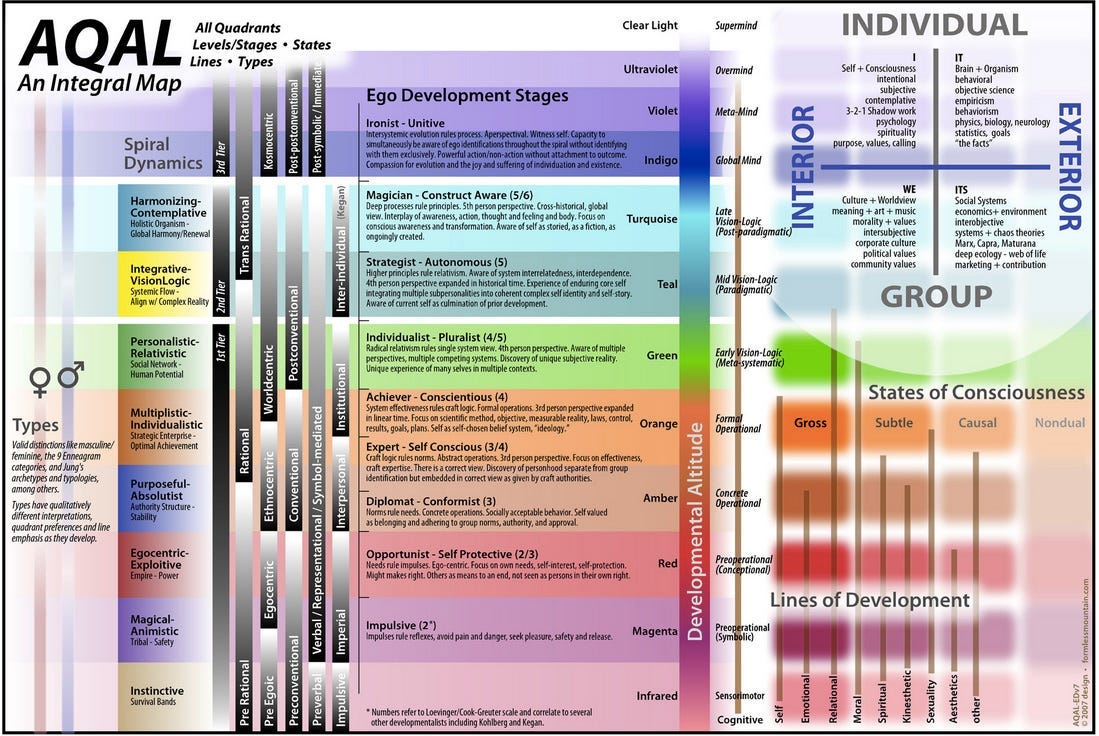
As we’ve said, there are four quadrants.
Each quadrant represents a perspective you can take regarding some set of experiences.
The quadrants are divided into being either subjective or objective, and also individual or collective.
Let’s explain each quadrant one by one, starting with the individual level:
Quadrant 1 is individual-subjective - Known as “I,” so your thoughts, emotions, and individual beliefs. This is your inner subjective world. Think the mind vs the brain.
Quadrant 2 is individual-objective - Known as “It,” this is where brain is opposed to mind. Think of the cognitive processes that operate unconsciously deep inside your brain. Also your nervous system, your limbic system, your physical body, pretty much. This quadrant includes hard sciences like physics, neuroscience, and biology.
Now let’s move onto the collective level, which is easier to understand once you have grasped the individual quadrants:
Quadrant 3 is collective-subjective - Known as “We,” this is everyone’s individual thoughts, emotions, and beliefs that come together to shape our culture and society. So, shared values and group beliefs compared to individual beliefs and values in the first quadrant. Think “I” versus “We.”
Quadrant 4 is collective-objective - Known as “Its,” this is the systems, structures, and institutions that come to organize our physical world as it is. This is not only my physical body, but everyone else’s physical bodies and the objects that surround us all, and how we interact in the collective to solve problems efficiently. Think “It” vs “Its.”
Being dead honest, this is heavy stuff, so don’t feel like you need to understand it right away.
Let me give you an example of how we could use this four quadrant model when thinking about a problem, which will make it easy to understand in practice... which is what matters.
Let’s say you have a motivation problem.
You know what you should be doing, like studying, exercising, or learning a new skill to better your life, but no matter how hard you try, you can’t get yourself to do it.
We’ve all been there. I myself am definitely no saint.
Here’s how you could approach this problem, but based on each individual quadrant:
Quadrant 1 is your mind (thoughts) telling you that you’re lazy. You have no discipline. You have never had any discipline. And that something is wrong with you and you’ll never be enough because of it.
The explanation originating from that quadrant alone, that would wipe out most people cold.
And we haven’t even gotten on to the other quadrants.
Maybe if you were to look at this problem based on Quadrant 2, you’d realize that you haven’t had a good night sleep in weeks. Always doomscrolling until 1am. Not training your physical body throughout the week, so your mind naturally wants to satiate itself by staying up late to “relax,” because you have no energy and you always feel exhausted.
The first quadrant thinks it’s purely a you problem. But when we take a look at quadrant 2, we now find that you’re running on nothing but high-levels of cortisol (stress), your nervous system is dysregulated as a result, and so are your emotions and therefore your thinking.
And this bit is important.
Every quadrant is constantly influencing every other quadrant, at every given moment.
See how your mind might not be the enemy, since you also have a body to consider too?
Now we consider the third quadrant.
Maybe upon reflection, you realize that for your whole entire life you’ve been told that effort looks like this or that. Studying for 8 hours a day on every day off is normal (I was told this in school... what a dangerous thing to tell students who can’t think for themselves, and that includes me especially).
So you compare yourself to the standards set by everyone else, and devour yourself when you don’t meet them?
And you’re tired. And your mind won’t shut up. And you feel like you’re never doing enough compared to everyone else.
Then we get to the best quadrant of all, which introduces your smartphone.
Since your phone has been carefully engineered by the world’s top scientists to keep you fucking using it all day every day, it saps away the limited focus and mental energy you get to spend on any given day.
3 hours of doomscrolling and your mind is toast.
Mix it all together, and you have a lot of problems. It’s not just any one of them, it’s all of them combined. Because whenever you approach a problem, a question, a person’s perspective or opinion - even your own in the form of explanations - you must consider each of these quadrants.
Without doing so, you will always have an incomplete perspective, an incomplete explanation, and you won’t be seeing the entire big picture.
In other words, your explanation of any situation is only as good as the number of quadrants you’ve actually looked through.
Thinking your explanation as to why you think you have a “motivation problem” is a one quadrant explanation for a four quadrant reality. And you cannot solve a four-quadrant problem from a one-quadrant level of thinking.
Read that last sentence one more time.
You cannot solve a four-quadrant problem from a one-quadrant level of thinking.
Most people only look at one quadrant in any given situation.
I just need to work harder, I just need to sleep more, or the system is fucked and nothing else.
A complete explanation requires all four quadrants.
So we can now define what stupid thinking is, to set ourselves up for thinking at higher-levels.
Stupid thinking is when you look through one open window and think you’re seeing the whole damn planet.
The gym-bro who thinks getting jacked will solve all of his problems will still fail at building trust in relationships.
The businessman who believes that all problems are just systems problems will fail the minute emotions get thrown into the mix.
The learner who thinks higher-education will solve all of his agency problems by securing a job and working up the corporate ladder will fail as soon as AI wipes out most low-agency jobs.
These people are not stupid people, they are just under-explained.
That’s why bad explanations can be so dangerous.
They are invisible to the naked eye when you operate from lower levels of thinking, which is the majority of the population.
Most people don’t even know their explanations are broken, and thus, they only experience the consequences and therefore the suffering instead.
Smart people are often the most stuck people in life.
Usually, because they are so well-developed in one quadrant to an extreme - think specialization - and that is their only source of truth.
Ask a devout believer in religion and a scientist to have a discussion about how the Earth was formed, and you’ll see what I mean pretty quickly.
This is why the smartest people you know are sometimes the quickest to make the dumbest decisions and suffer the most because of it.
How To Think About This Map
Now that we have our map of all knowledge - the four quadrants - we need to understand something important.
The four quadrants show you what to look at.
But the levels of thinking determine how clearly you can see each quadrant.
Two people can look at the exact same quadrant, say, their inner world, and see completely different things because their levels of awareness are different.
One person might look inward and think that they’re just... lazy.
Another person might look inward and realize they’re running a story about laziness they’ve been told since the age of seven, by someone older than them who didn’t know any better - who was likely even lazier themselves - and have been living inside that narrative ever since, without testing it against reality.
It’s regarding the same quadrant, but it’s two different explanations coming from two different levels of thinking (awareness).
This is why your level of development determines what problems you can see, what explanations you can build, and what solutions are available to you.
And this is why Einstein was right when he said:
We cannot solve our problems with the same thinking we used when we created them.
Or, when we first explained them.
Lower levels cannot perceive higher levels. But higher levels can look back down and understand lower ones. The higher you climb up the levels, the more you can see because you have more awareness. This is all that this is about, increasing your awareness of yourself.
Because the more you can see, the better your explanations become. And the better your explanations become, the better your life outcomes get.
That’s the whole game, folks.
So, there are 9 levels of thinking.
I’m going to organize them into three chunks so this doesn’t become overwhelming. And I’m going to describe each one by what it feels like from the inside, so you don’t need to memorize names that sound somewhat silly and unrelatable.
Chunk 1 - Subconscious (Levels 1-3)
This covers roughly 5% of the population, mostly young children (and adult ones too).
Level 1 - Survive
This is pure desire. I want, I need, I feel. There is no “other people” yet - just you and your immediate desires. A newborn operates entirely here. But so does any adult who hasn’t eaten in two days, or who is absolutely furious, or who is in physical danger. At this level, you are only thinking about your own desires, and don’t realize that other people’s desires exist.
At this level, your explanation for everything is just, I want this thing so I can stop feeling the suffering that comes from not having it. Like with hunger, thirst, or tiredness.
Level 2 - Connection
You realize other people have minds too. You try to give them what they want so they give you what you need. Appeasing the Gods with rituals, texting a friend to help you with homework at 11pm, helping someone for no other reason that they help you back in return. At this level, your explanation for everything is if I do the right thing for the right person, they’ll give me what I want.
Level 3 - Control
You realize you’re in a web of relationships and you can direct them. This level is about status and controlling your position amongst the dominance (competence) hierarchy. Think your tyrant boss and managers at your job, gangs, or the guy who takes up two parking spaces because the idea that other people want to park has genuinely never occurred to him. At this level, your explanation for everything is the world is mine to take, and everyone else is an obstacle or a tool to help me get what I want.
Chunk 2 - Conscious (Levels 4-5)
75-80% of the population are at these levels, with formal education taking us to these levels at most.
Level 4 - Belonging
You realize that what you want could hurt others, and that rules exist for a reason. You conform to fit in so the tribe doesn’t throw you out. Think religion, and cultural and societal norms or expectations. Following the rules because that’s just how things are done. Go to school, go to university, get a job yadada. This level built civilization, so it’s genuinely necessary, but it has a shadow: at Level 4, your explanation for everything is my group is right, which means other groups are wrong. There is one correct way, and I know what it is.
Level 5 - Achieve
You start questioning the rules. You build your own path. So, science, entrepreneurship, and self-help - The American Dream, too. This is the dominant paradigm of Western success, and like Level 4, it’s genuinely useful. But at Level 5 your explanation for everything is I can figure this out myself, and if I work hard enough and build the right system, I’ll get there.
The problem is that this explanation works brilliantly inside one quadrant - usually quadrant 4 - and catastrophically fails outside it.
Formal education gets you to Level 4 or 5. That’s it. And to be fair, that’s still not nothing. These levels are important, you need them., because they teach you not to behave like a wild bloody animal. But understand there is a still ceiling that we want to break through.
Chunk 3 - Integrated (Levels 6-9)
These levels mark for 15-20% of the population and can only reached through deliberate self-development.
Level 6 - Include
You realize everyone has their own valid perspective. You stop seeing your way as the only way. At this level, your explanation for everything is all perspectives are valid. Which sounds enlightened, until you realize that if all perspectives are valid, none can be wrong, and you lose the ability to make any decision at all.
All perspectives do contain some truth, but there are still perspectives that are more favorable than others. That’s where post-modernism fails, which is a topic for another day, which is why Level 6 is a genuine leap forward that can become its own booby-trap.
Level 7 - Harmonize
You can hold multiple perspectives simultaneously and synthesize them. You understand that all previous levels had truth in them, but might not have been able to see beyond themselves. At this level, your explanation for everything is the best answer draws from all quadrants, and all levels. Truth is a synthesis and not a position.
This is where second-tier thinking begins.
Level 8 - Construct-Aware
You start watching your own mind build its explanations in real time. You notice the stories forming before you believe any of them. Most people are lived by their explanations. But at Level 8, you watch yourself constructing them, which means for the first time, you have a genuine choice about whether to believe them or not.
Level 9 - Unitive
The boundary between you and reality begins to dissolve. You stop experiencing yourself as a separate observer looking at the world and start experiencing yourself as part of it. This is what Alan Watts pointed at, what Terence McKenna described; it’s what most contemplative traditions spend lifetimes trying to reach. At this level, the explanation and the explainer become the same thing. It’s hard to explain, but you basically become ego-less, and you simply just... are.
When I first started writing this newsletter, I was terrified to share my thoughts.
What if someone disagreed? What if someone didn’t like what I wrote?
I’ve had over one million Substack reads now, and only five or six genuinely negative comments. And compared to all the lovely comments I’ve received from you legends, those 5 or 6 are still enough to make every good comment feel worthless.
That’s a Level 4 explanation: My group needs to approve of me. If someone rejects what I say, it means I am wrong. And every negative comment confirmed it because that’s what bad explanations do. They find evidence for themselves everywhere.
Now I see negative comments differently.
I can look above the judgment and just take the feedback. That’s a Level 7 explanation. That’s a very different outcome I get from negative comments now.
That’s what moving up the levels actually looks like. A more useful explanation for the same thing that used to fuck you up!
So, to take a short breather...
The levels of thinking are about increasing awareness. That’s all we are doing.
I remember playing Skylanders as a kid, and it always used to piss me off when you came across a door that was locked. But once I found the key needed to unlock it, new doors would open, so would new levels and boss battles to face.
You only hear what you’re ready to hear, I think.
Even with starting my newsletter, writing it now seems almost effortless, but the journey that got me to this over the last 10 months is so scattered, and I can only really think of the general principles that now feel intuitive to me, and still, I don’t remember the moments that things just... “worked.”
It’s hard to explain that idea of improving yourself at a given thing, but things will just click if you iterate with trial and error and do it long enough.
So, if some of this isn’t landing for you right away, save this post, come back to it in 3-6 months. Even one week. You’ll read it a lot differently than you do now.
Why Smart People Are Still Stuck
Now here’s where this gets even more interesting.
You are not at one level permanently.
You are at multiple levels simultaneously - across different areas of your life.
And that’s exactly where the lines come in.
Think of the levels as your altitude of awareness. Now think of the lines as the different dimensions of your life that you develop along, each at their own altitude.
Ken Wilber identified over a dozen lines of development. They include:
Cognitive - how you think and reason
Emotional - how you process and understand feelings
Moral - how you determine right from wrong
Interpersonal - how you relate to other people
Spiritual - how you make meaning of existence
Psychosexual - how you relate to intimacy and sexuality
Aesthetic - your sense of beauty, creativity, and artistic expression
Kinesthetic/Physical - your relationship with your body
Values - what you hold as important and why
Needs - what you are driven by at any given moment
Self-identity (Ego) - how developed your sense of self is
Worldview - the lens through which you interpret reality at large
Here is the crucial thing to understand.
You develop along all of these lines simultaneously, but at completely different rates.
Which means you can be at Level 7 on one line and Level 3 on another. And your explanations will reflect whichever line you’re drawing from in that moment.
Let me show you what this looks like in real life.
The founder who has built a company worth 100 million quid.
Cognitively, at Level 7. They can synthesize complex information, spot patterns, build systems. But emotionally, they’re at Level 3. They have never learned to process the feelings that have been building up for decades. They sell the company. The cognitive challenge disappears but the emotions that have been built up, don’t. They become depressed and have no explanation for why, because their emotional line has never been developed enough to even see the problem.
Their explanation: I should be happy. I achieved everything I set out to achieve.
The real explanation: I built my entire identity around one line of development and neglected everything else.
The gym-bro who is an absolute unit.
His body line is at Level 8, but his interpersonal line is at Level 3. He can get the girl... but he can’t keep her for long. Not because he isn’t attractive but because attraction and connection require completely different lines of development, and he has only ever invested in one.
His explanation: Women are impossible to understand.
The real explanation: I have never developed the interpersonal line that would allow me to understand them.
The creative whose work is genuinely beautiful.
Aesthetically at Level 7 but practically at Level 4. They cannot market the value of what they create for shit. Meaning they cannot pay rent, and believe that art and business are incompatible, which is itself a Level 4 explanation, borrowed from a culture that always seems to separate the two.
Their explanation: The world doesn’t value real art.
The real explanation: I haven’t developed the lines that would allow me to bring my art to the people who would value it.
These examples are uneven.
So are you, and so am I.
The lines also explain something important about regression.
You don’t stay at one level permanently. When you are stressed, tired, hungry, or overwhelmed, you drop back down - sometimes several levels - on the line that’s under pressure. The last time you had peak mental clarity while sleep-deprived, running on stimulants, and starving for nutrients, you probably didn’t, because your cognitive line dropped back to survival mode.
This is what it means being human.
So now you have the map, the AQAL model and the four quadrants showing you what to look at.
You have the nine levels of thinking, showing you how clearly you can see the quadrants.
And you have multiple lines showing you where your development is uneven.
The question now is what to actually do with it.
How To Increase Your Consciousness
Here it is.
It starts in the next ten minutes, it costs nothing, and it is the minimum viable version of everything we have covered today, but applied to your actual life, right now.
The practice is writing
Not journaling for the sake of it.
Not morning pages.
Not a gratitude list (which I do like doing).
We will be using writing as a tool for building and examining your own explanations.
Why?
Every explanation you hold lives inside your head as a feeling. A vague sense of how things are. The moment you write it down, it becomes examinable. You can see it. You can question it. You can evaluate and find the cracks in it.
You cannot edit a thought you cannot see.
This is what writing actually does. It externalizes your thinking so you can work on it. Every newsletter I write is me doing exactly this, which is just building an explanation, offering it to you legends, and refining it across the next one I write. The writing is not the output, but the practice.
You need outcomes, not tasks
Forget saying “I will write everyday” yeah yeah we know.
That’s a task, or better, an activity.
We want outcomes than activities allow us to achieve.
Here are your four questions (outcomes), one per element of the framework.
Very binary, yes or no, did you do it or not.
Pure physics.
(1) Did you write down one explanation today?
Something that happened. Something that’s been sitting heavy. A decision you made that you don’t fully understand yet. A feeling you can’t articulate. Write the explanation you currently hold for it. Don’t edit it, just get it out. You can write in the style of an essay or a mind map. I prefer mind mapping because I can quickly view relationships between key words. Writing huge essays can hide relationships and take up a lot of time.
(2) Did you examine it through all four quadrants?
What is your inner world saying about this? (I)
What does your body, behaviour, or physical reality say? (IT)
What has your culture, environment, or the people around you taught you about this? (WE)
What systems, structures, or external forces are shaping this situation? (ITS)
A complete explanation requires all four. Don’t be like most people stopping at one.
(3) Did you identify which line of development this touches?
Is this a cognitive problem?
An emotional one?
Interpersonal?
Moral?
Aesthetic?
Physical?
Naming the line tells you where to direct your development. You can’t strengthen a line you haven’t identified.
(4) Did you find one piece of evidence that challenges your explanation?
Just one.
Not to destroy the explanation but to stress-test it.
Good explanations survive pressure, whereas bad ones collapse. This is how you tell the difference.
These four outcomes should take ten to twenty minutes. Less if you learn to think on paper with mind mapping, which we learned about here.
Example
A few weeks ago I uploaded a YouTube video and within an hour, one negative comment arrived - just one - and it derailed my entire morning. It ruined my lifting session that day to be dead honest, since I couldn’t stop thinking about it.
Here is what the practice looks like, but applied to that moment.
Step 1 - Write the explanation down
Someone didn’t like what I wrote. That means it wasn’t good enough. That means I’m not good enough.
Now that it’s visible, we can question it fully.
Step 2 - Run it through all four quadrants
Q1 - I felt pretty upset!
Q2 - My body went into stress response. I could feel my cortisol going up, and my chest feeling heavy (It doesn’t help that I was lifting, and also very much caffeinated at this time).
Q3 - I grew up thinking that anytime someone else disagreed with me, I was instantly in the wrong, and that I would get into trouble or be given out to. This had a lot to do with the people I surrounded myself with.
Q4 - People are more likely to share hate online than in person because there’s a barrier of protection. You can hide behind a screen without needing to physically confront someone in person, which most people would never do.
Step 3 - Identify the line
This is primarily an emotional line problem, with a secondary interpersonal line problem.
My cognitive line knew the comment was one data point.
My emotional line hadn’t developed enough to hold that knowledge under pressure.
Step 4 - Find one piece of evidence that challenges the explanation
A couple thousand views to receive one negative comment.
That’s a pretty large ratio!
New explanation: One person offered feedback from their own perspective, shaped by their own level of development and their own lines. It may contain something useful. It may not. Either way, it is not an absolute verdict on anything.
Recap
Explanations are the simplest, most profound tool you have. They are free and available at any time. The quality of your explanations - the explanations you tell yourself and believe - are what determine almost all outcomes of your life. Bad explanations feel invisible, they just feel like your life.
The AQAL model is our map for understanding all that can be known about reality. There are four quadrants you must consider in order to create a complete explanation, or as complete a perspective as possible. Most people only ever look through one quadrant and call it absolute truth. A complete explanation requires all four.
The levels of thinking determine your awareness. The higher the level you can think at, the more awareness you have over any given problem, experience, or for considering other people’s explanations. Formal education gets you as far as levels 4 or 5, but only you can go beyond with personal self-development. You cannot solve a problem from the same level of thinking that created it.
The lines determine your development across different types of intelligence. We are all uneven to a degree. You can be advanced in one line and a complete noob in another.
The daily practice (for as little as 30 seconds mapped out quickly too) is for writing down an explanation, evaluating it, challenging it, and running it through the four quadrants. This will help you increase up the levels and lines.
The push never ends, and now you have a map!
I’m ending it here because I’ve waffled long enough, and I’m tired.
Thanks as always.
You’re an absolute legend.
- Craig :)
Check out the things I’ve built:
If you want to become dangerously self-educated, and get a customized learning plan suited to your own problems and goals from a carefully-constructed AI prompt I made, download The Profound Self-Education Guide.
If you want to stop forgetting everything you read, and retain more in 10 minutes of reading than most do in 2 hours, download my Guide to Profound Reading.
Paid subscribers to my Substack can read both for free, here.
Here are some writing guides if you’re looking to start writing online, grow your personal brand, or even learn a hobby that beats doomscrolling every morning:

How To Learn & Master Any Topic through Writing

This is a continuation of How to do Research for Long Form (Essays, Newsletters, Articles etc.).

How to do Research for Long Form (Essays, Newsletters, Articles etc.)

A profound thinker is someone building unique knowledge and looking for ways to share it.
🙌🔥 This is really mind-blowing stuff here.
Legends.
This article is mind-blowing. Thank you for sharing it with us.