


Most of your learning is fucking pointless.
And everything you think is making you smarter, is actively holding you back.
Nobody tells you highlighting books is a waste of time.
Writing 70,000 words of notes in your second brain only to let them gather dust, never to be seen again.
Podcasts on walks, or while driving to work in the morning, that go in one ear and out the other.
It’s all mental masturbation making your ego happy.
Here’s what I think actually works.
Waking up excited to create.
Building something that matters.
Learning by solving real problems (and not collecting information you’ll never use).
This is the life I’ve built in the last 8 months, and it's the life this newsletter will show you how to build too.
Because in the last 8 months I’ve taken the opposite approach in learning how to grow my newsletter to over 21,000 subscribers. And I say learning, because I did. I had to learn all this by scratch.
Not by spending 2 hours a day watching YouTube tutorials on “how to write,” or “how to start a personal brand.” But by solving problems in real time. Learning by doing. By finding what I need in the moment to overcome an obstacle, applying what I just learned, and moving on to my next problem stopping me from progress.
This is what I call outcome-based learning, and it’s why I think most self-education plans fail.
Most learning plans teach you to collect information, they don’t teach you to use it for achieving something great.
Here’s a profound idea:
The real test of learning isn’t what you know, but what changes.
Naval says that intelligence is getting what you want out of life.
Self-education is the vessel that takes you there, that builds this type of intelligence.
If your learning isn’t producing results, like better creative outputs, exams being passed, having meaningful work you actually want to do by jumping out of bed each morning like a hyper-active child, it’s just intellectual masturbation.
You are wasting your fucking time.
Sorry, I get quite passionate about this.
If unfinished books, forgotten ideas, no measurable outcomes sounds like you, keep reading. We have some profound ideas to discuss.
You can watch the video version of this newsletter here:
Life is lived on the battlefield, not a second brain
A little over a year ago, I spent 3 months writing 70,000 words worth of linear notes inside of Obsidian.
It was from only 3 books:
The Problems of Philosophy by Bertrand Russel
The Republic by Plato
The Nicomachean Ethics by Aristotle
I retained almost none of it, and the breaking point came three months in.
I sat down to write an essay using all that “knowledge.” I opened Obsidian, scrolled through 70,000 words of notes, and realized I couldn’t remember a single useful insight without reading it again. I couldn’t write without looking at my notes meticulously.
I’d spent hundreds of hours building a graveyard and not a brain.
(If you struggle with this too - reading books but retaining nothing - I built A Guide To Profound Reading. It's a 3-step system for turning what you read into deep, connected knowledge that actually sticks. No highlighting. No note-taking graveyard. Just comprehension and retention.)
That was my “aha” moment with all this.
If I have to re-read my notes to use them, I never learned them in the first place. I just moved information from a book to a hard drive. The knowledge never entered my head.
So I deleted all of it :)
…and started over with a different question:
What if I only learned things I could use immediately?
Also.
Should I really have been putting all that time into my thesis project? For sure… but we’re not here to discuss that!
The problem I have with second brains is that we confuse storing information with building real knowledge.
Knowledge lives inside the brain. Knowledge is built inside the brain.
Not on a computer.
Not on a Notion or an Obsidian database.
Not in a commonplace or compendium notebook.
Because if you have to look something up to use it, you haven’t learned it. You stored it somewhere outside your brain, outside your web of knowledge.
And if you’re doing this in the first place, the thing you’re filing away is likely not worth becoming high-quality knowledge.
If you have to store and track a piece of information, it’s likely a waste of your fucking time.
I understand that second brains can work.
But most people use them as storage boxes and not battlefields. They offload the learning process onto a system and mistake organization for understanding. The notes pile up. The tags multiply. The knowledge never compounds because it was never in their head to begin with.
If you use a second brain for storage, you are limiting how efficiently you can learn.
I still use a second brain (Eden) but not for storing notes.
I use it for curating high-signal ideas and sources that could fill gaps in my knowledge. Questioning my own ideas and building prompts with AI. Writing and publishing my 1-2 newsletters per week. The vital distinction is that I’m not archiving information, I’m using it to create. If the information is worth knowing, I’ll encode it and use retrieval practice. I won’t write a bloody note document to “learn it.” That’s not how the brain likes to learn.
The mind is not a vault, it’s a garden. It’s a web of knowledge. And I use my second brain not for storage but for building the web inside my head through execution.
Storage is passive, execution is learning.
This connects to a deeper problem.
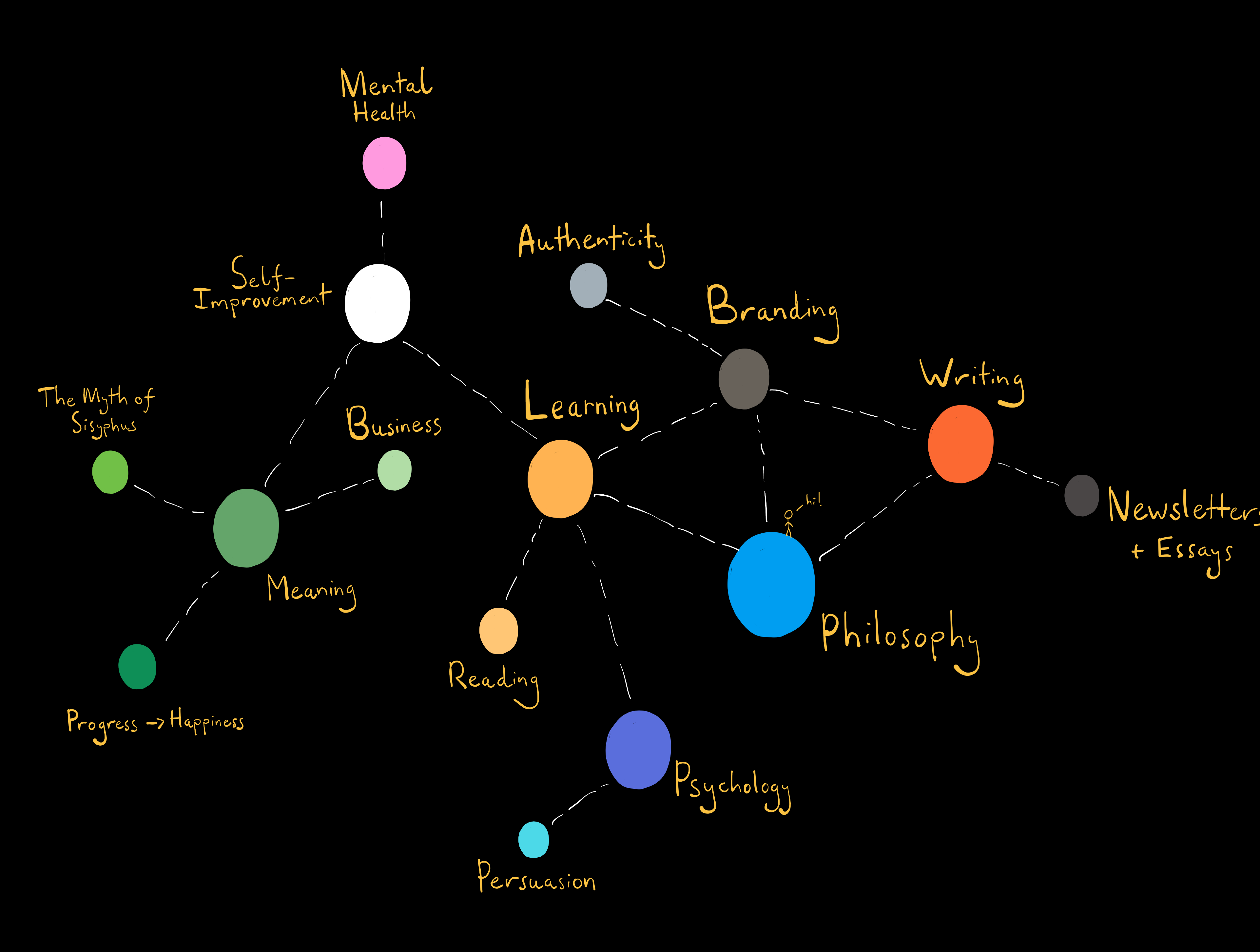
Most learning systems are linear.
Courses, curriculums, books with personal note-taking system, they train you to move from start to finish like a train on a track.
But knowledge isn’t linear, it’s a web. It’s called a schema, which looks like this:
I went through 5th and 6th year in school copying and pasting linear notes from a projector to my hardback copy, never to look at 90% of those notes again.
Because I had a book. I even had access to the slides on my computer.
Just because you’re writing notes on a page, doesn’t mean you’re building new knowledge inside your head.
It’s busy work. Not productive work.
I want you to think of a spider’s web.
A spider can’t build a web that looks like a straight line. It would collapse without having a structure. It needs connections, anchor points, tension between lever-moving ideas. That’s how knowledge works. Each new concept gains strength from what it’s connected to. Isolated notes in a second brain are threads with nothing to hold onto, which get dumbed into a garbage bin by your first brain.
Linear storage, non-linear knowledge. That’s the mismatch preventing most people from becoming profound thinkers… and it’s my mission to change that!
So, how do you build knowledge that actually compounds?
How unique knowledge is built
This is something that still blows my mind.
Fundamentally, everything is just information.
Books.
Courses.
Conversations.
Lectures.
Slides.
AI outputs.
Web pages.
You get the point.
The difference between a life-changing insight and a forgotten fact is not the source, it’s what you do with multiple sources.
I want to show you my own understanding of how knowledge is built inside the brain, and once you see this, you’ll understand straight away why most learning systems are designed backwards.
Think of your brain like a construction site, and you’re building a house maybe. Maybe a Minecraft house. Information arrives like raw materials. You have your wood, your stone, your glass. But you can’t just dump them in a pile (or in a chest) and call it a house. You need to build something, you need to do something with the materials.
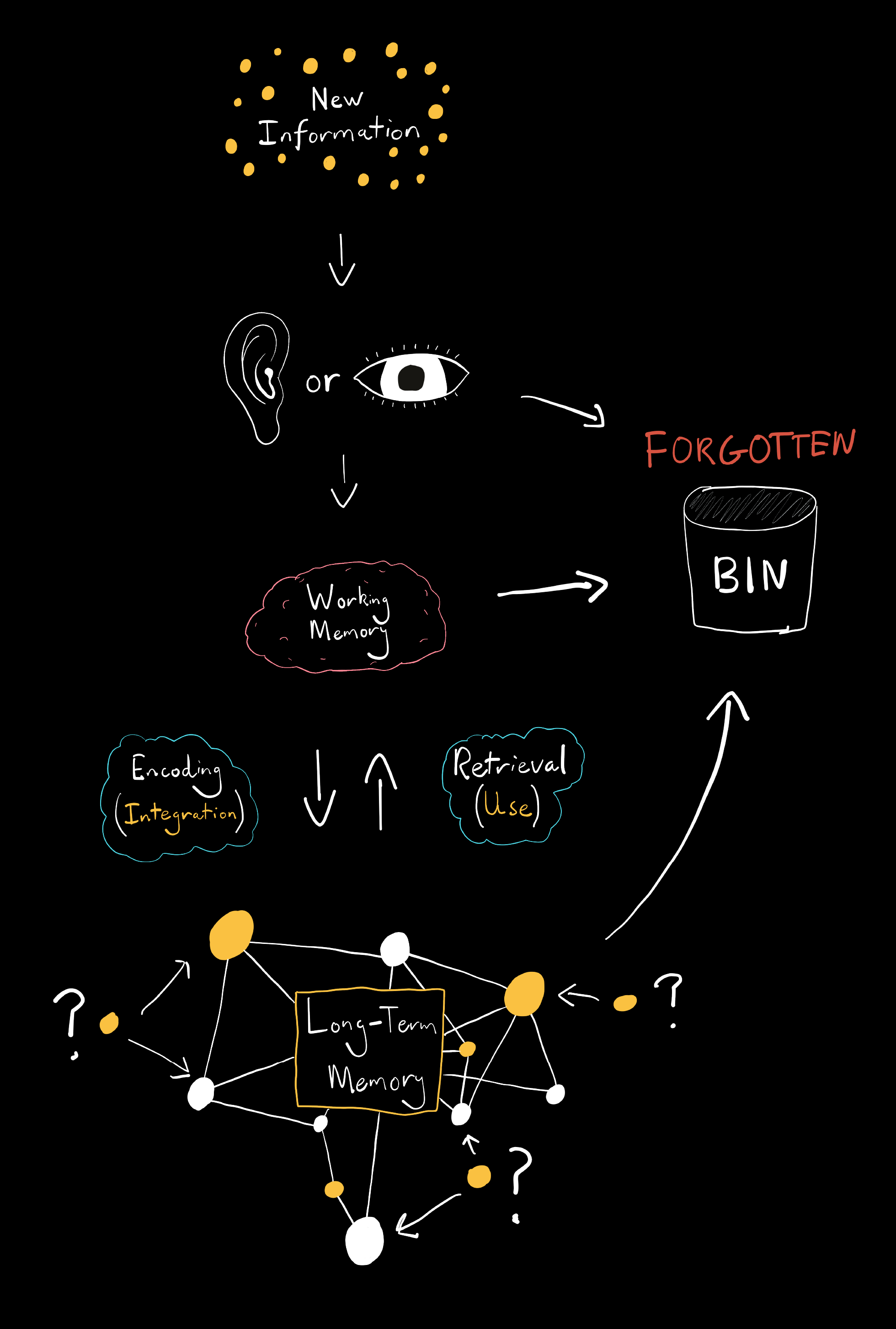
1) Information enters working memory
Your working memory is your workbench. It’s where you process the raw materials. But the issue is that your workbench is tiny. It can only hold 7 (plus or minus 2) things at once before they fall off the bench... and disappear forever.
This is why you forget podcasts the moment they end. The information hit your workbench and it fell off before you could do anything with it.
2) Encoding information from working memory into long-term memory (integration)
To move information from the workbench (working memory) into permanent storage (long-term memory), you have to integrate it with the structure you’ve already built.
You do this through three types of encoding:
Elaborative encoding - Connecting new information to prior knowledge. Connecting new ideas to what you know about philosophy, psychology, neuroscience, your favorite mocha you drink every morning etc.
Organizational encoding - Chunking information into mental models, frameworks, schemas. Building the spider’s web we talked about earlier, like a mind map but inside the brain.
Semantic encoding - Understanding the meaning of concepts inside the big picture, not just memorizing words. Think reading between the lines, as they say.
I always love keeping you guys up to date with what I’m currently learning about. I see my newsletter as myself learning in public, and sharing my solutions to my past/present/future problems.
I’ve been learning about business and marketing. Breakthrough Advertising by Eugene Schwartz, the levels of customer awareness (this is blowing my mind), market sophistication, Alex Hormozi’s $100M Offers. I haven’t been taking notes on every detail, like we’ve said. I’ve been looking for how these concepts connect. How they fit into my overall understanding, my spider’s web of business.
Encoding is integration, and you integrate by making connections.
You can obviously see now that highlighting books doesn’t do this.
You’re just marking pages and not building deep connections inside your brain.
3) Retrieval (use)
Here’s where most people fuck everything up.
They think learning ends at step 2, at encoding. But what’s arguably more important than encoding is retrieval.
To retain knowledge, you have to use it.
Retrieval is the act of pulling information back out from memory, without looking at your notes.
Think of the Feynman technique. Writing a newsletter from memory. Solving a real problem in your daily life. Every time you retrieve knowledge from memory, you strengthen your web. But every time you don’t, the threads weaken and eventually snap. I learned this the hard way with my 70,000 words in Obsidian. I was encoding (barely), AND I never had a retrieval practice in place. I never used the knowledge to build anything. So, it evaporated.
Three months of work, covered in dust, across the abandoned desert I call my PC hard drive.
Here’s the metal model:
Information → Encoding (integration) → Retrieval (use) → Unique Knowledge
Knowledge isn’t just facts in your head.
It’s the structure that guides your actions, thoughts, and decisions. It’s what lets you solve problems and build the life you want. Which brings me to the most important point, or profound idea of this entire newsletter:
To know what knowledge to build, you don’t need a learning plan. You need problems.
You. Need. Problems.
Because without a problem to solve, you have no reason to retrieve. And without retrieval nothing will stick. Your workbench stays cluttered and the construction site never becomes a house.
All those materials you gathered, and still no Minecraft house to live in.
This is why outcome-based learning works. It gives you a purpose for every piece of information. A place in the web. A problem to solve. Let’s go through the system together now.
The outcome-based learning system
I - Priming: Start with a vision, not a topic
Before you learn anything you need to know why you’re learning it.
Not I want to learn marketing.
That’s a topic. Topics are infinite.
You could spend a lifetime learning about marketing while never moving a single needle.
Instead, ask yourself this question: what life am I trying to build?
A year ago, I said I wanted to wake up, write for 1-2 hours every morning, talk about my interests online, and build a business around it. Although I didn’t properly understand at that point how to achieve that goal, that vision still primed everything I learned. Every piece of information got filtered through that question: does this help me build that life?
Now I’m getting a few hundred subscribers per day, and I’m expected to quit my job in the next 6-12 months doing this full-time.
Another recent example I can think of (from last week) is when I needed to learn how to outline newsletters.
I wasn’t studying writing. I had a specific bottleneck, being my drafts were messy and my newsletters were taking too long to complete. The vision (publish a newsletter within 5-6 hours of work) made the problem obvious, and made the learning urgent and purposeful.
Your vision is what primes your mind on what to look for.
Most people learn in terms of topics and chapters. You’ll read Chapter 3 which is all about persuasion, but your brain doesn’t care about Chapter 3. It cares about solving problems.
Profound Idea: Linearity in learning is a prison.
Instead of thinking you need to learn X and Y, think about what’s blocking you from the life you want.
Your learning starts with your bottlenecks. Your problems are your learning curriculum.
II - Information: Hunt, synthesize, apply
Here’s how outcome-based learning works in practice. I’ll use my newsletter outlining problem as the example:
Identify the immediate bottleneck - My newsletters were taking 10-12+ hours to write because I had no solid outline structure. I was wandering and waffling.
Curate sources - I found 15+ YouTube videos on outlining and added them to my curation folder inside Eden, my second brain.
Consume and synthesize - I watched 3-4 videos and compared and contrasted them, looking for patterns. I did not take any notes while watching these videos. I used my own brain to think, and took mental notes inside my brain. They all followed the same principle, being outlines have layers of ideas. Start with the big picture (macro structure) then drill into specifics (micro structure). That’s the general principle I spotted right away.
Stop consuming - After watching a few more videos, they all started saying the same thing. This meant I had struck a high-signal, idea dense principle for solving my problem.
Apply immediately - I built an AI prompt to teach me how to outline (not do it for me). Then I made 3 outlines to test what I’d learned. Each one got better, and by outline no. 3, things started clicking for me.
Iterate - The problem got solved. I’m moving from the research/ideation phase to my outlining phase within 2 hours or so. It used to take 5-6 to complete both phases, which is important feedback for me. The new knowledge has stuck because I used it, and will continue to use it permanently.
Move to the next bottleneck - Now it’s reducing my time spent editing.
The reason why this works is because it’s all non-linear, integrated learning.
You’re not reading one book cover-to-cover, but leaping from source to source like a frog on lily pads. You’re only landing on the lily pads that solve your immediate problem.
You don’t read a 300-page book to answer how many planets are in the solar system. You Google it and move on to your next question.
You delay taking action because you think you need to learn more first. But the real learning only begins once you start doing. That’s the paradox. - Jude Fredman
Learning by doing is the ultimate filter because it removes anything that isn’t needle-moving.
Once a problem gets solved, it stays solved. This means your knowledge compounds. It simplifies itself, it forges general first principles you can hold as your own. Your knowledge becomes high-signal and idea dense.
This is how I grew my newsletter to 21,000 subscribers in 8 months. I know it sounds like a brag, and there’s no way of saying it without sounding arrogant. But you have to be willing to sound arrogant online, because it’s proof. I also keep getting messages asking how I did it, so if it’s a problem people are having, I should address it in my writing.
A year ago I stumbled across one Dan Koe video at the very desk I am writing this at right now (I’ve just started drinking my second coffee, it’s 7:14am and it’s lashing rain; I have to walk to work soon) and it completely changed the trajectory of my life.
I had to learn all this from scratch. From Zero (niche Linkin Park reference hehe)
I didn’t do any of this by quote-unquote learning about writing, but by making a 1% permanent improvement every week.
I’ll say it again, A 1% PERMANENT IMPROVEMENT every week.
Profound Idea: All you need 52 x 1% permanent improvements, and you’re a whole different human 12 months.
Last week it was outlines. This week it’s editing. The week before it was idea density.
I know you get the point by now.
III - Knowledge: Make it dense, general, and usable
Information should be turning into knowledge that compounds over time.
Your knowledge should be getting denser. More general, more applicable, more first-principles. If you’re interested in idea density, listen to the Naval podcast.
When I learned about outlining, I didn’t memorize shit. I extracted the principles - hierarchical structure, macro to micro. That principle now applies to every newsletter I write, or am in the process of writing.
That’s compounding knowledge. Not isolated facts. It’s a web of principles that strengthen each other.
Back to the construction site metaphor, you’re not just piling up wood. You’re building a structure, a scaffolding that allows each new piece to connect to what’s already there.
This is where encoding and retrieval come back in.
Encoding → Synthesizing
You consume 3-5 sources and extract the general principle. You’re not storing details but building connections.
Retrieval → Action
You use the knowledge without looking at notes. Writing a newsletter from memory. Solving a problem in real time. Every retrieval strengthens the web.
Here’s a profound idea:
Doing leads to the desire to learn and therefore to learning. - Naval
The more you use knowledge, the more it sticks. The more it sticks, the more you want to use it. This is the opposite of a second brain full of notes that you never touch. Knowledge that compounds is knowledge you use.
That was a lot to take in, so here’s mini-plan for you to complete right now:
Here’s what to do right now:
Pick ONE problem that’s blocking you today - Not 5-10. Just one. The thing that, if solved in the next 48 hours, would unlock immediate progress.
Hunt for solutions - Find 5-10 sources (videos, articles, whatever). Watch/read them looking for patterns, not details. Don’t take notes. Think.
Apply it immediately - Spend 30 minutes testing what you learned. If it doesn’t work, adjust and try again.
That’s it.
One problem, one solution, one iteration.
Do this and you’ll see your first win within 48 hours. Not weeks, not months. Then repeat for your next problem. If you did this for 30 minutes a day for one month, you’d solve 15-20 real bottlenecks. That will change your life.
The purpose of self-education is to build the life you want. Not to know stuff. Not to read 52 books a year. To change. School teaches you topics. Self-education teaches you how to live.
Let’s walk through 3 examples now.
A creative project, a physical skill, and a reading list/exam preparation.
But first, I know what you’re thinking.
“I’ve been taking notes for years. I have a second brain. I’ve built systems. You’re asking me to throw all that away?”
Not exactly. I’m asking you to test a different approach. Try it for a week. Keep your second brain if you want, but try learning without it. Just for one week. Solve one problem per day using the system I just showed you.
If it doesn’t work, you lose nothing. But if it does work, you’ll never go back to highlighting and note-taking again. And in my own opinion, you’re not missing out on much.
The mental shift feels weird at first. But unlearning a bad habit is easier than you think when the new habit gets you results in 48 hours instead of 48 weeks.
Now, let’s walk through 3 examples.
Example I - Starting a newsletter (creative project)
Let’s say you have a creative outlet you love doing.
You don’t have to think about monetization or “business” shit for now. Let’s just get you creating and publishing content consistently (with iteration).
And I say with iteration because I don’t like the 10,000 hour rule.
Here’s a profound idea:
10,000 hours does not make you a genius, it only points you in the right direction. 10,000 iterations makes people geniuses. 10,000 mistakes spotted, fixed, and learned from, across years.
I remember writing my first newsletter thinking, how in the world am I going to get anyone to read this?
Writing is a skill, and a skill consists of various techniques (micro habits) that come to form that skill, which solves a problem, or series of problems to achieve an outcome. You don’t need to learn “writing.” What you do need, is to solve one of your own problems with writing each newsletter. I’m not talking about the content within the newsletter, but your process of writing a not-terrible one.
I can’t tell you what a good newsletter is. Only your audience can. But I can tell you what a newsletter I would never read looks like.
My first newsletter belongs to get burned in the trenches of hell (you can read it if you want, it’s at the bottom of my Substack page).
But my newsletter the following week took half the time.
The newsletter after that week then, took twice as long... but I learned how to create more attractive thumbnails and better hooks.
Then I started addressing my bottlenecks as they appeared. Crafting better hooks with curiosity loops, pattern interrupts, and vulnerable stories. Curating ideas from idea-dense sources. Structuring my essays better so I don’t ramble (my current issue).
I would recommend writing down your bottlenecks, like we’ve said.
For each bottleneck, curate 5-10 sources.
If you’re like me, it could be YouTube videos on hooks, articles on storytelling structure and copywriting frameworks. High-performing ideas from writers you admire and wish to emulate.
If you do this you will extract principles, not tactics.
You will learn that hooks create curiosity by withholding information. That’s a skill. You can literally learn this, and get more people to care to read your work.
Or that a good structure moves from problem → insight → solution.
Ideas come from your own problems and solutions, your own proof from your own experience, and not trends.
You have to write, publish, see what works, do more of what does and less of what doesn’t, and iterate constantly. You need to publish at least one newsletter per week. I wouldn’t do any more than that. You want the quality to be as high as possible. Give yourself a full week to write it. 1000-2000 words if you’re starting out.
After 8 weeks, you will have solved 8 bottlenecks, and each solution will become a part of your growing creative process.
This will give you more authority and skill development than any writing course ever could. Credentials can lie, but nature/physics and free markets cannot. Get your writing out into the world and the world will tell you how to improve it.
Example II - Learning jiu-jitsu (physical skill)
There’s isn’t a more rewarding journey than that of reaching your jiu-jitsu blue belt.
At 20-21, I was obsessed with jiu-jitsu. I only train once or twice per week now, my newsletter is my main source of purpose at the minute taking up all my energy. But I will never forget the day I got my blue belt. I nearly missed the grading too, I had gone over to see TOOL perform in London with my sister that week and I landed one hour before training began!
Let’s say you want to start training jiu-jitsu, or learn any type of physical skill.
When training physical skills, it’s important to understand the importance of having a desired outcome (vision) and iterating based on feedback or data relentlessly.
Only focus on improving one thing at a time each session.
You want to sprint, rest, reflect, and sprint with a new iteration, a new 1% improvement.
Human’s are built to hunt like lions, not graze like cows.
If you do more than one thing at a time, you won’t be able to focus on getting quality feedback relating to the one issue you’re trying to solve.
For example, if I rock up to Friday Open Mat, which lasts 2 hours, meaning I’ll get about 10 rounds on average, that’s 10 rounds to practice one technique with focus, or to practice 5 techniques distracted.
Pick one problem and focus on just that.
When hunting for solutions, be deathly specific. You don’t watch a 10 hour jiu-jitsu course just to get a tiny detail on your wrist placement during an arm bar. You find 5-10 videos on close guard arm bar and you repeat the process we’ve talked about.
Example III - Completing a reading list/studying for an exam (abstract knowledge)
Let’s say you have a reading list, or an exam to pass.
The reason why I say both examples here, is because both require having learning outcomes.
This will be your retrieval practice. And any form of digesting of information you do, will be about encoding said information in the way you plan to retrieve it.
Random example:
You have 12 chapters to study in 2 weeks. That’s 6 chapters per week that must be encoded, and then retrieved from your memory across those 12 weeks as much as is required to prevent loss of retention, or what’s called the forgetting curve.
It’s Monday morning. You’ve sat down at your desk with your favorite coffee and Harry Potter mug, and you start taking notes on everything, starting with chapter 1.
This is completely wrong.
You start by looking at how you will be tested.
i.e. how you plan to retrieve the knowledge from your memory.
If it’s an exam you’re preparing for, do past exam papers. If it’s a book you’re reading on your reading list, make a test for yourself. Ask AI to make one for you, and tell it what you want to get tested on. Be specific with this.
Then, hone in on the big picture concepts.
Always start with the big picture. You can memorize fine details later once you actually understand where each detail connects. Test yourself a lot. Use the Feynman technique to explain the concept out loud without notes, or while looking at a mind map drawn from memory. Anything you miss or can’t explain, they’re you’re knowledge gaps. Fill them in and repeat the process until your books/topics feel intuitive to you.
It means that when testing day comes, you’re not recalling individual facts. You’re navigating a web of connected knowledge inside your own brain.
Learning happens when you solve problems, not when you consume information.
You don’t learn to write by reading about writing.
You don’t learn jiu-jitsu by watching YouTube.
You don’t pass exams by highlighting textbooks.
You learn by doing. By facing a problem, hunting for what you need, applying it, and moving on.
If you want the complete system for building this into your life, check out The Profound Self-Education Guide.
Thank you for your time and attention, I know it’s very valuable.
You’re an absolute legend!
- Craig :)
P.S
If you want to start writing long-form (essays, articles, newsletters etc.) and build an audience of readers by writing about your genuine interests and profound ideas, check out The Profound Writer.
Free/paid newsletters:
How to make your life interesting again

If I asked you right now to give me exact details on what you wanted from your life within the next 5 years, you probably couldn’t give me an answer.


How To Understand More of What You Read

I have recently discovered a problem that silently plagues hundreds of thousands of readers and they are all completely unaware of it.
How to Memorize Large Amounts of Information Quickly (Encoding Guide)

I spent my first airplane flight of 2026 studying a Wikipedia page.
Thanks man for keeping it free
Haha. Knowledge like a web reminds me of the relational database in development. You pick one property from table A and then try to figure out its relationship with table B. And once you start following those links, thinking naturally shifts from isolated facts to connected structure.