


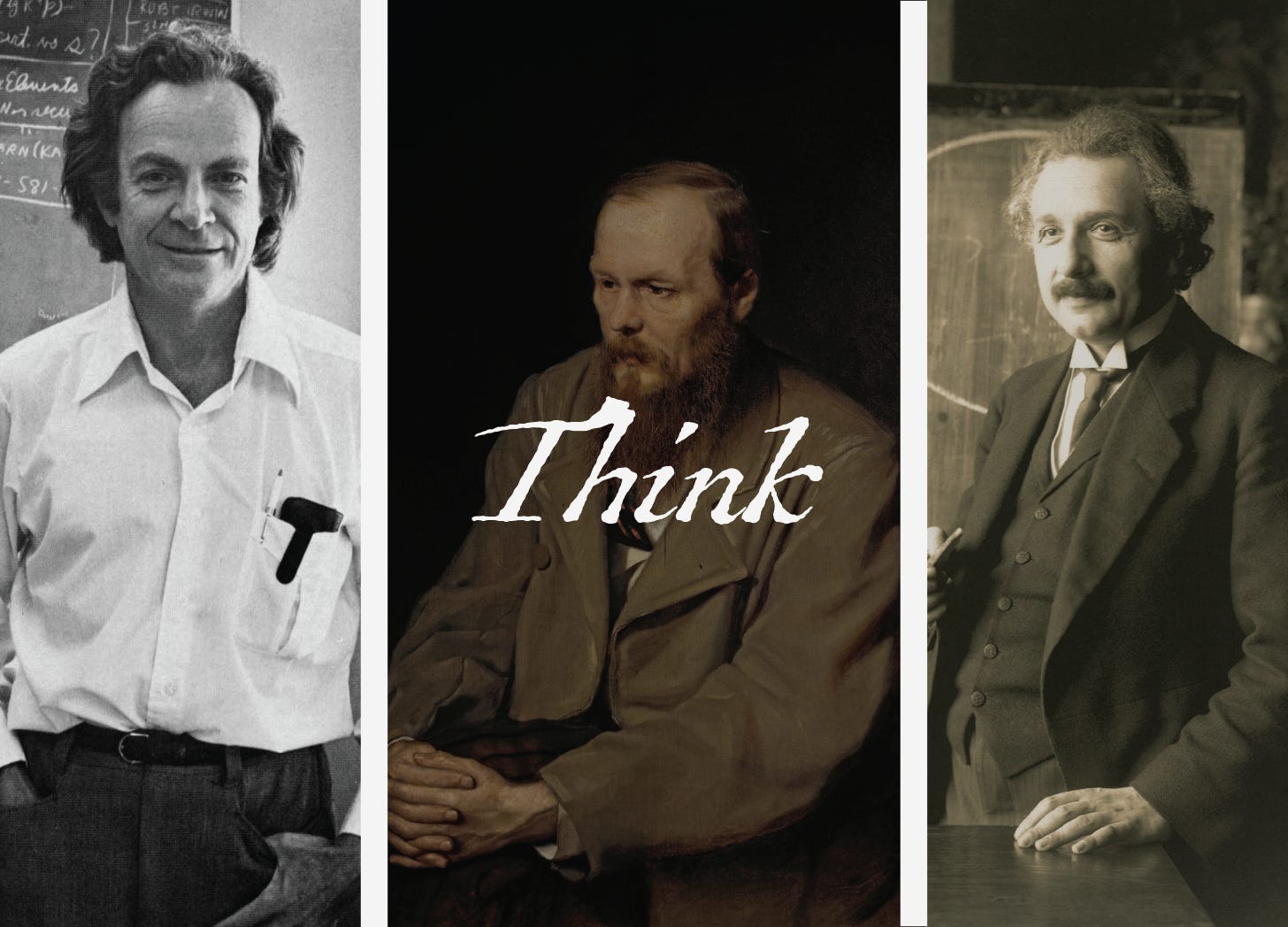
Most people will live their whole life thinking and living by other people’s thoughts.
They will die with borrowed beliefs and opinions.
They will die never having had an authentic perspective on life.
They will die never having had any control over what thoughts they listened to, first thing upon waking up in the morning.
If this idea scares you, keep reading (it scares me too).
And if you want to regain control of your mind and learn to think profoundly, I believe this newsletter will help you do that.
The framework has 3 steps:
Choose A Problem First
Research, Write, & Synthesize
Hold A Strong Perspective Lightly
If you want to think independently, think originally, be more creative, or learn to control your mind, let’s get straight into it folks!
Ah yes… education
The whole educational and professional training system is a very elaborate filter, which just weeds out people who are too independent, and who think for themselves, and who don’t know how to be submissive, and so on - because they’re dysfunctional to the institutions.
Noam Chomsky
Education fails to do the one thing it says it does - educate.
You are told what to think based on a government-mandated curriculum.
Not how to think.
Not how to challenge other people’s perspectives.
Not how to challenge and rewire your own thinking.
Not how to shape your own mind into a tool that helps rather than hurts.
Thinking is the ultimate form of self-control.
Without thinking, you have no control over how you live your life, or where it could possibly end up. This is exactly why most people drift through life being assigned a purpose, a belief system, and a perspective of the world that is not their own.
If you don’t have anywhere to go in life, then anyway will take you there.
If you don’t know how to think, other people will think for you, and tell you where to go and what to do.
This was me before I started writing online.
The reason why I am writing this is letter, is because I didn’t learn how to think properly until I was 22.
Twenty-fucking-two - think about that for a second.
It was starting my Profound Ideas newsletter that changed all that.
(I am beyond grateful for all of you being here; nearly 3k subscribers in less than 5 months here on Substack is so profound and shocking to me, and I thank you for giving me such a profound purpose in own my life - thank you!)
But before then, I was always bad for memorizing everything I read (if you’re new here, I don’t shut up about that fact).
And I’m now thinking that there’s a deeper reason as to why.
I always wanted to know (memorize) things because I never wanted to create my own solutions to problems.
I wanted to use other people’s solutions instead.
I wanted to use other people’s ideas, instead of forging many ideas into a perspective I could have called my own.
I didn’t want to challenge Aristotle.
I didn’t want to question Nietzsche.
Who was I to challenge them? Some Irish kid who had a weird obsession with (profound) ideas? Not a fucking chance.
Even in my own life I was always terrible at offering an opinion or a perspective in fear of offending or challenging someone else.
I always believed that if I offended someone or reached a disagreement, it was me who was in the wrong.
So, I kept my mouth shut usually. I didn’t want to think for myself. Think outside the box. Offer my own solutions to problems, my own perspective, or create a profound system of thinking originally for myself.
Most people are like this. No spine. No perspective to hold. Nothing to distinguish you from the crowd.
Without these things you are not an individual.
Most people would rather live by other people’s beliefs.
You don’t question anything people say or tell you, and you live by other people’s words.
You let other people’s beliefs dictate what you say, what you think, and how you act.
You let other people control your life.
And you are too scared to fight back.
And maybe you are fine with that.
But if not, the second half of this newsletter will help you out a lot.
There isn’t a more terrifying idea than letting life happen to you, instead of fighting for a life you want to happen for you.
The antidote to this, we shall soon see.
How to think profoundly
Education is not the learning of facts, but the training of the mind to think.
Albert Einstein
Being a profound thinker has nothing to do with knowing everything.
Not remembering everything you read, memorizing books, having a folder of quotes inside your head, ready to take out when a party trick is needed.
Profound thinking comes down to synthesis.
By synthesis, I mean the ability to connect what you know into something unique which you can offer to the world. A solution to a problem, or a unique perspective on an issue.
You need to realize this:
life is just a series of problems.
Let’s say when you wake up in the morning, you want to have a silent mind.
The first thing most people do when they wake up is scroll. They want to numb and distract their mind with noise so they don’t have to think or feel things that would cause them suffering.
But lets say you want to come up with a profound solution to that problem - how do I wake up with a silent mind?
Maybe you watch videos on deep work.
Morning routines.
Huberman and his podcasts talking about the benefits of early morning sunlight.
Maybe from there you look into circadian rhythms.
Maybe you stumble across a random TikTok reel talking about boredom.
So you research that perspective, even though it doesn’t seem related. But you think and make a connection between early morning sunlight exposure and having a more stable nervous system.
You link that to the default mode network that runs in your brain when you feel bored.
Maybe, then, a solution to waking up and having a silent mind is not about numbing it first thing with reels and carousels.
Maybe, your offer is this:
If you want to feel more mental peace when you wake up each morning, try getting outside as soon as you wake up. Get natural light into your eyes for 5-30 minutes, and don’t bring your phone with you. Don’t listen to music. Stare at a dot on the wall during this entire time, and let your default mode network do its thing. Inner peace comes from being able to sit in peace.
The purpose of knowledge is action, says Aristotle, and he’s write.
The purpose of knowledge is to solve problems.
That is how you create a unique perspective, an offer, a solution (they’re all the same thing really) to a common problem.
Maybe even a problem you’re having in your own life.
We all have access to the same information sources as everybody else. Books, social media; AI can regurgitate information from most sources, and you can talk to it to get pretty specific answers to your questions.
But what separates profound thinking from all this is how an individual builds with the same bricks as everybody else.
Interest is the most ultimate form of motivation and leverage for success.
Profound thinking is about letting your interests and curiosity guide you in your perspective building.
The easiest way to get ahead of most people in life, is to do what feels like fun to you, but feels like work to other people.
What makes you curious is the exact pathway towards becoming irreplaceable as a thinker.
Study hard what interests you most in the most undisciplined, irreverent and original manner possible.
Richard Feynman
Good thinking always starts with a question or a problem.
Profound thinking always starts with a question or a problem you genuinely want solved - a problem you are interested in solving.
This is why most people fail at learning or starting anything new; a new reading or writing habit that doesn’t seem to stick after 5 days - because you don’t fucking care about it enough.
You need emotional stakes. Curiosity. Intrigue.
The fact that students would gladly fall asleep in a lecture hall or classroom is a clear example of why interest is fucking power.
Naval Ravikant always talks about the power of using fun as your learning criteria. If you let interest and spurs of passion guide your thinking, you will become authentic as a person through developing your areas of interest, and your way of perceiving the world will make you irreplaceable.
Be a walking paradox.
The bodybuilder who loves to run. The book worm who loves jiu-jitsu. The quiet soul who can’t shut up when asked about philosophy.
It is your interests that make you and your thinking unique, not the other way around.
Now that you know what profound thinking is, here are your steps to help you achieve it:
FRAMEWORK: How to become a profound thinker
Step 1: Choose A Problem First
Write down a list of 5-10 problems you have. They can be problems, questions, or things you would like changed in how you live your life.
A great way of finding out what problems you’re having is by asking yourself these two questions:
What is a problem in my life I should fix?
What is a problem in my life I could fix?
The key thing here is that you need to be interested in solving the problem. If not, you’re not going to care to think about it.
Our brains are cybernetic. Meaning, we view reality in relation to goals and beliefs we have in our minds. It’s the reason why you see red cars when all you think about is red cars.
If you genuinely care about solving a problem, you will be surprised by ideas that reveal themselves in unlikely sources, that could help solve your problem.
Step 2: Research, Write, & Synthesize
Write down your chosen problem and think about how you would go about solving it.
Ask yourself what the desired solution is that you want. Maybe you want to learn a new topic like Absurdism. Maybe you want to stop overthinking about the past, and you want to learn how to silence your thoughts.
I always start by searching my problem or question into Youtube. I listen to as many different videos from as many different people - perspectives - as possible. This is how I do research for all my newsletters. My newsletters are just 5-10 different sources synthesized together, along with my own ideas.
If you don’t know what to do, research.
Read. Listen. Talk to people in your own life.
In the final analysis, it’s all just information. It’s your job to take this information and form it into a solution.
And then, if you don’t know how to articulate an offer, an opinion, a potential solution - write.
Write 1000-2000 words comparing and contrasting the different YouTube videos you watched. Start off by writing a few hundred words on:
What the problem is
How it is affecting you right now
What an undesirable future will look like for you if you don’t solve it.
Then, start talking about ideas that stood out to you in your research. What ideas sparked your interest? Your curiosity?
Compare them, contrast them, link them together and look for gaps.
Merge your favorite ideas into your own perspective. Then, start questioning it. Challenge your perspective and poke for holes.
Even if you don’t know how to form a logical essay, or “sound smart,” it won’t matter.
There is no difference between writing and thinking. If you are writing, you are thinking. That is what matters with this step.
Step 3: Hold A Strong Perspective Lightly
Your perspective is an offer, not law.
There isn’t a more noble stance to have, than to hold a strong perspective lightly - remaining open to other perspectives that could challenge and improve your own.
At the end of the day, it’s night.
But seriously. Truth, wisdom, love, and respect will take your thinking far. It’s co-operative. It makes it easy to talk to people.
Most people don’t stand for anything. They just fight for thoughts that have been placed inside their head involuntarily by other people. They speak with other people’s words, and even if they do think by asking themselves questions, they still answer with other people’s words.
Perspectives are all that exist, really.
My first car was an absolute shit-box, a 2006 Toyota Yaris called Terry. Yes, he may have broken down twice within the first two months of purchase, but there’s someone out there who wouldn’t have been able to afford it, and would have killed to have had that car.
Someone who has a 2 hour bus commute everyday to a job they hate.
I called my car old, while they would’ve call it their dream.
Maybe, even, you do walk to work in the pouring rain to a dead end job you don’t like, as you’re building your newsletter on the side.
But what about those who can’t walk, or get out of bed, or get the opportunity to work a job because they have cancer, or a sickness?
What about people who are blind and don’t have the chance to write a newsletter at all?
Am I in the right to say my first car was old and shit and that I hated it?
yes.
But that was my perspective at that time.
But not anymore.
You are not the only conscious being walking around on this planet. Try to understand other people’s perspectives and your mind will open up more than you ever thought was possible.
So, become a walking paradox. A paradoxical thinker.
Become certain of the uncertainty of your thinking and your perspective.
There is no greater danger to profound thinking than certainty, because by embracing certainty you limit the openness of your mind to new and profound ideas and perspectives.
Stay open minded.
Always try to understand other people’s perspectives.
I feel pretty close to certain in saying that that profound idea will take you far in life.
I’ll leave it there for now.
Thanks for reading.
You’re an absolute legend!
- Craig :)
If you got this far, you should click this button to change your life (offer ends Friday):
Here are some free stuff and my Profound Thinker paid-tier posts:
If you need a template for resetting your life, download my free Profound Life-Engineering Template to help you create a vision, anti-vision, goals, and deep work tasks.
You can download my free eBook if you want to build a personalized habit plan with AI and Aristotle’s Golden Mean philosophy for sustaining any habit for life.
Read this if you want to become a polymath with just one hour per day of writing.
Read this if you want to read your books better and actually think about what you read.
Read this if you want to self-educate faster than 99% of people in just 30 minutes a day.
You can unlock one paid-post for free if you haven’t subscribed yet, or if you haven’t used your free paid-post token thing.
Thank you, legend :)
Congratulations! 22 is earlier than many. It is about the time our brain development is ready for abstract processing. Yes, we could learn it earlier. As a teacher, that was one of my goals. I agree the system teaches kids to internalize facts more than it teaches true individual thought. For many it feels unsafe to challenge the beliefs we’ve been taught and not going with the ‘truth’ so many around us accept as completely valid. It is often more important to “not be them” than to really consider what “being us” and “being them” actually means. What good does each hold to? What areas on each side need reconsideration?
🔥