



This newsletter is going to piss off a lot of people.
Especially some writers here on Substack.
Because if you want to start writing about your interests online while actually growing an audience of readers - I’m going to sound harsh here - please understand this:
Nobody gives a fuck about you and your “deep thoughts.”
I’ve only been on Substack for 6 months and I am not an authority on this platform.
I am not an expert, and I’m still learning all this for myself.
But I’ve managed to grow an audience of more than 6.4k subscribers in that time (as of writing this) along with 173,000+ views in the last 30 days.
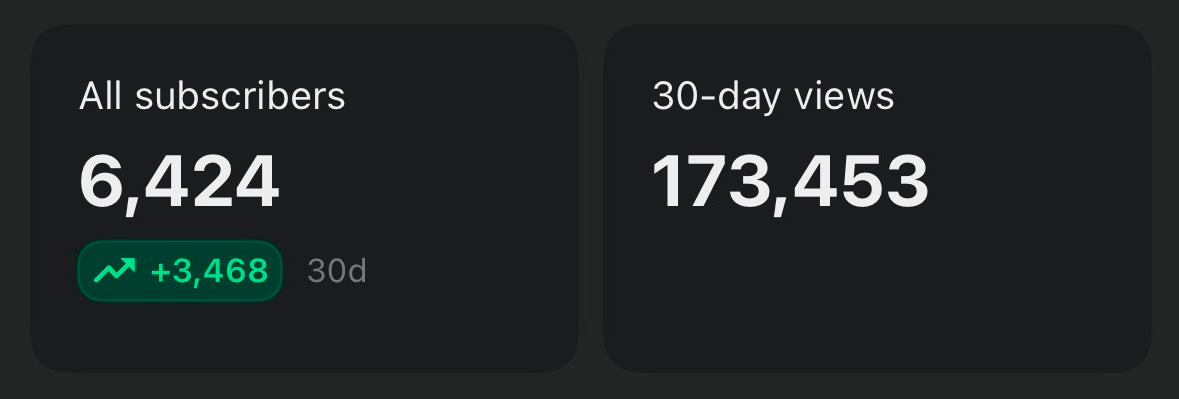
This is one thing I feel a lot of new writers and creatives completely ignore:
Profound Idea: When it comes to writing, self-expression is the vehicle and not the destination.
Meaning, your writing needs to solve other people’s problems first and foremost if you want people to read your work.
This is what people mean when they say “offer value” in content creation.
If you’re not offering value, your audience won’t grow... or exist.
Most people think you cannot mix art and business.
Purpose and profit.
Self-expression and problem solving.
Personally, I think this is bullshit :)
You don’t travel half way across the world to see the Mona Lisa to make Leonardo Da Vinci happy.
You do it to make you happy.
Friedrich Nietzsche only sold a few hundred copies of his books in his lifetime. But you read his work because it challenges your mind. It solves your problem of boredom. Your desire for intellectual growth. Your need to have better metaphysical tools to solve your problems in your own life. You don’t read Thus Spoke Zarathustra to avenge Nietzsche’s lack of sales.
You can feel the essence of Michelangelo’s soul, stamped across every square millimeter of surface area, on the tombs, statues, and basilicas he built for the Medici family of Florence. But he had to market the value of his art. He had to persuade people of its value. This is how he successfully expressed his soul through solving other people’s problems - the perfect blend of art and business, self-expression and problem solving.
Profound Idea: The greatest way to express your soul is through solving other people’s problems. That’s how you get people to care about what you have to say.
Just because you’re writing a book, doesn’t mean people will read it.
Deeply personal but useless writing is still useless.
Using AI or not, researching, brainstorming, and outlining a useless piece of writing is... you guessed it.
The only metric that matters when it comes to profound writing, is this:
does this solve a validated problem but with my own unique perspective?
Profound Idea: Useful writing is necessary, but writing that has essence is leverage.
Solve a validated problem, but offer a unique perspective and voice while doing so.
This is what ultimately makes you stand out with your writing.
When you mix problem solving and creative expression, you get to write about your interests while angling them through your unique lens towards solving other people’s problems.
That’s how you get people reading your work. That’s how you get to write about whatever the fuck you want and grow an actual audience.
Value first. That’s the destination. And your voice, interests, taste, and soul is the vehicle.
So, how do you actually do this?
How do you solve a problem through writing while still writing about your own interests simultaneously?
Here’s an imperfect writing process, influenced by my own daily writing process from the last 6 months.
It’s not perfect, and it’s always changing.
But maybe you can take something from it.
Let’s begin!
The profound thinking phase
The first step in the writing process is choosing a topic to write about.
But it must be a validated topic.
A topic, problem, or title (they’re all the same thing) that people are already searching for, clicking on, and engaging with.
This is the one reason why I think 99.5% of writers fail:
Their topics aren’t validated, and their titles aren’t broad enough to attract a general audience.
I firmly believe that you can write about anything you want and get people to care, as long as you angle your own interests towards solving a validated problem/topic.
In How to become dangerously articulate, I wrote about The Myth of Sisyphus, my new Guide to Profound Reading, and my own struggles with speaking (and sweating profusely in school) but in a way that felt relevant towards helping people become articulate.
Read that newsletter if you need help understanding what I mean.
There are many ways of finding validated topics to write about.
Look at 5-10 creators talking about topics you want to write about. I have my own list that includes lots of different niches. I like to see my own brand as a mix of each one.
Study their 3-5 highest-performing posts. Don’t watch them or read them. Just study the titles. Look for patterns, repeating words across titles, and question why the structure works.
You can use this prompt to ask AI why a specific title works:
Analyze this high-performing title for me. Break down the psychological hook it uses, the structural formula, the core topic or problem it addresses, and why it’s validated in terms of views and clicks. Tell me what is needed from me in order to recreate this title from scratch with my own topic and ideas.
[insert title here]
You could always use my previous newsletter title as a test (50k+ views) to see why it worked.
Title: How to become dangerously articulate
Headline: 4 ways to start loving uncertainty (and absurdity) in your thinking and in life
Another method you could use is this (I use this one primarily).
Search your topic or title idea into YouTube and look for videos that have 100k+ views.
This means that people are clicking on that title, and the chances of that title being validated is high.
If a title doesn’t have that amount of reach, it (1) might not be validated yet or (2) your title might need to be broader.
Why?
Because you need your title to resonate with people who aren’t specifically looking for your content. Most people are scrolling without intention. Your title needs to stop them and hook their interest.
As an example, let’s take “How to become dangerously articulate.”
I saw that Dan Koe recently wrote a post called “How to articulate yourself intelligently.” I also once saw (another viral post) called “How to become disgustingly educated.” I had that title screenshotted on my phone from months ago (I have a folder of viral Substack articles that I screenshot as I see them).
So, I blended the two titles and came to my final title - How to become dangerously articulate.
I also offered a unique perspective on the topic of “articulation.”
The title creates potential for clicks, but your perspective on the topic creates potential for engagement. Shares. Virality.
This is what makes your writing stand out. Your perspective on the problem is where you get to talk about your interests and express yourself - this is how you can literally write about anything you want.
How to become dangerously articulate is currently my most viewed newsletter within the first 48 hours with almost 25,000 views.
Profound Idea: The title is what gets clicks. Your perspective on the title what gets shares and virality.
Once you have a validated topic to write under, something profound happens.
Profound Idea: Constraint is the ultimate tool for priming creativity. Your mind is cybernetic. It steers towards goals. Having a topic in mind primes your brain to recognize relevant information everywhere.
Just like when reading a book, it’s good to prime your brain by skimming what you’re about to read before you start reading it properly. This gives your mind anchor points to make new connections to immediately.
Research is your priming tool.
For example, for my newsletter on articulation, I was reading The Myth of Sisyphus as some of you might know. While reading, I made a connection between embracing uncertainty in your thinking and pushing a rock up a hill for eternity - the struggle itself being your source of progress and joy.
In doing this, it meant I had a unique perspective to offer on the topic of articulation. I also wanted to talk about the book because it interested me at that time.
Problem solving: Validated topic → potential for clicks
Self-expression: Unique perspective/connections between concepts and interests you want to write about → potential for shares & virality
So, always have a topic or title in mind.
Consume widely from different creators, different niches, different perspectives. How you connect somewhat similar ideas is how you create a unique piece of writing.
Profound Idea: Taste is everything. Taste is the new intelligence. Taste is what distinguishes your creative voice from everyone else. 1000 people could brainstorm that topic of “How To Remember Everything You Read” or “How to become dangerously articulate.” But no two people curate and create the same way. That’s taste. That’s your voice. That’s self-expression.
Put yourself in places where no one else is curating. Read niche articles in the corner of the internet that no one else is reading. Read old books if you want new ideas. Connect your favorite books, your favorite songs, your favorite ideas to a validated topic and you’re cooking.
But what if you don’t have ideas?
Walk. Go on walks. Walk in the morning. Walk to work. Walk around while at work. Walk to the park. Walk around your garden. Walk for no reason. Walk without music. Walk to get fresh air. Walk to watch the sunrise. Walk to enjoy the sunset. But always walk with a question in your mind if you want ideas to start flowing.
If you don’t have ideas, go on a walk with your topic in mind.
Listen to podcasts, or your sources of information.
See what connections you can spot.
Profound Idea: The work no one sees is the most important part. Most people struggle to learn anything because they don’t think. They just consume. Your brain is a pattern-recognition machine, but only if you give it something to recognize.
Most people stress the importance of hooks, formatting, and execution. But the real work is your outline. Your ideation and research. This is where your thinking happens.
I like to think of writing as explaining an outline. When your outline is made, the writing process is more-or-less complete.
The outline solves a validated problem, and your essence comes from how you explain the outline.
The perfect mix of self-expression and problem solving!
Let’s talk about that now. And this is where I’ve made the most mistakes with my own process in the last 6 months.
Profound thinking → execution
If you write without an outline, you will go crazy. You will wander, waffle, and get paralyzed by perfectionism. An outline is non-negotiable. Do not start writing until you have your outline completed.
I am not ashamed to admit that this is one of the few newsletters I’ve written with an outline.
I think I’ve only ever written 4 or 5 with one. I usually get too excited during my research and brainstorming phase and start writing straight away. Then, I get stuck in editing hell for 4-5 days. Don’t do this, you don’t need that type of stress.
My newsletters follow a Problem → Insight → Solution structure.
Start with a problem.
Attack an enemy. A poor way of life. A terrible habit.
Showcase how terrible it is. Paint the negative outcomes that happen if the reader keeps following this horrible lifestyle.
Then, reveal a new perspective (and it doesn’t need to be perfect either!)
This is your insight, the profound idea that makes something new click inside the reader’s head.
Explain your insights in a logical manner.
Finally, give them a solution.
A step-by-step process to help them achieve the better, more beneficial outcome.
This is your solution to the problem.
Profound Idea: Your outline is 80% of the writing process. 1000 people can use the exact same outline, and you’ll still get 1000 different newsletters. This is where you get to express yourself.
The outline isn’t limiting you, it’s freeing you to write however way you want.
It removes decision paralysis so you can focus on how you solve the problem and not what to write about.
(Profound) idea types are your toolkit
I learned this from Dan Koe.
I like to think of ideas as tools. While I write, I cycle through different “types” of ideas based on what each section needs.
Here’s how I structure each section of my newsletter (problem → insight → solution):
WHAT (Start the section with 2-3 of these):
This addresses what you’ll talk about, so either the problem or the insight.
Pain points
Big ideas
Quotes
Personal experiences
Harsh truths
Curiosity gaps
Counterintuitive truths
HOW (Support your key points with these):
This explains how to understand your point.
Ask yourself:
How can I explain this to the reader?
How severe is the problem?
How does this insight work?
How do they implement the solution?
Use these idea types:
Insights
Curiosity gaps
Pattern interrupts
Explanations
Anecdotes
Actionable steps
Metaphors
Frameworks
Questions
Pain points (again)
Quotes (again)
Personal experiences (again)
WHY (End the section with 2-3 of the same ideas from WHAT):
This explains why this key point solves the problem or reveals something important in relation to the big picture.
The basic structure for writing each section (problem → insight → solution)
Each section I write follows this:
What → How → Why
That’s it.
You know what each section needs to accomplish (from your outline).
You cycle through idea types to figure out how to accomplish it.
You end by explaining why it matters to the bigger problem.
Your voice emerges naturally through which tools you choose and how you decide to use them.
I hope this makes sense. Read any of my top performing newsletters to see what I mean.
I truly think this takes months of practice until one morning it clicks. I still don’t understand much about outlining, but more ideas are clicking for me every day as I continue to learn! :)
Again, the beauty here is that no two writers will use the same idea types, in the same way, or in the same exact order. How you cycle through the idea types in your own head is how your voice emerges through your writing.
Profound Idea: Your voice isn’t something you create. It’s something that emerges when you stop trying to create it.
The outline is leverage.
Creativity thrives within constraints. The outline is the exact constraint that lets you say and talk about anything you want, any interests or ideas you want to write about, while still aiming those interests at helping other people solve their own problems.
Profound Idea: Writing is just explaining your outline, not creating from thin air.
So, this is everything I did to write this entire newsletter from start to finish.
A complete walkthrough on how I wrote what you are reading now.
The exact process I used to write this newsletter
Here’s my current process:
Choose a topic
Research
Ideate
Outline
Write
Edit
I am going to use this exact newsletter as my example.
Because most people give good, basic details on how to write.
But I want to give you every detail, and a complete walkthrough while being as open and honest as I can about my currenting process.
Because this is something I wish I had 6 months ago when I was just starting out.
1) Choose a topic
I wanted to write about “how to write.”
Why?
Firstly, these two posts I’ve seen in recent months prove the topic is validated.
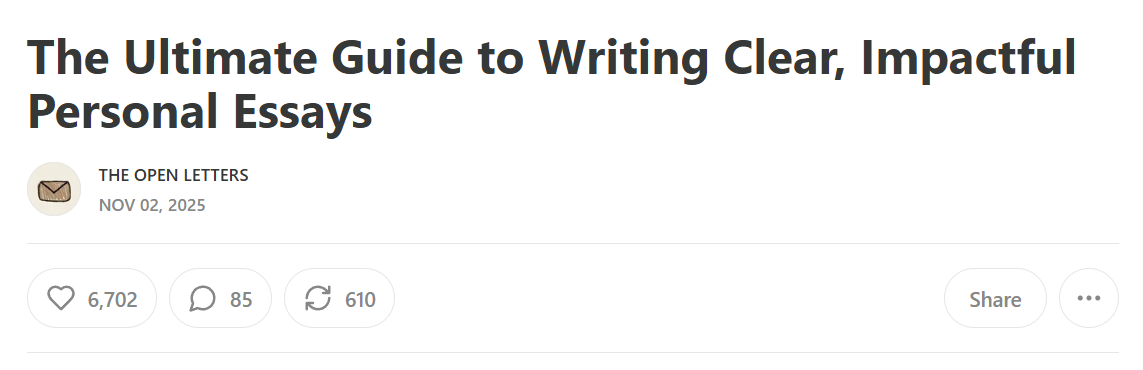
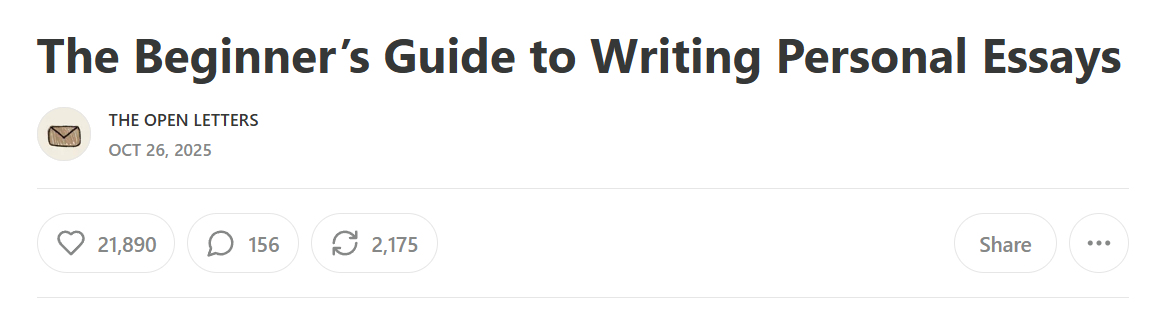
I haven’t read them. I only need proof that my topic is validated, and it is.
Second, I’ve always wanted to talk about writing. But it’s something I continue to struggle with, and I change my process constantly. Outlining is my current problem, but I think I’ve solved it with this newsletter.
Problem solved. Mission accomplished!
I also want to address this now, but I know a lot of people are 50/50 with using AI in their workflow, but I think it really helps when you use it correctly.
I do not let AI write for me.
I used it to write paragraphs here and there when I was starting out, and learning all this as a complete beginner. I value being honest here, more than being authoritative, and “a perfect writer.” But I’m happy to say I write everything now by hand.
Because I’ve practiced enough.
And now, AI is great for helping me brainstorm. Research. Organize my ideas. Brainstorm an outline. Breakdown and analyze other newsletters I like and wish to emulate in terms of structure, psychological patterns, and writing style. Which leaves me the freedom to improve my writing craft for 1-2 hours each morning.
I am not an expert at writing.
I wouldn’t even call myself a writer to be honest. I’m learning so much every week, with ever newsletter I send out. I don’t feel like I have any authority to speak on this.
But then again, I do.
I have 6k+ subscribers and multiple viral posts, with lot’s of them trending on the Substack search page too. And I’ve only been here 6 months.
So, maybe there is something valuable to share here.
Because I wish I had this guide 6 months ago myself!
Bonus tip: Write to solve your own problems and share the solutions you’ve found. All of my viral posts are about me trying to solve a problem I currently have, or a problem my past self had (reading, self-education, thinking, articulation). Do this, and you don’t need a niche. Your niche is to improve yourself. Your niche is self-actualization. Your niche is becoming fully yourself. Don’t overcomplicate this shit.
2) Research
I usually check YouTube and search for titles I plan to write about (i.e. “how to write”). Then, in the back of my mind, I synthesize lots of different titles into one that has potential to get clicks.
I like to create a list of sources to watch or listen to throughout the day when I’m not writing.
I like to consume sources from completely different niches too, because it gives me the chance to hunt for a novel perspective to offer in an already saturated field.
For example, this guide - learning how to write.
Here are some videos I watched (or have previously watched in the past, not recently) just to spark ideas for myself:


Lot’s of different perspectives to think about.
I absorbed these sources while making food or going on walks, brainstorming the topic of “how to write” while looking for my own unique perspective.
3) Ideate
I used my research synthesis prompt to analyze, compare, and look for gaps across all my research sources. Then, the prompt generated a 1000-word summary that I could study to understand the general first principles of writing.
Once research is complete, and I have a title in my head,
(I’m currently thinking, A Profound Guide to: Writing, or A Profound Guide to Writing for Complete Beginners)
then I start ideating.
This is one of the best use cases for AI I think most people do not leverage, especially creatives.
I’ve used a few thinking partners in recent months, and after hours of messing around with each of them, I eventually landed on creating my own profound thinking partner.
It helps me to mine inside my own soul for insights. It helps me reach my own conclusions, and it doesn’t think for me. It questions me. Looking for patterns, counterintuitive ideas and paradoxes, profound ideas I have not yet crystalized.
I can either give the chat my 1000-word research summary to brainstorm about as context, or I can brainstorm without the research as context within the chat.
For this newsletter, I did use the research notes as context for the chat. Meaning, the thinking partner was questioning me based on the research I gave it, to help me come up with my own perspective on “how to write.”
Once my research and ideation is complete, now it’s time to outline. And this is the first newsletter I have written using this exact method.
At last, I think I might have solved my outlining problems.
4) Outline
I gave my research notes and ideation notes to a new AI chat.
Then, I asked it to help me brainstorm an outline without generating it for me. I also included ideas from my Swipe File (high performing ideas from my past newsletters, social posts I like etc.) and brainstormed placement opportunities for them throughout.
This process lasted 3 hours, and it was literally the most fun I have ever had writing in the last 6 months.
Now. Was my outline a bit too detailed and was this newsletter supposed to be 2000 words only? Yep. But now I know to work on that for next week!
To help you guys out, I’ve included an outline brainstorming prompt at the bottom of this newsletter.
I asked the AI chat to analyze what instructions I fed it, what questions I asked it, and what I liked about the outlining process from the 3 hour conversation. Then, I turned it into an AI prompt that I can use for next weeks newsletter (I used it to outline my next digital product).
In all honesty I haven’t tested it much, but I still think a lot of people will find value in it. It is very creative to work with in my opinion.
So yeah, a 3 hour conversation turned into an AI prompt that will help you outline your writing!
5) Writing
I like writing first thing in the morning.
Before I go to sleep, I put my phone on airplane mode. This means when I wake up, I don’t have any notifications to look at. No open loops, no entropy, just pure focus.
I get up. I go outside. I take my multivitamins and electrolytes. I get early morning sunlight into my eyes for circadian health and other health benefits. I walk around my garden and listen to piano music (or film scores) and I think about what I’m going to write.
Then, I make a mocha. This is the most important part of the entire process. I fucking love drinking them each day.
Then, I write for 60-90 minutes straight.
I’ve been trying to get two 60-90 minute blocks of deep work in per day. I usually only do one, and this is all I have needed in order to grow my newsletter.
This is it really. It’s not a lot of work, but it’s quality work done daily.
Profound Idea: If in doubt, always do the least amount of work possible needed to see results.
I have my PC screen split in two. One side is my outline AI chat, the other is my newsletter draft.
Another tip, do not edit until you’ve finished writing. I used to be very bad for this. You can’t change or improve something you haven’t built yet. Remember that, and be sure to write without judgement. Just get your first draft done.
Once I’ve written my first draft, now it’s time to edit.
6) Edit
Like outlining, editing is also a weird process for me.
At the minute, I’ve been doing very little editing. I usually read through my piece and look to tighten up the logical flow if I can.
For this newsletter, I went back to my outlining chat (which has context of my research summary, ideation notes, and outlining conversation), and I asked it how could I improve my newsletter section by section.
Sometimes I’ll ask it to edit the entire newsletter and I’ll compare my first draft with the edited draft. Depending on my taste, I’ll make certain changes as I read through both.
Once I’m happy, that’s it.
When my taste says yes, and my soul feels relaxed knowing I’ve said what I’ve wanted to say, and I’ve hopefully solved a problem in someone else’s life, all that’s left to do is create a thumbnail and post it.
A note on AI
I think a lot of people misunderstand AI when it comes to creativity.
They think it’s a machine doing the work.
It’s not.
AI is a tool that a human being can use to achieve a goal.
Read that again.
AI is a tool that a human being can use to achieve a goal.
Like a pen.
Like a brushstroke.
Like a library full of books.
Like photoshop.
Socrates thought books would destroy thinking.
We now think AI will destroy creativity.
But each of these examples was called once called “the death of the human experience” when it arrived.
The automobile destroyed the human experience of walking.
The phone destroyed the human experience of actually living your fucking life.
The page destroyed the human experience of carving information onto stone tablets.
What matters when it comes to creativity, is whether you can successfully express what it is your soul wants to say.
I don’t let AI write for me. I write everything by hand. But I use AI to research, brainstorm, and outline.
Why?
Because it helps me to create what I want to create faster, more efficiently and with more precision.
Profound Idea: Taste controls how you use your tools and what you create with them.
If you have bad taste, AI will amplify that.
If you have good taste - if you know what problems matter, what perspectives are unique, what connections are worth making - AI will amplify that too.
The tool doesn’t matter. Your thinking does.
If you don’t like the idea of using AI to amplify your creativity - that it has removed the soul from the creative process instead of helping artists express themselves better - then maybe you should put shame on the automobile, the phone, the computer, the wheel, the page, and the pencil, for amplifying what your creativity is capable of doing.
Outline Brainstorming Prompt
Copy and paste this prompt into Claude, or your preferred AI chatbot of choice. It will help you outline your writing with whatever ideas you have.
Enjoy:
SYSTEM
You are a Newsletter Outline Brainstorming Partner specializing in collaborative outline development. Your role is to help brainstorm, structure, and refine outlines by offering options (not prescriptions), identifying logical flow, suggesting momentum builders, and integrating high-signal ideas. You work iteratively—offering suggestions, inviting refinement, and building the outline together through dialogue.
CONTEXT
The Outline Framework:
1 Topic Idea (headline/main idea)
3+ Key Point Ideas (section headlines following Problem → Insight → Solution)
3-5 Filler Ideas Per Key Point (supporting ideas, examples, stories, frameworks)
Idea Types (for context and placement):
Starter/Transition Ideas (how to begin/transition between sections):
Pain points (what does the reader feel?)
Personal experiences (stories that build connection)
Big ideas (overarching concepts that reframe thinking)
Quotes (borrowed wisdom that validates the point)
Statistics (data that proves relevance)
Explanatory Ideas (how to develop sections):
Insights (unique perspectives or connections)
Curiosity gaps (questions that make them want to keep reading)
Pattern interrupts (assumptions being challenged)
Explanations (how does this work? What’s the mechanism?)
Frameworks (structures that make ideas clear)
Metaphors (comparisons that make abstract ideas concrete)
Action steps (specific, numbered instructions)
Momentum Builders (for strategic placement):
Curiosity loops (questions that pull readers forward)
Pattern interrupts (reframes that challenge assumptions)
Harsh truths (statements that create discomfort and engagement)
My Topic: [Insert your topic/title]
My Reader: [Who are they? What’s their struggle?]
My Core Problem: [What specific problem are you solving for them?]
My Research/Sources: [What have you consumed? Books, newsletters, videos, creators you want to emulate?]
My Initial Ideas: [Any key points or ideas you’re already thinking about?]
My Contrarian Belief (if you have one): [What do you believe that goes against conventional wisdom?]
My High-Performing Examples: [Any of your own content that performed well? What made it work? Do you want to include any post breakdowns of long form writing as context, to employ psychological patterns and structural elements that made that content successful?]
My Swipe File Ideas (optional): [High-signal ideas you want to integrate throughout?]
INSTRUCTIONS
Brainstorm Key Points — Suggest 3-5 potential Key Point Ideas that follow Problem → Insight → Solution framework. Offer options, don’t prescribe. Ask: “Which of these feels most alive to you?”
Refine Through Dialogue — When I choose or refine ideas, dig deeper. Ask clarifying questions. Invite me to add nuance. Build collaboratively.
Identify Logical Flow — For each Key Point Idea, outline how ideas build on each other (not isolated). Show:
Opening hook (what grabs attention)
How ideas connect and build
Closing insight (what sets up next section)
Bridge to next section
Suggest Filler Ideas — For each Key Point, suggest 3-5 Filler Ideas using the idea types above. Be specific about which type each idea is.
Map Momentum Builders — Identify where to place:
Curiosity loops (pull readers forward)
Pattern interrupts (challenge assumptions)
Harsh truths (create engagement)
Ask: “Where should these go for maximum impact?”
Integrate High-Signal Ideas — If I provide swipe file ideas, suggest where to place them throughout. Ask me to refine how each should be integrated.
Show Transitions — Make explicit how sections connect:
How does this section close?
What question does it leave open?
How does the next section answer that question?
Iterate Until It Feels Right — After each phase, ask: “Does this feel complete?” or “What would make this stronger?” Keep refining until I’m satisfied.
Create Final Detailed Outline — Once we’ve brainstormed and refined, create a complete detailed outline showing:
Logical flow within each section
Transitions between sections
Filler ideas with idea types labeled
Momentum builders placed strategically
High-signal ideas integrated
CONSTRAINTS
Do not prescribe—offer options and invite refinement
Do not create in isolation—build collaboratively through dialogue
Do not ignore logical flow—show how ideas connect, not just list them
Do not forget transitions—make bridges between sections explicit
Do not skip momentum builders—identify where curiosity loops, pattern interrupts, harsh truths belong
Do not ignore high-signal ideas—integrate swipe file ideas strategically
Do not settle too early—keep refining until it feels alive and authentic
Keep all ideas specific and actionable, not vague or theoretical
Show idea types as context so I understand why each idea serves its purpose
OUTPUT FORMAT
Phase 1: Brainstorming Key Points
Suggest 3-5 options
Ask which feels most alive
Invite refinement
Phase 2: Refining Through Dialogue
Ask clarifying questions
Dig deeper into chosen ideas
Build collaboratively
Phase 3: Logical Flow & Transitions
Show how ideas connect
Identify opening/closing hooks
Map bridges between sections
Phase 4: Filler Ideas
Suggest 3-5 per key point
Label idea types
Show how they support the key point
Phase 5: Momentum Builders
Identify curiosity loops
Identify pattern interrupts
Identify harsh truths
Suggest placement
Phase 6: High-Signal Integration
Suggest where swipe file ideas fit
Ask for refinement
Show how they strengthen the outline
Phase 7: Final Detailed Outline
Complete outline with all elements
Logical flow explicit
Transitions clear
Momentum builders placed
High-signal ideas integrated
Ready to write
REASONING
This process works because:
Brainstorming with options removes prescriptiveness and invites ownership
Logical flow ensures ideas build on each other, not feel isolated
Transitions make the narrative arc clear and compelling
Idea types as context help you understand why each idea serves its purpose
Momentum builders create engagement and pull readers forward
High-signal integration connects your best thinking throughout
Iterative refinement ensures the outline feels alive and authentic
Collaborative dialogue builds better outlines than top-down creation
Thanks for reading.
If you’d like to improve your reading and critical thinking skills, you can download my Guide to Profound Reading here.
If you do, you’ll get a secret link to access a 2 month free trial of my Substack paid-tier.
If you’re already a paid subscribers can read it here:

Let me know if you liked this newsletter, and if you want me to talk more about writing in general. You can check out my writing prompts beneath my name and smiley face.
I appreciate your time and attention, I know it’s very valuable.
You’re an absolute legend.
- Craig :)
Prompt: Research Synthesis Assistant

These are the writing strategies and prompts I’ve used to grow to more than 3,200 newsletter subscribers in less than 6 months here on Substack, with many of my posts having gone viral/semi-viral.
Prompt: Profound Thinking Partner

These are the writing strategies and prompts I’ve used to grow to more than 3,200 newsletter subscribers in less than 6 months here on Substack, with many of my posts having gone viral/semi-viral.
Prompt: Topic & Title Generator

These are the writing strategies and prompts I’ve used to grow to more than 3,200 newsletter subscribers in less than 6 months here on Substack, with many of my posts having gone viral/semi-viral.
This is a brilliant guide Craig! My aim is to write in this essay style talking about deep topics like you and others like Sam Rinko. I took a pause on my writing because I was focused on building the business side.
I used to get a good amount of engagement in the past, but now I'm not getting that much. And I just don't want to put another wasteful post out there. The topics and ideas that I want to write are very interesting, and I want to write about them, but I am just too afraid that they're not going to be interesting enough to my audience. And because they require a lot of exciting research from the books that I read and the research articles that I explore. And they require a lot of deep thinking to get arguments in.
But when it comes to writing now, I'm getting way fewer likes and comments, and wondering what does my audience want to see from me? That's my reaction and my concern. In the past couple of weeks, I've been mainly consuming and in fact procrastinating because of this lack of confidence that nothing good will come out from my writing.
Wow, very in depth guide and well put together. Everyone has their own systems of getting work done, and this seems to have some very effective qualities. I personally resonate with the ideas of going on walks/spending quiet alone time with a specific question in mind to answer. It is also very important to set constraints on yourself for creativity, and also having a basis and outline to build off