


There is no greater threat to your intellectual development than an inability to think.
It doesn’t help that the world is hardwired to make you consume, comply, and listen, not to think or question.
For the longest time I never questioned myself on what good thinking was.
While in 5th-6th year in secondary school, instead of studying V-shaped valleys and quadratic equations like I should’ve been, I’d spend every free second of time listening to philosophy and psychology lectures on Youtube.
The Big Five personality model, Nietzsche, Piaget, Dostoevsky - a lot of Jung - the problem of why most people suffer so much more than they have to.
And I thought I was thinking about all the profound ideas I was consuming...
...and herein lies the hidden problem.

What is good thinking?
Is it the ability to ask questions?
If so, is it the ability to ask good questions, or many questions?
Is it being able to give an irrefutable explanation of a theory, concept, or understanding?
Or is it about solving your own life problems and suffering less?
Introduce learning, reading, writing, and articulation, then things start getting overwhelming.
In reality, thinking is the most fundamental node or dot within a web that all these skills branch out of.
Thinking is the engine of an intellectually-curious life.
Writing is formalised thinking.
Reading and learning requires you to think about information in a certain light, to effectively encode it into memory.
Articulation requires embracing the unknown, the world of uncertainty, by not knowing what words might or might not slip out of your mouth.
This is why learning to think is the most valuable skill of this day and age for anyone.
Thinking determines what decisions you make, and therefore every outcome of your life. It is the most important life skill without question.
Personally, I think there are 3 camps of thinkers.
(1) The Emmets
Have you ever seen The Lego Movie?
If you haven’t, the main character Emmet has his head explored by the other characters of the film, to understand how he thinks, and if he can become a master builder (really just a synthesiser of ideas).
To their hilarious shock, his mind is empty.
Zero thoughts... or Lego bricks.
Other than a double-decker couch floating around - his own synthesised creation having merged a bunk bed and couch - there are no thoughts.
But he’s happier than everyone else around him.
These more minimalistic thinkers are often envied by the Dostoevsky’s.
(2) The Dostoevsky’s
I swear to you that to think too much is a disease, a real, actual disease. - Fyodor Dostoevsky
These types of people are the opposite of The Emmets - they can’t shut their minds up.
Their minds are never empty. There’s always ideas flowing. Both painful and awe-inspiring. Connections being made forming novel solutions to questions and problems.
But I think the duality of life is best shown with these two types of thinkers.
The “dumb” person wants nothing more than to feel “smart,” yet the “smart” person wants nothing more than to have a “dumb” person’s less active mind.
If the third group didn’t exist, I would agree with Dostoevsky saying that consciousness can be a disease that paralyzes your soul after that initial 5 seconds of not knowing who or what you are upon waking up every morning.
Let’s discuss what makes someone be apart of that third group - the profound thinkers - amongst many of their capacities, in 2540 words (not including the prompt).
No rambling in this one, folks!
The profound thinkers
This is you.
Yes, I am being serious.
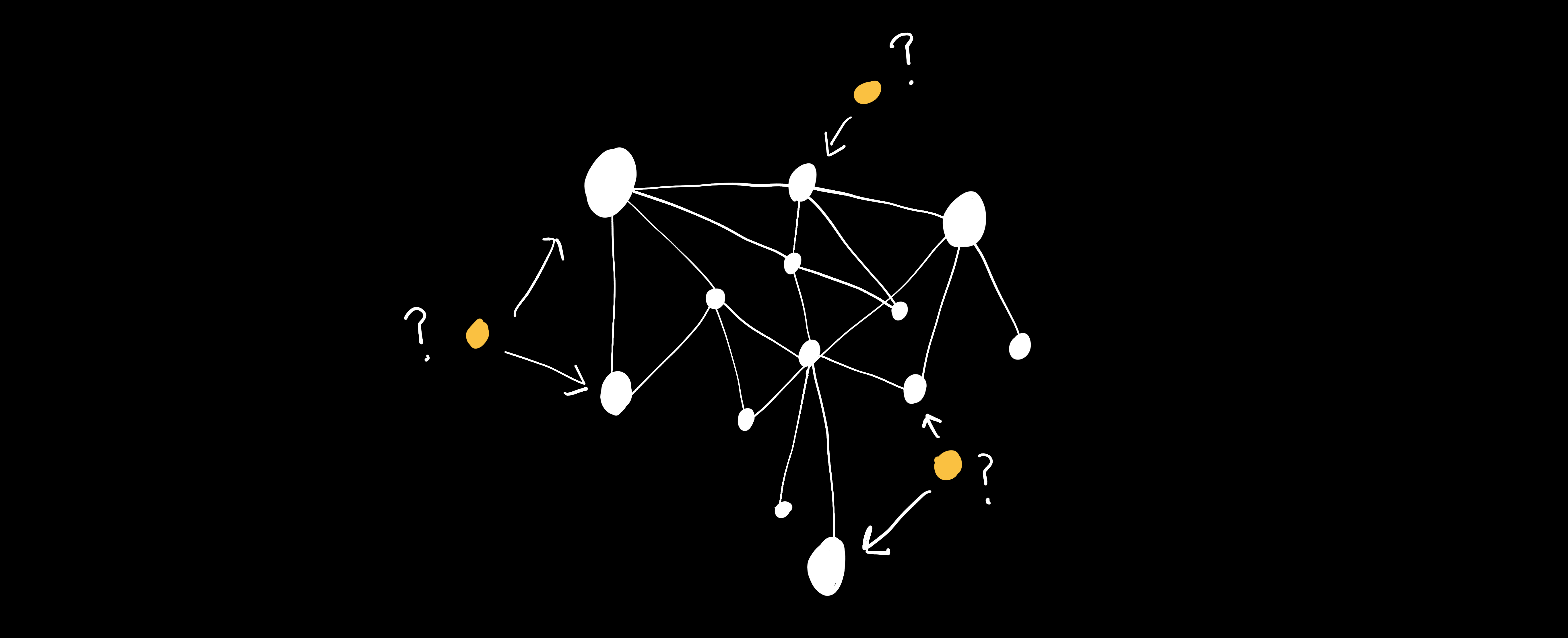
The way you perceive the world is actually carefully constructed.
Everything you’ve ever read, experienced, and encoded builds a unique web of knowledge, and that web becomes the lens through which you make sense of reality. It shapes what you define as problems, what solutions you create, and what choices feel like the right ones to make.
This is called a knowledge schema, and your knowledge of the world inside your brain looks this image.
Now.
Cybernetics is often defined as the art of getting what you want. It comes from the Greek word kybernētēs which means “to steer.” You see what you aim at, and what you (decide to) aim at will be governed by your thinking.
What shapes your thinking?
The web of knowledge being constructed over the course of your lifetime.
Your web is more-or-less the captain that steers your thinking ship. That’s why any two people can walk into a sports complex to watch a jiu-jitsu competition, and one of them sees a podium they want to stand on, while the other sees something far more frightening...
You can probably relate to this, but my family always used to tell me when I was younger that “life is just your perspective on it.” But the discussion never went beyond the surface level of that profound idea.
Your unique knowledge is what creates your perspective on life, and ultimately, what you aim at, the decisions you make, and therefore what you shape yourself to value. You can’t love drinking mochas or lattes without ever having tried one. Same applies to jiu-jitsu, lifting weights, or reading a new book for the first time.
If you want to think better you need to build a better web. You need connected knowledge with lots of nodes, and connections that integrate those nodes into your thinking ship, to strengthen its hull against the bashing tides of life.
Here’s a profound idea which on the surface looks like a limiter, but is actually a source of strength:
Your web will always be somewhat incomplete, and you cannot see what you don’t know.
This is the power of epistemic humility.
It’s why I say your perspective is an offer to the world (and yourself), not a law that everybody (yourself included) must follow.
As much as it pains me to say it, there are only so many books, essays, and newsletters like this one you will consume in your lifetime. Which means there’s a limit to what your web of knowledge can look like.
Your perspective on life will always be incomplete, as will your knowledge. But there can still be power with a partial perspective.
Ken Wilber, the creator of the AQAL Model, once said this profound idea.
I don’t have to agree with everything you say, but I should attempt at least to understand it, for the opposite of mutual understanding is, quite simply, war.
- Ken Wilber
I would recommend researching the AQAL model if you would like to get your head melted in the best way imaginable.
So now, understanding that your perspective has its limits, it’s important to make this idea intuitive.
You are a web of knowledge, and everything you do and think about reinforces and stems from this incomplete web.
So.
Thinking is how you construct your own web of knowledge to help you combat the problems of life. The quality of your thinking determines the quality of your life.
But how can we build the best web of knowledge possible, despite its limits?
How to think like a profound thinker
Knowledge is what forges your life perspective. But how is knowledge built? How can you start building a web that helps you suffer less instead of suffer more?
Here’s how you can do it with profound thinking.
I - Encoding and retrieval practise
Information is integrated into memory by encoding.
Think of it like grabbing a piece of clay and shaping it into a giraffe. Weird example, I know. But you cannot shape raw material (information) into a unique creation (knowledge) without actively moulding it into something new.
To maximise encoding, use these 3 questions:
What does this mean in definition and in depth?
Where does this fit inside the big picture?
How does this connect to what I already know?
But encoding is just one side of the coin. You also need retrieval.
Most people focus on getting information in... and that’s it. That’s why they read a chapter of a book and forget it all within a week.
Profound thinkers understand the power of pulling information out from memory and using it practically to achieve the outcomes they.
The way you retrieve knowledge influences how your mind encodes it. If you’re preparing for a speech on The Myth of Sisyphus, recalling your knowledge by talking out loud will be more effective than re-reading linear notes. This is called the encoding specificity principle.
For a simple retrieval practise, open a blank page and write down everything you know about a topic. Don’t overcomplicate this. You just need to be writing, because if you’re writing, it means you’re thinking.
If you’re a creator, write a persuasive hook or body section.
If you’re trying to fight doomscrolling, just write some words down instead of reaching for your phone.
Give yourself the time to think and carefully pick the right words.
Do this for 5-10 minutes, 3-5 times per day spaced out between encoding/consuming sessions. For example, I like to read whenever I can, using my encoding questions to make sense of what I’m reading, and then I write in my notebook between reading bouts.
There’s a reason why I’ve started doing this. Writing by hand, I mean.
Writing by hand activates a different part of your brain than typing. It forces you to slow down your thinking, and therefore think with more impact. It requires you to be deliberate with choosing what words should and should not become written into existence.
You’ll be killing multiple birds with one stone using this method. I also find it helps keeping my mind grounded in our chaotic, noisy world.
II - Reading books correctly
Some books are to be skimmed. Others must be relished.
Skim often and digest rarely.
If you’re reading a book and most of what’s being said feels intuitive to you, congratulations. You don’t need to spend hours relearning what already rests safe inside your own intuitive knowledge.
I would also call this taste.
Be careful not to confuse the map with the terrain while reading.
Just because you’ve encoded Mediations by Marcus Aurelius well, and can write about it in your retrieval notebook upon command, does not mean you’re suddenly a stoic. You just know more about stoicism than you once did.
Like how watching lots of jiu-jitsu black belts rolling does not give you black belt rolling abilities. Trust me, I’ve tried and gotten smashed in the process.
Reading can give you information. But it’s your job to turn that information into knowledge, firstly, and then to embody that knowledge through everything you do.
Writing.
Speaking.
Doing.
Living life in the arena.
Action is what gets you to where you’re headed, not simply thinking about actions alone.
